
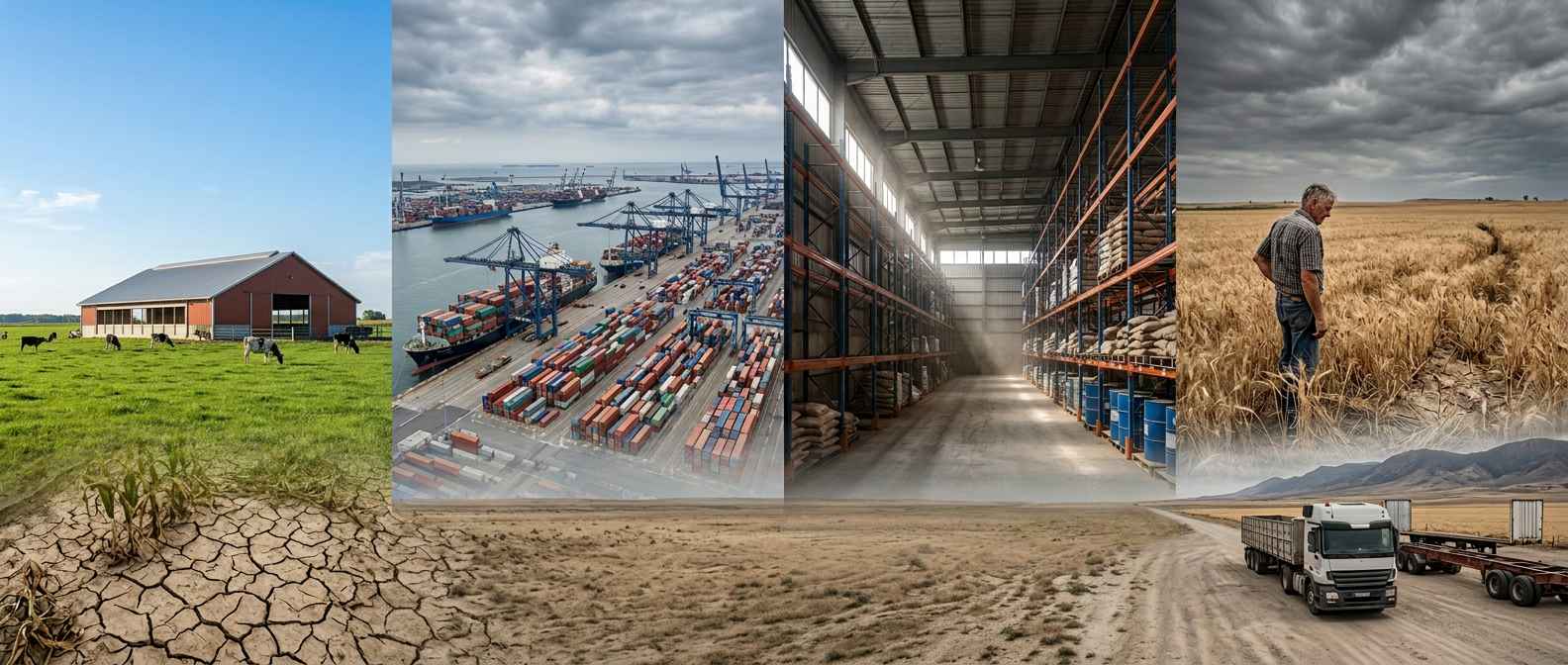
Over the past few years, the food industry has faced several major disruptions in raw material supply. Following the pandemic, the energy crisis and logistics challenges, manufacturers have been confronted with new risks, including extreme weather conditions, geopolitical tensions and sudden changes in demand.
Two raw materials have attracted particular attention from the market: cocoa and whey proteins. Cocoa prices reached historic levels due to production problems in West Africa, while WPC 80 became one of the most sought-after dairy protein ingredients due to the explosive growth in demand for high-protein foods and limited production capacity.
However, food manufacturers and procurement teams are increasingly asking an important question: which raw material could become the next critical ingredient?
The answer is not simple, but several categories are already showing signs of increased risk.
Coffee
Coffee is another raw material that could become a serious challenge for the food industry in the coming years. Although it is most commonly viewed as a final consumer product, coffee plays an important role as an ingredient in many food applications, from chocolate, ice cream and desserts to energy drinks, instant products and flavour systems. Its production is highly dependent on climate conditions, and major producing countries such as Brazil and Vietnam are increasingly facing droughts, high temperatures and changing rainfall patterns that directly affect crop yields.
Another challenge is the continued growth of global demand. The expansion of specialty coffee markets, increasing consumption in Asian countries and the growing use of coffee extracts and flavours in the food industry are putting additional pressure on existing production capacity. Similar to cocoa, the issue is not only the current price level but also the long-term availability of high-quality raw material. If production does not adapt to climate change, coffee could become another ingredient where food manufacturers will need to plan alternative sourcing strategies and maintain higher safety stocks.
Gelatin: Dependence on the Animal Industry Becomes a Risk
Gelatin is another raw material that could face increasing pressure in the future.
It is widely used in the confectionery industry, gummy candies, dairy desserts, dietary supplements and pharmaceutical applications. However, gelatin production depends on the availability of animal-derived raw materials, mainly skins and bones, meaning it is directly connected to developments in the livestock industry.
Changes in beef and pork production, animal diseases, regulatory requirements and growing demand for alternative proteins could influence the availability of the basic raw material.
Another challenge is that not all gelatin products are the same. Different applications require specific characteristics such as Bloom strength, colour, viscosity and microbiological quality.
Because of this, manufacturers cannot simply replace one supplier with another without considering the technical impact on the final product.
Palm Oil
Palm oil is one of the most important vegetable raw materials in the world and is used in a huge number of food products, from biscuits, chocolate spreads and confectionery products to margarine, bakery products and ready-to-eat foods. Its advantages include high productivity compared with other oil crops, good stability during processing and specific technological properties that make it difficult to fully replace with other fats. However, precisely because of its wide application, any disruption in the palm oil market can affect a large number of food categories.
The majority of global production comes from Indonesia and Malaysia, which together account for around 85% of worldwide palm oil output. This concentration represents a significant risk, especially when climate problems, export restrictions or government policy changes occur. At the same time, the industry faces challenges related to ageing plantations, labour shortages and increasing sustainability requirements. Additional pressure comes from the biodiesel sector, where growing amounts of palm oil are being used for fuel production, creating direct competition between the food and energy industries. Rising palm oil prices often affect not only palm oil itself but also other vegetable oils such as soybean and sunflower oil.
Lactose: The Silent Crisis in Dairy Ingredients?
When discussing dairy ingredients, market attention is usually focused on WPC and WPI, but there is another product that could become increasingly important: lactose.
Lactose is obtained from whey and is used in a wide range of food products. Its applications are not limited to the dairy industry. It is used in sports nutrition, confectionery, bakery products, infant nutrition and pharmaceutical applications.
The challenge is that lactose production is directly linked to the availability of high-quality whey. As demand for WPC 80 and WPI 90 continues to increase, dairy protein producers are increasingly directing whey streams towards protein recovery, while the lactose market may face limited production capacity.
Additional pressure comes from the infant formula sector, where quality and purity requirements are extremely high.
Lactose could become one of those ingredients that appears stable for years but suddenly becomes a major challenge when the balance between supply and demand changes.
Additives and Functional Ingredients
One of the key lessons from previous supply crises is that problems do not only occur with large commodity categories.
Some of the biggest challenges for manufacturers can come from ingredients used in very small quantities.
Examples include:
emulsifiers, stabilisers, hydrocolloids, vitamins, minerals and specialised functional ingredients.
If one of these ingredients becomes unavailable, production of a specific product can be interrupted even when all other materials are available.
For these ingredients, substitution is often not simple because every change can affect texture, shelf life, product labelling or the manufacturing process.
Is It Possible to Predict the Next Raw Material Crisis?
It is impossible to predict the future with complete accuracy, but companies can monitor certain warning signals.
The highest risk exists for raw materials where four factors appear simultaneously: limited production capacity, growing demand, dependence on climate conditions and a small number of global producers.
This combination of factors contributed to the recent challenges with cocoa and WPC.
For this reason, food manufacturers can no longer evaluate procurement decisions only based on price per kilogram. Supply chain stability is becoming just as important as the purchase price itself.
How Can Food Manufacturers Prepare?
The biggest mistake companies can make is waiting until a supply problem occurs.
Once the market enters a crisis, alternatives are usually more expensive and more difficult to secure.
Smarter strategies include early identification of critical raw materials, development of alternative formulations, cooperation with multiple suppliers and maintaining appropriate safety stock levels.
Companies that analyse risks today can gain a significant advantage over competitors tomorrow.
The Next Crisis May Not Be the Most Expensive Raw Material, but the One That Is Unavailable
Cocoa and WPC 80 have demonstrated one important lesson: the food industry can no longer assume that key raw materials will always be available at stable prices.
The next major crisis may not happen with the most expensive ingredient, but with the one that is the most difficult to replace.
For food manufacturers, the biggest challenge in the coming years will not only be cost control, but also building a resilient supply system capable of withstanding future market disruptions.