
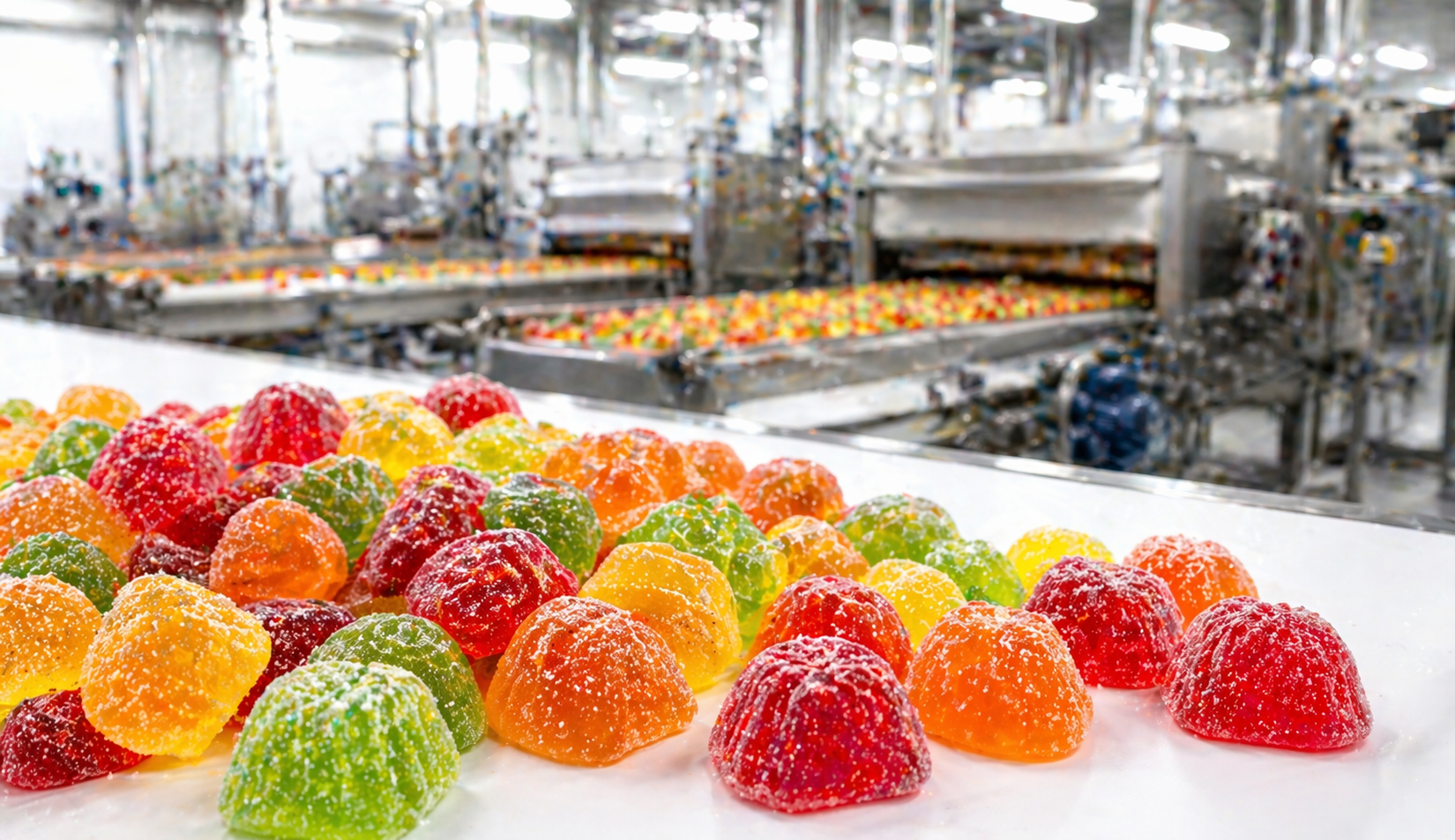
Jelly candies look simple: sugar, water, flavor, color and a gelling agent. However, behind consistent texture, glossy surface and stable shelf life stands a carefully coordinated sequence of process steps and parameters. Small fluctuations in cooking temperature, solids content, pH or hydrocolloid dosage can lead to overly soft, chewy, overly dry or sticky jelly, synaeresis or sugar crystallization during storage.
Therefore, technologists in the confectionery industry must understand not only the formulation, but also the sensitivity of the technological steps. Below are the key process parameters in typical industrial production of jelly candies based on pectin, gelatin or starch systems, with a focus on practical aspects for production.
Basics of jelly candy formulation
The base formulation of jelly candies is built around a blend of sugars (sucrose, glucose syrup powder, fructose or combinations), water, acids, flavors, colors and one or more gelling systems such as pectin, gelatin, modified starch or combinations with gums like xanthan and locust bean gum.
The technologist must understand that the choice of hydrocolloids determines not only texture, but also critical process conditions. Pectin requires controlled pH and solids content for proper gelling. Gelatin is sensitive to temperature and heating time. Starch and combined systems require adequate gelatinization and later dehydration in dryers or tunnels.
Control of composition and dry solids
One of the most important parameters in jelly candy production is total solids content in the mass before depositing. Typically, jelly candies have solids in the range of about 78–83%, depending on product type, target texture and desired shelf life.
Too low solids content leads to a soft structure, higher water activity, increased risk of microbial growth and shorter shelf life. Excessive solids content yields a candy that is too firm, prone to surface whitening and potential sugar crystallization. Therefore, continuous monitoring of °Brix (online refractometers or sampling) is a key control point during sugar cooking and in the phase prior to depositing.
In addition to total solids, the ratios of individual sugars (sucrose, glucose syrup powder, fructose, dextrose) influence crystallization tendency, hygroscopicity and mouthfeel. Higher proportions of glucose syrup and maltodextrin reduce crystallization risk but affect sweetness and viscosity. The technologist must align the sugar profile with the desired texture and the gelling system.
Cooking temperature and heating profile
Cooking the sugar mass to the target solids content usually requires reaching temperatures of 118–125 °C, depending on formulation and system. Cooking too fast with local overheating can result in caramel notes, darkening and degradation of pectin or gelatin if they are added too early or are not adequately protected. Slow cooking with long holding times at high temperature increases sucrose inversion and alters rheological behavior.
For pectin jellies, pectin is typically added in an early preparation stage, but cooking parameters are adjusted to avoid degradation. For gelatin jellies, gelatin is usually added after the main cooking step, into a slightly cooled mass (often below 80 °C), to avoid denaturation and loss of gelling power. In all cases, control of maximum temperature, holding time and cooling rate is crucial for repeatable quality.
pH and acidity
In pectin jelly candies, pH is a critical parameter for gel formation. High methoxyl pectins require pH in the range around 3.0–3.5 and appropriate solids content to form a stable gel. If pH is too high, the gel will be weak or fail to form. If pH is too low, premature gelling in the wrong process step or accelerated pectin hydrolysis during storage may occur.
Acid (typically citric, lactic or blends) is usually added at the end of the process, just before depositing, when the mass is already partially cooled. This avoids long exposure to low pH at high temperature. The technologist must pay attention to precise timing and homogeneity of acid addition, since uneven pH leads to non-uniform texture and gel strength.
In gelatin jelly candies, pH is somewhat less critical for gelling itself, but it influences flavor stability, colors and possible interactions with other hydrocolloids. It is typically maintained in a mildly acidic range that delivers pleasant taste and improves microbiological stability.
Rheology of the mass and depositing temperature
For successful depositing into starch moulds or silicone/metal moulds, the mass must have appropriate viscosity and temperature. If the mass is too viscous, accurate dosing becomes difficult and air bubbles can be trapped. If it is too thin, segregation, settling and non-uniform shapes may occur.
Depositing temperature is typically in the range of 70–90 °C, depending on the gelling system. With pectin, mass is deposited while still fully fluid, before intensive gel formation, so that gelation happens after proper filling of the mould. With gelatin, the temperature must not remain above the degradation threshold for extended periods, especially if the mass is held in intermediate tanks before depositing.
The technologist must monitor viscosity (through parameters like temperature, composition and mixing shear) and optimize equipment design for minimal hold-up, to avoid degradation and segregation.
Drying and stabilizing jelly candies
After depositing, jelly candies go through gelling and drying phases. In starch mould systems, part of the water is absorbed into the starch, followed by additional drying in chambers or tunnels. In other systems, candies may be exposed to controlled air to reach equilibrium moisture.
Air temperature and relative humidity in the dryer are key parameters. Excessively high temperature leads to surface drying and “crust” formation, which hinders water diffusion from the core, creating internal stress and uneven texture. Too low temperature and high humidity slow down the process, increase risk of microbial growth and sticky surfaces.
The goal is to achieve a stable moisture content and water activity level that ensure microbiological safety, mechanical stability and expected bite, without subsequent synaeresis or crystallization.
Finishing, anti‑stick treatments and surface quality
Many jelly candies undergo additional processing steps after demoulding and drying, such as sugar sanding, sour sanding or oil/wax application to prevent sticking. Again, process parameters matter: product and coating temperature, viscosity of oil, dosage of powder and drum rotation speed.
If candies are too moist when entering the coating drum, clumping and uneven coverage will occur. If the surface is too dry, the coating will not adhere properly and may dust off during storage and transport. The technologist must align the preceding drying phase with finishing and define the optimal product temperature at drum entry.
Stability during storage: crystallization and synaeresis
Although jelly candies seem “finished” once they leave the line, in reality the texture continues to change during storage. Water migrates, sugars may crystallize and the gel can release water (synaeresis) if the system is not balanced. Sugar profile, type of hydrocolloids, pH and storage conditions jointly define long‑term stability.
Technologists must consider that temperature and humidity fluctuations in the warehouse or during transport accelerate moisture migration and crystallization, especially in sanded products. The correct specification and choice of packaging (moisture barrier, seal integrity, interaction with the candy surface) complement what has been achieved in the process itself.
Conclusion
The technology of jelly candy production is much more complex than it appears at first glance. From precise control of solids content and sugar ratios, through management of temperature and pH during cooking and depositing, to carefully controlled drying and finishing, every process parameter affects texture, stability and shelf life.
Technologists who systematically monitor and document these parameters, use suitable hydrocolloids and understand their requirements will be able to secure consistent quality and flexibly introduce new formulations. In a market where consumers expect the same recognizable texture and appearance with every purchase, robust process control is a key competitive advantage.