
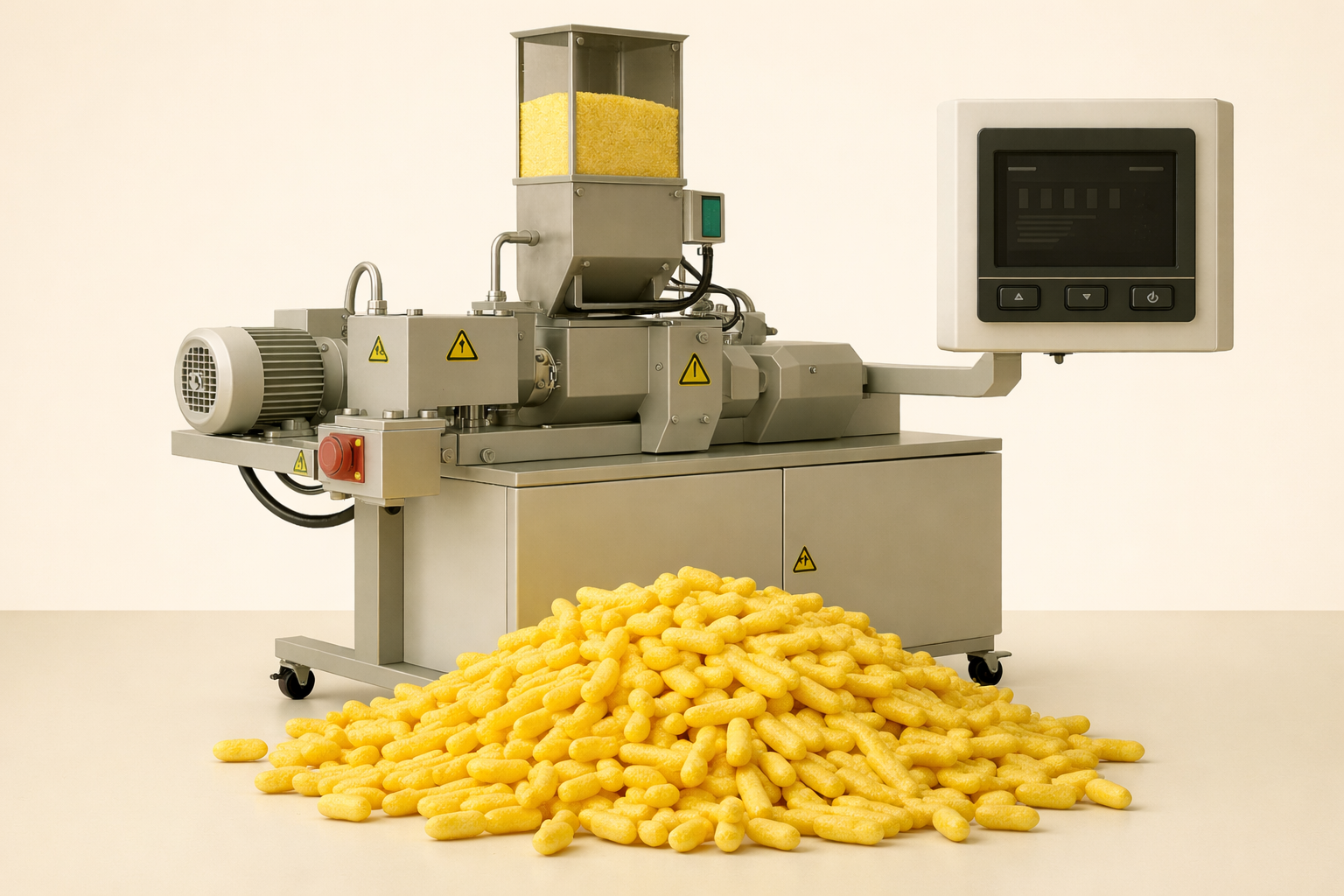
Extruded snacks – from classic corn puffs to protein and high‑fiber snacks – are produced under extremely dynamic conditions of pressure, temperature and shear. At the die exit, the melt experiences an abrupt pressure drop, water flashes off as steam and instant expansion occurs. At that exact moment, cell structure, porosity and crunchiness are formed, which will later define the eating quality.
Although process parameters (temperature, screw speed, moisture, die design) play a major role, the key determinant of texture is the composition of the raw material blend: the ratio of starch, proteins and fibers. This article focuses on a scientifically grounded explanation of how these components affect expansion, cell structure and crunchiness of extruded snacks.
Basics of extrusion expansion and structure formation
During extrusion, the mixture of starch, proteins, fibers, salt and possibly sugars passes through a heating and mechanical shear zone. Under these conditions, starch softens plastically and gelatinizes, proteins partially denature and form a network, and water acts as a plasticizer. At the die exit, the rapid pressure drop allows water to flash into steam, causing the melt to “puff”.
Expansion depends on the viscosity of the molten mass, steam diffusion rate, matrix elasticity and the ability to retain the gas phase before the structure “freezes” through cooling. Starch is the primary driver of this expansion, while proteins and fibers mostly limit it, but at the same time provide structural strength. The balance between these three elements is critical for achieving the desired crunch and porosity.
Starch as the main “engine” of expansion
Starch in extruded snacks usually comes from corn, rice, wheat or potato. Its chemical composition (amylose/amylopectin ratio), granule morphology and degree of gelatinization inside the extruder directly affect expansion and texture.
Amylopectin, with its highly branched structure, provides higher water‑holding capacity and a viscous, elastic melt phase favorable for expansion. Therefore, raw materials with higher amylopectin content (e.g. waxy corn starch) typically give higher expansion and a finer, more uniform porosity. Amylose, with its linear chains, favors the formation of a firmer network and higher brittleness after cooling, but too high a proportion can reduce expansion because it restricts matrix stretching before steam release.
Scientific studies show that there is an optimal range of starch content and gelatinization level for maximum expansion. Insufficiently gelatinized starch leads to poor expansion and dense structure, whereas overly degraded starch (due to excessive shear and temperature) produces a low‑viscosity melt that cannot retain the gas phase, resulting in structural collapse and a harder, denser snack.
Effect of moisture on starch behavior during extrusion
Initial moisture content in the blend has a critical impact on expansion. Too low moisture makes the melt overly viscous, which hinders gas bubble growth; too high moisture leads to lower expansion because water tends to remain in the liquid phase, rather than flashing into steam rapidly at the die exit.
For classic low‑fat extruded snacks, typical feed moisture is around 12–18% (w.b.), while during extrusion, specific mechanical energy (SME) is monitored as an indirect indicator of starch gelatinization degree. Adjusting moisture basically means adjusting starch melt rheology and thereby controlling expansion.
Proteins: from ally to “brake” on expansion
Protein addition in extruded snack formulations is a major trend due to the growing market for protein snacks. However, proteins typically reduce expansion compared with purely starchy systems. The reason lies in their different behavior under heat and shear.
During extrusion, proteins denature and form a three‑dimensional network via disulfide bonds, hydrophobic interactions and hydrogen bonds. This network is less elastic and less capable of expansion than a starch gel. As a result, overall expansion decreases, porosity becomes coarser and the structure denser and harder.
Protein level and type are crucial for the final result. Plant proteins such as soy, pea or wheat protein (vital gluten) have high functionality but also a strong impact on expansion reduction when added beyond a certain threshold. In practice, formulators seek a compromise: enough protein to achieve nutritional claims, but not so much that it completely suppresses expansion and crunchiness.
From a scientific perspective, the starch–protein ratio affects the viscoelastic properties of the melt, typically measured via G' (storage modulus) and G'' (loss modulus) in dynamic rheology. A higher elastic modulus at extrusion temperatures is usually associated with lower expansion, because an overly elastic system resists deformation and gas bubble growth.
Protein structure and type as texture drivers
Not all proteins behave the same. Soy protein isolate and concentrate, with their high protein content and gelling ability, can form a strong network that reduces expansion but may contribute to a pronounced “snap” upon biting. Pea protein concentrate often gives a somewhat milder, less rubbery profile, but similarly restricts expansion.
Wheat vital gluten, due to gluten network formation, markedly increases melt elasticity, which may lead to non‑uniform porosity if not carefully dosed. Wheat plant protein can act as a milder alternative, with a somewhat lower impact on elasticity compared with pure gluten.
An optimal formulation often combines a highly expandable starch source with a controlled protein level, and adjusted processing conditions (higher temperature, higher SME) to partially offset the negative effect of proteins on expansion while retaining the desired crunch.
Fibers: nutritional benefit that complicates expansion
Introducing dietary fibers into extruded snacks enables the development of products with reduced energy density and potential health benefits. However, from a technological viewpoint, fibers generally reduce expansion and lead to a firmer, denser texture.
Insoluble fibers, such as wheat or psyllium fibers, act as solid particles that mechanically disrupt starch matrix continuity. They hinder the formation of a homogeneous melt phase and reduce the matrix ability to expand uniformly during die pressure drop. The result is lower expansion, thicker cell walls and higher bite force.
Soluble fibers, such as certain citrus fibers or modified polysaccharides, may act more like hydrocolloids, increasing the viscosity of the aqueous phase. Depending on concentration and interactions with starch and proteins, they can slightly support the cell wall structure or, at higher levels, also reduce expansion due to excessive melt viscosity.
Scientific studies show that fiber type (fiber length, surface morphology, water‑binding capacity) and level strongly influence pre‑expansion melt rheology. Fibers that bind large amounts of water reduce free water available for starch gelatinization, further hampering optimal expansion.
Balancing high fiber content and acceptable texture
Formulators targeting “high fiber” claims must carefully balance nutritional objectives and sensory acceptability. One approach is to combine different fiber types (for example, fine‑particle wheat fibers and soluble citrus fibers) while using high‑expansion starch and adapting processing conditions.
Increasing SME, optimizing die design and precisely controlling moisture can partly compensate for the negative impact of fibers on expansion. Still, it is scientifically well established that above a certain fiber level, typical puff‑like texture cannot be maintained and the product shifts towards a denser, granola‑like behavior.
Crunchiness, brittleness and porosity: linking them to composition
Crunch and brittleness in extruded snacks result from a combination of porous structure and mechanical properties of cell walls. Highly expanded products with fine, uniform porosity usually have thin cell walls that fracture easily under low force, generating intense, high‑frequency acoustic signals during chewing. Consumers perceive this as a light, crispy texture.
Increased protein and fiber levels, with reduced expansion, lead to thicker cell walls and lower porosity. Such products exhibit higher hardness, require greater bite force and generate deeper, lower‑frequency sounds on fracture, which is often perceived as a “heavier”, less aerated texture.
Microstructural analyses (e.g. scanning electron microscopy) and instrumental texture measurements (fracture force, compression tests, acoustic emission) clearly demonstrate the correlation between composition (starch–protein–fiber), degree of expansion and sensory perception of crunchiness. For R&D teams, combining these analytical tools with sensory panels is key to optimizing formulations.
Role of sugars and fats in combination with starch, proteins and fibers
Although this article focuses on starch, proteins and fibers, sugars and fats also modulate matrix behavior. Sugars such as dextrose, fructose or glucose syrup powder act as plasticizers, lowering glass transition temperature and affecting hardness at ambient conditions. High levels of soluble sugars can reduce expansion and increase stickiness.
Fats, whether added before extrusion or as coatings, decrease friction and SME, which often results in lower expansion. At the same time, they can improve “short” crisp fracture and provide a pleasant fatty mouthfeel, which in some products compensates for lower porosity.
A formulation containing starch, a moderate protein level, controlled fiber content and well‑selected sugars and fats allows fine adjustment of crunch, ranging from light, aerated texture to strong, crunchy bite.
Conclusion
Extruded snacks are an excellent example of how microstructure and raw material composition directly define product sensory properties. Starch is the main driver of expansion and porosity; its amylose/amylopectin ratio, gelatinization degree and moisture content determine how much the product will puff and how light it will be. Proteins, while essential for nutritional profile, generally reduce expansion and lead to a denser, harder structure, so their type and level must be carefully optimized. Fibers further complicate structure, reducing expansion but enabling development of high‑fiber products.
A science‑based formulation approach – involving understanding of melt rheology, microstructure and correlations with instrumental texture – enables technologists to balance nutritional targets with consumer expectations for crunchiness. In the era of protein and high‑fiber snacks, fine‑tuning of the starch–protein–fiber ratio and adaptation of extrusion conditions will be crucial for successful development of new, sensorially appealing extruded products.