
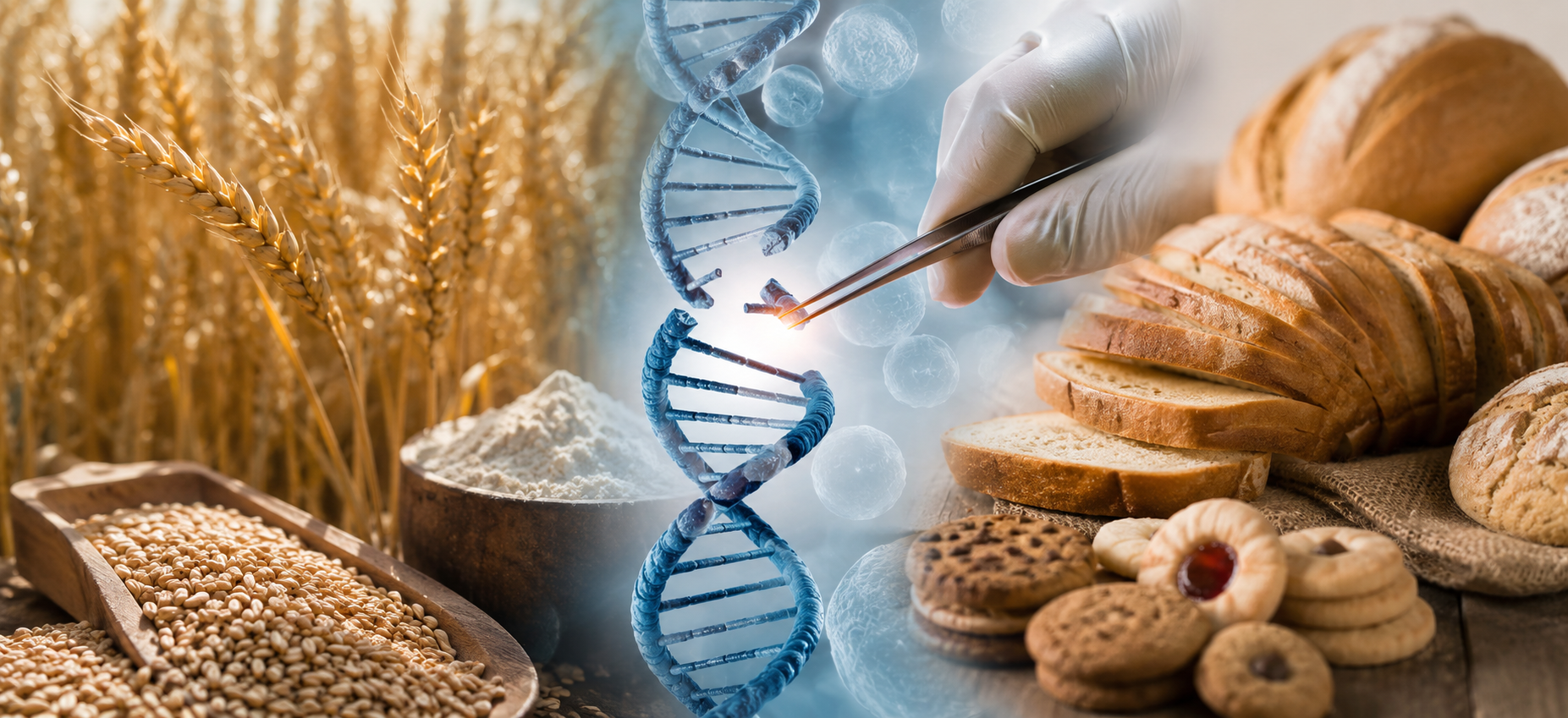
Acrylamide is one of the most extensively studied process contaminants in the modern food industry. Its presence in cereal-based products, especially in bread, toast bread, biscuits, crackers and other bakery items, is a consequence of thermally induced reactions during baking and toasting. Since the first reports in the early 2000s, it has become clear that acrylamide is not introduced via raw materials, but is formed during processing as a by‑product of complex Maillard‑type reactions, when free asparagine and reducing sugars are present in a starchy matrix.
Regulatory pressure in the EU, including benchmark values and the obligation to implement mitigation measures for acrylamide, has driven the industry towards downstream interventions: process optimisation, recipe modification and technological solutions at factory level. However, the limitations of this approach are evident. Acrylamide reduction is often achieved at the cost of compromises in crust colour, aroma, texture and overall sensory acceptability. Consequently, there is growing interest in upstream solutions at the level of the primary raw material, primarily wheat as the dominant flour source in baking.
Biochemical basis: free asparagine as an acrylamide precursor
Acrylamide in cereal products is formed predominantly via the reaction of free L‑asparagine with reducing sugars (glucose, fructose, maltose) under Maillard conditions. In the presence of sugars and elevated temperature, asparagine undergoes a series of decarboxylation and deamination steps, resulting in acrylamide as one of the final products. In most wheat flours, free asparagine is the limiting reactant for acrylamide formation, whereas reducing sugars rarely represent the limiting factor, especially in fermented doughs.
The free asparagine content in wheat grain is a function of genotype, agronomic practices (in particular nitrogen and sulphur fertilisation regimes), climatic stress and plant developmental stage. Analyses of different cultivars show multi‑fold differences in free asparagine levels, and it is well established that stress conditions and suboptimal sulphur status can markedly increase its content. This directly leads to a higher potential for acrylamide formation in the finished product, even under identical baking conditions.
From the practical perspective of millers and bakers, this means that an identically set process can yield different acrylamide levels depending on the batch of flour. In this context, reducing asparagine at the plant level appears as a logical strategy to control acrylamide “at its root cause”.
Conventional acrylamide mitigation approaches and their limitations
Current industrial strategies for acrylamide mitigation in bakery products are primarily based on interventions at the formulation and process stages. Modifying baking time and temperature, adjusting the sugar profile, altering dough pH, applying specific enzymes and selecting flours with lower asparagine content are typical tools in the technologist’s arsenal.
From a technological standpoint, each of these measures interacts with key functional parameters. Reducing baking temperature or time leads to a paler crust and a less pronounced flavour profile, which consumers often interpret as “underbaked”. Reducing total sugars or specific sugars affects fermentation, loaf volume, crumb structure and taste. Shifting pH to a more acidic range changes yeast activity and dough rheology. At the same time, the use of enzymatic treatments requires precise control of dosage and process conditions to avoid adverse effects on texture.
An additional complication is raw material variability: even a well‑optimised process can hardly compensate for extremely high initial free asparagine levels in flour. Hence the interest in a solution that does not start in the mixer but in the field – through a modified genetic potential of wheat.
Genetic target: asparagine synthetases in wheat grain
Asparagine biosynthesis in wheat is regulated by the activity of asparagine synthetases, enzymes that catalyse the formation of asparagine from aspartate, using glutamine as the amide donor. Hexaploid wheat carries multiple copies of asparagine synthetase genes, with certain isoforms being particularly important for the accumulation of free asparagine in the grain.
The identification and functional characterisation of these genes enable targeted genetic intervention. Inactivation or down‑regulation of specific grain‑expressed asparagine synthetases causes the plant to accumulate less free asparagine, with nitrogen being redistributed into other pools (e.g. proteins or other amino acids). The key question is whether such a modification can be achieved without negative effects on yield, stress tolerance and overall plant metabolism.
CRISPR/Cas technology as a tool for precise genome editing
CRISPR/Cas systems enable targeted editing of specific genomic loci with high sequence specificity. In the context of low‑asparagine wheat, research teams design guide RNAs that direct the Cas nuclease to selected asparagine synthetase genes. Following the induction of double‑strand DNA breaks, error‑prone repair pathways lead to small insertions or deletions, often causing frame‑shift mutations and loss of gene function.
This approach enables:
Targeted knock‑out of one or more grain‑expressed asparagine synthetase genes, without changes in non‑target genomic regions. Creation of different combinations of knock‑out mutations to achieve an optimal balance between asparagine reduction and preservation of plant physiology. Faster iteration and selection of desirable lines than with classical mutagenesis, where mutation identity is initially unknown. Field trials have shown that it is possible to achieve reductions in free asparagine in wheat grain on the order of 50–90%, depending on the combination of target genes, while maintaining yields comparable to conventionally bred controls.
The expert view here is that the precision of CRISPR is not merely a technical advantage but a prerequisite for industrial viability: without preserved yield and agronomic performance, such cultivars would have no realistic route into commercial practice.
Effect of reduced asparagine on acrylamide formation in bread and biscuits
When flour produced from CRISPR low‑asparagine wheat is tested in standardised baking protocols, results show a direct correlation between the reduction in free asparagine and the decrease in acrylamide formation. In experimental bread and biscuit series, using identical formulations and baking conditions, acrylamide levels in products made from low‑asparagine flour are significantly lower than in controls.
In some cases, for breads that were further toasted, acrylamide concentrations in samples from low‑asparagine wheat fell below the limit of detection, while in control samples they remained clearly quantifiable. Importantly, essential quality parameters such as specific loaf volume, crumb structure and elasticity, as well as typical crust colour, were not significantly compromised.
From an industrial practice standpoint, this means that part of the acrylamide risk can be “built into” the raw material, rather than relying solely on process corrections. Such a raw material would be particularly valuable in high‑risk segments such as toast bread, thin biscuits and crispy crackers, where targeted acrylamide reductions are difficult to achieve with process measures alone.
Comparison with lines obtained by classical mutagenesis
Before the advent of CRISPR, research had already focused on wheat lines with reduced free asparagine content obtained via chemical mutagenesis and conventional breeding. These lines can indeed exhibit substantially lower asparagine, but often at the cost of reduced yield or other undesirable agronomic traits, due to a broad spectrum of untargeted mutations across the genome.
Comparative studies indicate the following pattern: randomly mutagenised lines can deliver approximately 50% reduction in free asparagine but with yield penalties of about 20–25%, likely because of mutations affecting plant physiology outside the target pathway. In contrast, CRISPR lines directed at well‑defined asparagine synthetase genes can achieve similar or greater asparagine reductions without significant yield penalties.
From a supply‑chain perspective, this is critical: cultivars carrying a substantial yield penalty are unlikely to see wide adoption, even if they offer clear technological benefits. Thus, in this case CRISPR is not just “more sophisticated science” but also a more practically sustainable option.
Regulatory landscape: between scientific potential and political reality
From a regulatory point of view, CRISPR low‑asparagine wheat sits at the intersection of diverging approaches. In the United Kingdom, post‑Brexit legislation has introduced a framework that differentiates “precision‑bred” organisms from classical GMOs, provided that the genetic changes introduced could, in principle, arise naturally or through conventional breeding. This has enabled faster implementation of field trials and opens the possibility of relatively earlier commercial releases to the domestic market.
In contrast, the European Union largely maintains a framework in which genome‑edited organisms, including many CRISPR crops, fall under the same stringent rules as transgenic GMOs. The approval process is lengthy, demanding and costly, which constrains the pace at which innovations can move from research to commercial deployment. At the same time, the EU is tightening reference and maximum levels for acrylamide in certain food categories, exerting additional pressure on manufacturers.
For the food industry in South‑East Europe, which is strongly export‑oriented towards the EU, this combination is paradoxical: on the one hand there is a clear technological need for tools to reduce acrylamide, while on the other, the use of one of the most obvious upstream solutions – CRISPR low‑asparagine wheat – is regulatory‑wise uncertain. Even if local regulations became more permissive, the status of such products on the EU market would remain a crucial limiting factor.
Any future revision of EU legislation on new genomic techniques will therefore play a decisive role in determining whether these cultivars will become part of mainstream practice or remain confined to a handful of markets with more favourable regulatory frameworks.
Implications for industrial practice and acrylamide control strategies
In a scenario where CRISPR low‑asparagine wheat becomes regulatorily acceptable and logistically available, the approach to acrylamide control in baking could change substantially. At plant level, standard preventive measures would certainly remain in place, but their intensity could be calibrated differently.
Manufacturers would have greater flexibility to optimise crust colour and flavour without constantly risking exceedance of acrylamide benchmark values. Batch‑to‑batch variability in acrylamide levels would likely decrease, given that initial asparagine levels in flour would be consistently low. In high‑risk product categories, combining low‑asparagine flour with targeted process optimisation could offer a practical route to meeting stricter standards without major compromise in sensory attributes.
It should be emphasised that even with a marked reduction in asparagine, extreme baking or toasting conditions can still lead to acrylamide formation. In other words, CRISPR wheat does not remove the need for process engineering, but shifts the starting point and reduces the intensity of corrective measures required to achieve regulatory compliance.
Broader perspective: integrating genetic and technological solutions
Viewed along the “farm‑to‑fork” continuum, low‑asparagine wheat obtained via CRISPR technology illustrates a transition from purely process‑based fixes to integrated solutions for process contaminants. In practice, the most convincing application models are likely to be those where genetic innovation is combined with existing best practice in formulation and processing.
For plant breeders, this implies that safety‑related parameters (such as acrylamide formation potential) enter the breeding target set on an equal footing with yield and quality. For arable production, it implies adjustment of agronomic practices to a new “baseline” asparagine level. For millers and bakers, it means establishing differentiated raw‑material streams, robust traceability and clear communication of the value proposition of such flour to their customers.
The assessment is that the more successful companies will be those that start early in understanding the scientific and regulatory aspects of this technology as well as its real‑world limits. CRISPR low‑asparagine wheat is unlikely to replace all other acrylamide control strategies, but it has the potential to become a key component of a layered, science‑based approach to reducing this process contaminant in bakery products.