
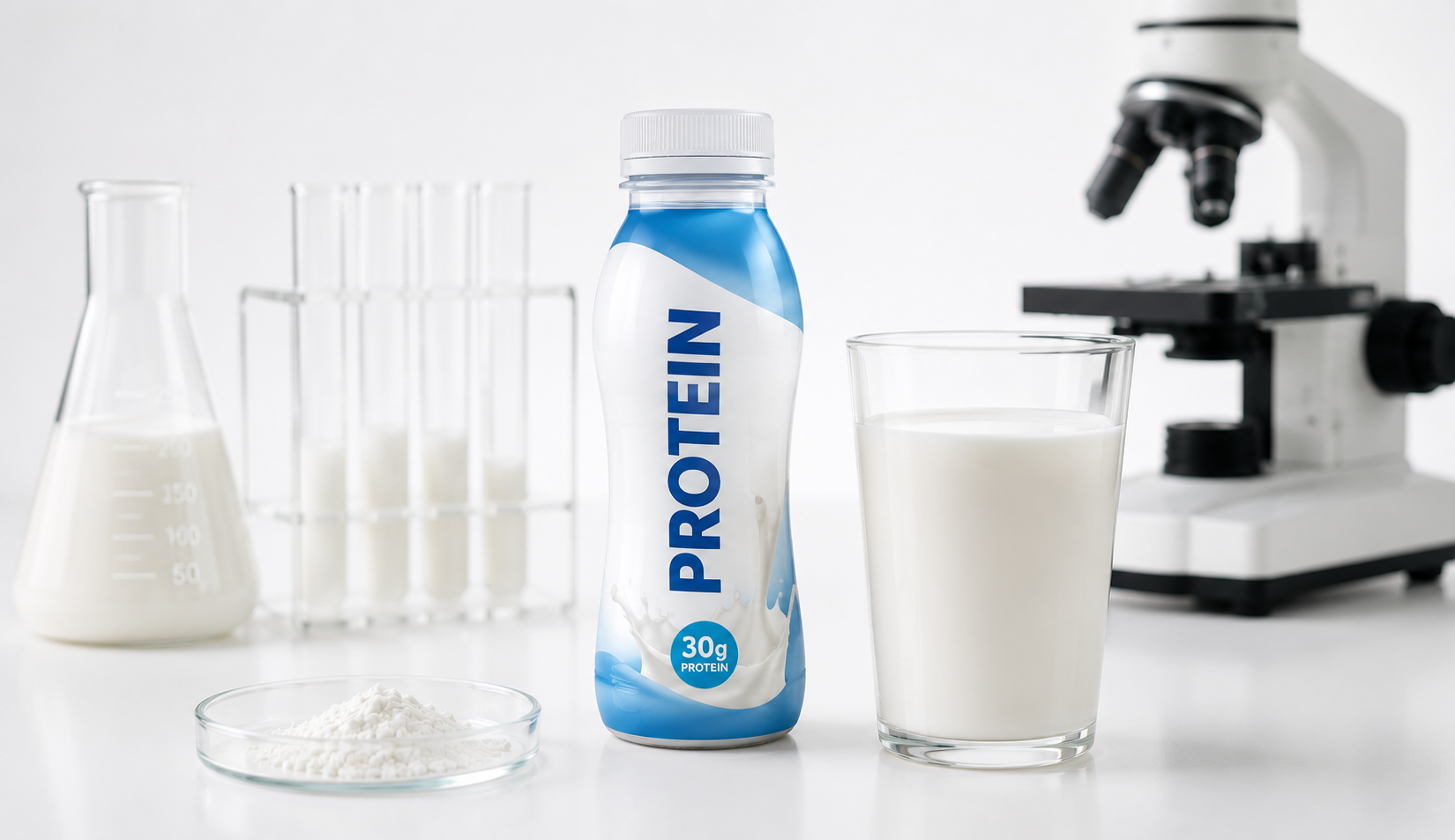
Protein drinks have long since moved beyond the narrow niche of athletes and bodybuilders and become part of everyday nutrition for a broader population. At the same time, consumers are increasingly sensitive to product composition, labelling and “naturalness” messages. In this context, a clear reformulation trend in protein drinks has emerged in recent years: a shift towards ultra-filtered milk as the primary source of complete protein, higher protein content per serving and, at the same time, removal of artificial sweeteners, flavours and colours, with a shorter ingredient list.
This development is not just a marketing move, but a reflection of deeper changes in technology, regulation and consumer perception of proteins. The focus below will be on technological and formulation aspects of such reformulations, without reference to specific brands, but rather to the general direction in which the industry is moving.
Why ultra-filtered milk? Technological and nutritional reasons
Ultra-filtered milk is milk that has undergone membrane separation, where part of the water, lactose and minerals is removed, while proteins and, to a lesser extent, fat are concentrated. The result is a raw material with a higher protein content per unit volume and lower lactose content compared to standard milk.
From a nutritional point of view, the advantage is obvious. Milk proteins are complete, with a favourable amino acid profile and a high content of essential amino acids, including BCAAs. The combination of fast-digesting whey protein and slower-digesting casein in the same drink provides both rapid and prolonged amino acid availability, which fits well with positioning products for everyday muscle health support, not just post-workout supplementation.
Technologically, ultra-filtered milk allows the manufacturer to achieve a higher level of protein (for example 26–42 g per serving) without relying too heavily on added protein concentrates and isolates. This can simplify the label, but also reduce viscosity compared to formulations with a very high share of dry protein powders in the finished drink. At the same time, the reduced lactose content lowers the risk of excessive sweetness and the burden for consumers sensitive to lactose, although the drink itself still needs to be clearly labelled.
The “no artificial” trend: no artificial sweeteners, colours or flavours
In parallel with category growth, consumer scepticism towards long lists of additives is increasing. In many countries, research shows that consumers are looking for a “cleaner label” – not necessarily completely free of additives, but with ingredients they recognise and understand. In protein drinks, this now translates into insistence on the following: no artificial sweeteners, no artificial flavours and no added colours.
From a formulation point of view, removing artificial sweeteners is a challenge. A high protein content, especially from dairy, brings certain bitterness and a “protein” aftertaste. High-intensity sweeteners (aspartame, acesulfame K, sucralose and others) have for years been a key tool to mask these notes while keeping energy value low. When they are removed, the manufacturer relies on nutritive sweeteners such as sucrose, spray-dried glucose syrup, maltodextrin or combinations of milk sugar with other sugars, which complicates the balance between taste, energy intake and sugar declaration.
The absence of added colours and artificial flavours also requires a stronger reliance on the quality of base raw materials and processing technology. For example, the profile of the cocoa component becomes critical for taste and colour in chocolate variants; the stability of vanilla notes must be ensured through careful choice of natural flavours and process conditions. All these constraints push development towards a more advanced understanding of interactions between proteins, fats, sugars and flavours in the final product.
Fewer ingredients, more technology
A typical claim for new protein drinks is “half the ingredients” or “shortened ingredient list”. This does not mean that the technology is simplified; quite the opposite. Instead of relying on a large number of emulsifiers, stabilisers, thickeners, flavour maskers and various sweeteners, the formulation is elevated to a higher level of optimisation of the basic building blocks: milk or dairy fractions, proteins, sugars, fats, cocoa or other flavouring components and a limited number of functional additives.
For drink stability, fat emulsification, viscosity control and prevention of protein sedimentation and any solid particles (for example cocoa powder) remain key. In the absence of complex additive blends, the role of high-quality emulsifiers such as lecithins, as well as carefully selected hydrocolloids, remains central. Choosing combinations such as lecithin plus a mild hydrocolloid, alongside optimised UHT or HTST conditions, can deliver a smooth texture, stable emulsion and acceptable viscosity with a relatively short label.
The expert challenge for R&D teams is to achieve the same or higher functionality with fewer declared components. This implies precise rheology modelling, shelf-life stability testing, compatibility with different packaging materials and flavour stability at ambient temperature.
“Protein for everyone”: from sports nutrition to everyday life
Another notable trend is the shift in communication from a narrow sports performance narrative to the concept of “protein for everyone”. Consumers increasingly associate protein with overall health, satiety, weight management and support for active ageing, not just with building muscle in athletes.
For the industry, this means that usage occasions are expanding: breakfast on the go, a snack between meals, late dinner replacement, recovery after recreational training or a practical solution for older people with reduced appetite. The protein drink ceases to be a “fitness tool” and becomes an everyday food.
From a formulation standpoint, this has consequences. The drink must be sensorially appealing to people who are not willing to “tolerate” a protein taste as the price for benefits. The texture should be smooth, not too thick, with a clear flavour profile (chocolate, vanilla, strawberry) close to what the consumer expects from dairy drinks. At the same time, the protein content must be high enough to support on-pack claims, but not to the extent that it compromises drinkability in a broader context (for example, as a drink with a meal).
Labelling, regulation and “protein clarity”
As mass interest in protein grows, so does confusion: how many grams are “enough”, what “complete” protein means, how plant and dairy sources differ, what “no artificial sweeteners” means in practice. Brands respond with specific terms such as “protein clarity” – the idea of explaining clearly and simply to the consumer what they get in each serving.
From a regulatory perspective, manufacturers must balance attractive marketing with strict rules on health and nutrition claims. Claims about the contribution of protein to the maintenance and growth of muscle mass, feelings of satiety and similar benefits must comply with local and international regulations. At the same time, the use of “free from” terms (no artificial sweeteners, no added colours, no artificial flavours) requires consistency across the entire supply chain and precise control of raw materials, in order to avoid discrepancies during inspections and potential regulatory consequences.
For product development teams, this means that label considerations cannot be solved at the end, but must be an integral part of the formulation brief from the very beginning.
Technological challenges at high protein levels
Achieving 30+ grams of protein in a 330–400 ml serving, combined with the requirement for good drinkability, stability and a cleaner label, demands serious technological work. Protein systems with such a high protein content are prone to sedimentation, flocculation, gelling and the development of sandy texture, especially during storage.
Key points are control of pH and ionic composition of the system, optimisation of heat treatment (avoiding an excessively denaturing effect on proteins) and selection of emulsifiers and stabilisers that do not “overwrite” the texture but fine-tune it. In milk-based drinks, interactions between casein, whey proteins and any added dairy proteins (for example WPC 80 or caseinate) must be considered in the light of target texture, shelf life and storage temperature regime.
In the absence of artificial sweeteners and with a lower level of additives, more pilot batch iterations with systematic monitoring of rheology, phase stability and sensory profile throughout the declared shelf life are necessary. Here, cooperation between R&D, quality and marketing becomes crucial, because every formulation change introduced to improve texture or stability must be compatible with the promised “cleanliness” of the label.
What this trend means for the beverage and dairy industry
For protein drink manufacturers, this trend is both an opportunity and a challenge. On the one hand, the shift to ultra-filtered milk, higher protein and a cleaner label positions the product better in the eyes of more informed consumers and enables differentiation in a mature and crowded category. On the other hand, the cost structure of such products is more sensitive: more demanding raw materials, higher protein content, more advanced processing technologies and invested effort in formula development inevitably increase complexity and cost.
For the dairy sector, growing demand for ultra-filtered milk and dairy protein fractions represents a new development opportunity. Dairies that invest in membrane technologies, optimise protein utilisation and develop tailor-made components for drinks gain an additional source of revenue with higher added value compared to traditional dairy products.
At the level of the protein drinks category, further expansion of the “protein for everyone” narrative can be expected, along with a growing share of products that combine dairy and plant proteins, as well as hybrid concepts focused on digestive tolerance, reduced sugar content and additional functional benefits.
New phase of category development
Reformulation of protein drinks towards ultra-filtered milk, higher complete protein content and the absence of artificial sweeteners, flavours and added colours is a clear signal of where the beverage industry is heading. The focus is shifting from a narrow sports segment to a broader population, and a “clean” and understandable label is becoming just as important as the number of grams of protein on the front of the pack.
For technological teams, the challenge is to achieve more in terms of texture, taste, stability and nutritional value with fewer declared ingredients. For marketing and brand management, the task is to translate complex protein science into simple, credible messages that consumers understand and trust. Manufacturers who manage to connect these two worlds – advanced technology and clear communication – are likely to lead the next phase of development in the protein drinks category.