
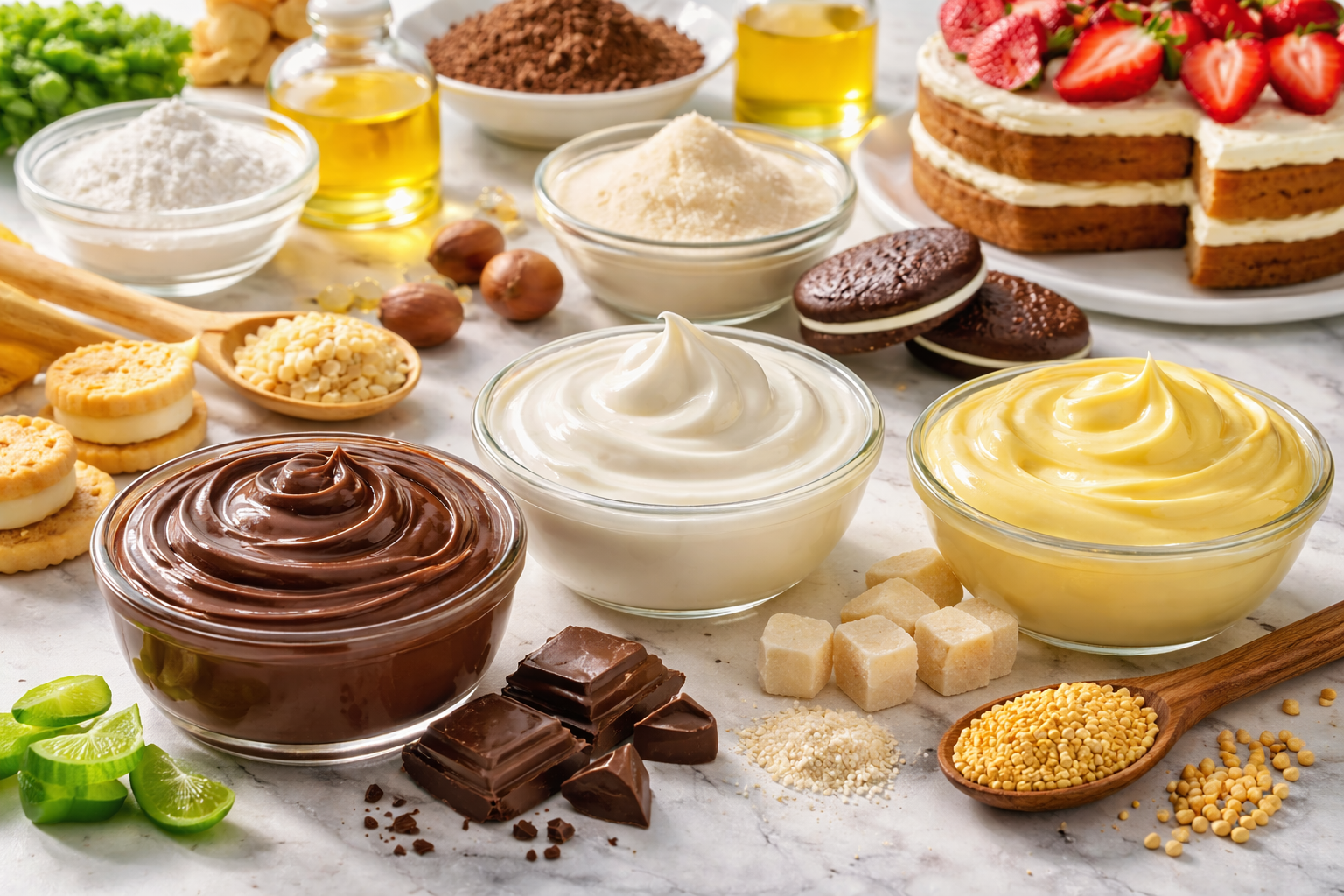
Cream spreads, fillings for biscuits, toppings for cakes and bakery fillings share a common feature: they must be thick enough to hold shape, yet spreadable enough to be easily applied or deposited into the product. Technologists know that a small change in composition – a few percent more fat, slightly less sugar or a different emulsifier – can dramatically change thickness, spreadability and stability. Understanding what these properties are based on is crucial for developing and optimizing creams, whether cocoa, dairy, protein or low‑sugar variants.
Below, we analyze the main factors that determine the thickness and spreadability of creams: the ratio of fat to solid phase, type and level of sugars, the presence of proteins and hydrocolloids, the role of emulsifiers and the impact of cooling and storage conditions.
What do “thick” and “spreadable” mean in technological terms?
In everyday language, a “thick” cream is often associated with high viscosity and the ability to hold shape, while “spreadability” refers to the ease of spreading and the absence of cracking or graininess when applied to a substrate. In rheological terms, creams are usually plastic or pseudoplastic systems with a yield stress: at low stress they keep their shape, and when a higher force is applied (knife, roller, pumps) they start to flow and spread.
Thickness and spreadability depend on how the particles of the solid phase (sugars, cocoa powder, dairy ingredients, proteins) are distributed and interconnected within the continuous phase, which in most creams is either fat (in high‑fat creams similar to chocolate spreads) or water (in water‑based, dairy or gelled creams). System microstructure, particle size and interactions determine whether the cream will feel “light and spreadable” or “heavy and sticky”.
The role of fat in defining cream structure
Fat is a key structuring agent in many confectionery creams. In high‑fat creams, fat forms a crystalline network in which particles of sugar, cocoa powder, dairy proteins and other ingredients are dispersed. This network has a dual function: it provides structural firmness and influences spreadability and mouthfeel.
The type of fat, melting profile and crystalline polymorphism strongly affect thickness and spreadability. Fats with a higher melting point and pronounced crystallization at room temperature provide firmer creams, often less spreadable at low temperatures. Fats with a broader melting range and a higher proportion of liquid fraction at room temperature deliver softer, more spreadable creams, but can be more prone to oiling‑out or “weeping” at higher temperatures.
Fat content also affects “lubrication” of the solid phase: more fat means a stronger lubricant effect between particles, which improves spreadability but may reduce apparent thickness and shape‑holding ability. Too little fat, or improperly crystallized fat, leads to compact, grainy and poorly spreadable structures.
Sugars and dry matter: how they affect thickness and rheology
Sugars and total dry matter directly impact viscosity and thickness of creams. Higher dry matter (sucrose, dextrose, fructose, glucose syrup powder, maltodextrin) generally means higher viscosity and a firmer cream, provided there is enough fat or aqueous phase to properly coat the particles. However, not all sugars behave the same.
Crystalline sugars such as sucrose and dextrose contribute to structure as discrete particles. Their size and distribution affect smoothness and spreadability. Finer grinding and a narrow particle size distribution produce creams with less “sandy” perception and better spreadability. Coarser crystals or a broad distribution can cause a gritty feel and hinder spreading.
Soluble sugars and syrups (glucose syrup powder, fructose, maltodextrin) contribute to viscosity mainly through their impact on the aqueous phase. They increase dry matter and bind water, which leads to thicker but often smoother textures in water‑based creams and toppings. The choice between sucrose and combinations of sugars and syrups influences whether the cream will be “heavily thick” or “smoothly thick” and spreadable.
Proteins and dairy components: emulsifying, structuring and affecting spreadability
Proteins, especially dairy ones (sodium caseinate, whey proteins, WPC 80), have multiple functions. In oil‑water systems they act as emulsifiers and stabilizers, while in firmer creams they contribute to structure by forming a protein network, binding water and interacting with sugars and fats.
Sodium caseinate is a strong emulsifier and stabilizer, capable of forming viscous yet spreadable creams, particularly in dairy toppings and creams with a significant water fraction. Increasing caseinate level raises thickness and resistance to phase separation, but excessive levels can lead to a rubbery or elastic texture with reduced spreadability.
WPC 80 (whey protein concentrate 80%) contributes to a fuller mouthfeel and may slightly increase viscosity and thickness, but thanks to its solubility and favorable functional properties, it often improves spreadability, especially in high‑protein creams. Plant proteins (soy protein isolate, soy protein concentrate, pea protein concentrate, wheat plant protein) also influence thickness, but can yield a more viscoelastic and “stringy” behavior during spreading, which requires careful balancing with fats and emulsifiers.
Hydrocolloids: fine‑tuning thickness and preventing syneresis
Hydrocolloids (xanthan gum, guar gum, locust bean gum, carboxymethyl cellulose – CMC, pectin, agar, carrageenan) are powerful tools for controlling thickness, viscosity and stability of creams, especially those with significant water content. They bind water, increase viscosity and can form gel structures, thus affecting the perceived spreadability.
Xanthan gum produces pseudoplastic systems: the cream can be very thick at rest but flows easily under shear (during spreading or pumping). This is ideal for creams that must hold shape yet remain easy to spread. Guar gum and locust bean gum generally provide a viscous, full mouthfeel, but at higher dosages they can cause a sticky spreadability.
CMC is particularly useful in water‑based creams and dairy toppings, as it provides a stable, smooth texture, reduces syneresis and phase separation, and enables fine control of viscosity. Pectin, agar and carrageenan are more often used when the goal is to form gel or semi‑gel structures (e.g. jelly‑type cream fillings), where spreadability depends on the gel’s ability to fracture and deform under force. Their impact is more “structural” than “lubricating”.
Emulsifiers: a bridge between fat and water, and structure “lubricants”
In many creams both fat and water phases are present, and emulsifiers are crucial for stabilizing the interface and controlling texture. Soy lecithin and sunflower lecithin are widely used in cocoa and chocolate creams, while mono‑ and diglycerides of fatty acids (E471) are often added to improve spreadability and prevent clumping.
Lecithin reduces interfacial tension between fat and solid phase, improves wetting of cocoa and sugar particles and reduces the amount of fat required to achieve desired spreadability. Correct dosing helps the cream to be thick and easily spreadable at the same time, without significantly increasing fat content. Mono‑ and diglycerides affect the rheology of the fat phase and crystallization, contributing to a softer, more homogeneous structure and easier spreading, particularly at lower temperatures.
In emulsion‑type creams (water‑in‑oil or oil‑in‑water) the choice and combination of emulsifiers, together with proteins, is critical for stable droplet size, which directly impacts perceived thickness and spreadability on the tongue.
Grinding, mixing and cooling: hidden regulators of texture
Although formulation is the foundation, processing parameters often decide whether a cream will have the targeted thickness and spreadability. The particle size of sugar and cocoa, obtained during grinding and refining, determines smoothness and resistance during spreading. Fine grinding lowers friction between particles and increases spreadability, but may require more fat or emulsifier to cover the larger specific surface area.
Mixing intensity influences phase distribution and air incorporation. Excessive air entrainment can create a “foamy” structure that feels less dense but may be mechanically unstable. Controlled mixing ensures uniform structure and a stable rheological profile.
Cooling is particularly important in fat‑based creams. Cooling rate and storage temperature affect fat crystal form, crystal size and development of the crystal network. Too rapid or poorly controlled cooling can lead to large crystals and a sandy or brittle texture, whereas proper tempering and gradual cooling produce a fine crystal network and a firm yet spreadable cream.
Regulatory and labelling aspects of structure‑forming ingredients
When selecting ingredients that affect thickness and spreadability, regulatory and labelling requirements must also be considered. The use of certain hydrocolloids, emulsifiers and sugar replacers has to comply with applicable legislation and limits on permitted additives and maximum levels.
“Clean‑label” formulations restrict the use of some emulsifiers and hydrocolloids, so technologists rely more on functional proteins, fibers, cocoa powder and modified or native starches to achieve the desired thickness and spreadability. This increases the importance of process optimization and functional synergy between ingredients.
Conclusion
The thickness and spreadability of creams are the result of a complex interplay between fats, sugars, proteins, hydrocolloids, emulsifiers and processing conditions. Fat and its crystal structure provide basic firmness and lubrication of particles, sugars and dry matter control viscosity and microstructure, proteins and hydrocolloids form networks that bind water and contribute to structure, while emulsifiers ensure stable and homogeneous phase dispersion.
For technologists, the key to success lies in understanding how each of these components affects system rheology and how small changes in formulation or process can shift a cream from “too thick and hard to spread” into the “stable yet nicely spreadable” zone. A science‑based approach, combining rheological measurements, microstructural analysis and sensory evaluation, enables precise texture control and the development of creams that are both technologically stable and attractive to consumers.