
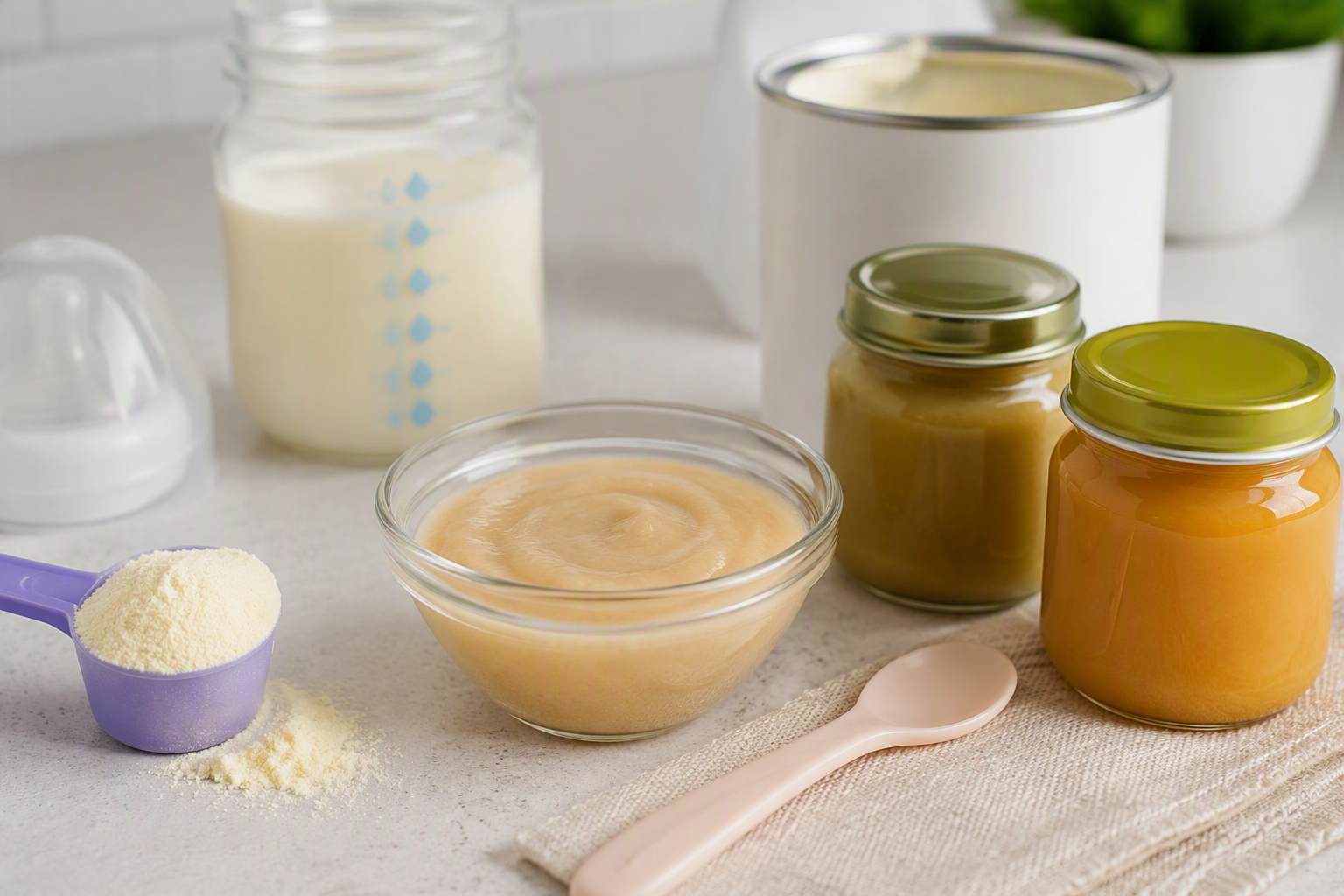
The European Union has initiated the process of introducing the first legal limit for cereulide, a heat stable toxin produced by the bacterium Bacillus cereus, in baby food. This move comes after a global incident in early 2026 that led to product recalls in nearly a hundred countries. For baby food manufacturers and the ingredient industry, this is the most important regulatory change in this category in recent years.
What Is Cereulide and Why Is It a Problem?
Cereulide is a toxin produced by the bacterium Bacillus cereus, and its key characteristic is exceptional resistance to heat. Unlike many other bacterial toxins, cereulide survives pasteurisation and common food processing methods, meaning it cannot be eliminated by standard thermal treatments. That is precisely why this toxin has been difficult to detect in routine microbiological tests for years. Symptoms of cereulide poisoning include nausea and vomiting, which usually appear within a few hours after consumption. In adults, symptoms are usually mild and pass on their own, but in newborns and infants they can be serious due to their small body weight and undeveloped metabolism.
What Exactly Has the EU Proposed?
On 1 September 2026, the European Commission launched a public consultation on a draft regulation amending Regulation (EC) 2073/2005 on microbiological criteria for foodstuffs. The proposed limit is 0.1 micrograms per kilogram of cereulide in dry, i.e. powdered infant formulae, including initial formulae, follow on formulae and food for special medical purposes for infants. For liquid products, the limit is adjusted by applying a reconstitution factor stated by the manufacturer, in order to ensure equivalent protection.
The consultation runs until 29 September 2026, and adoption of the final regulation is expected in the first quarter of 2027. The proposed limit will apply throughout the entire shelf life of the product, meaning manufacturers will have to ensure compliance from the moment the product is placed on the market until the expiry date.
Where Did the Need for This Limit Come From?
The introduction to this regulatory change was a serious global incident. In early 2026, recalls of infant formulae were initiated in 99 countries due to possible contamination with cereulide. Products from companies Nestlé, Danone, Lactalis Nutrition Santé and other brands were affected, and the source of contamination was identified as arachidonic acid (ARA) oils from a common supplier in China. The World Health Organization reported at least 144 suspected and confirmed cases of illness linked to contaminated products in ten countries during January and February 2026.
On 27 January 2026, the European Commission instructed EFSA to urgently assess the toxicity of cereulide in infants and safe thresholds for consumption. On 2 February 2026, EFSA published an acute reference dose of 0.014 micrograms per kilogram of body weight for cereulide in infants, with vomiting taken as the critical effect for determining this value. Based on this value and an estimated high consumption of 260 millilitres per kilogram of body weight for initial formulae, EFSA concluded that cereulide concentrations above 0.054 micrograms per litre in reconstituted initial formula could lead to exceeding the safe level. For follow on formulae, the threshold is 0.1 micrograms per litre.
What Does This Mean for Manufacturers?
For baby food manufacturers, this is primarily a question of compliance. The proposed limit of 0.1 micrograms per kilogram in dry formulae requires that laboratories performing analyses have a sufficiently low limit of quantification. The detection method must be aligned with ISO 18465, and laboratories must be able to reliably measure cereulide at a level of 0.1 micrograms per kilogram.
For liquid products, the situation is somewhat more complex. Manufacturers must provide data on the reconstitution factor in order to perform the conversion and demonstrate compliance with the equivalent limit in dry form.
What is particularly important is that the limit applies throughout the entire shelf life of the product. This means manufacturers must consider not only the initial level of cereulide in raw materials but also whether it might increase during storage.
Given that the source of contamination in the previous incident was ARA oil, manufacturers should pay special attention to suppliers of this raw material. It is recommended to test all products containing ARA oils, including stocks already on the market, in order to determine the current situation.
What to Expect in the Coming Months?
The consultation on the draft regulation runs until 29 September 2026, and all interested parties can submit comments via the DG SANTE platform. After the consultation ends, the Commission is expected to adopt the final regulation in the first quarter of 2027.
For manufacturers, the time to prepare is now. Reviewing suppliers, establishing routine testing for cereulide and understanding the requirements for laboratory analysis are not steps that can be done at the last minute. This is a regulatory change that will permanently shape safety standards in the baby food category.