
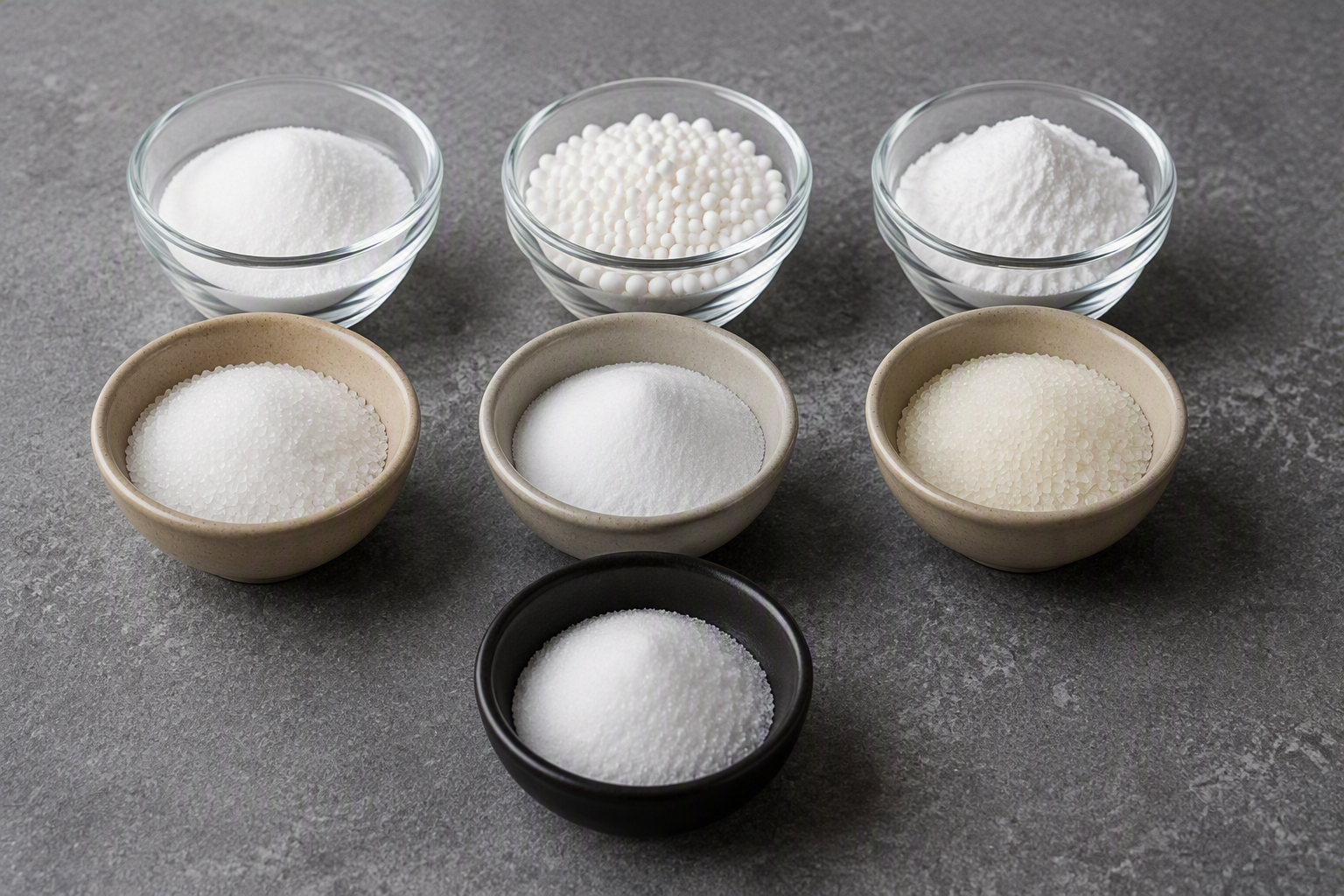
Choosing a sweetener is one of those tasks that looks simple until you run into the real constraints of your production line. Sweetness is only the starting point. What actually determines whether a sweetener will work in your product is its thermostability, its impact on texture, its behaviour during storage, its price per kilogram and, ultimately, its cost per dose required to achieve the desired profile.
This guide is designed as a decision tool. Instead of general definitions, the focus is on practical differences between seven sweeteners most commonly used in the European food industry.
Polyols: Isomalt, Sorbitol, Maltitol and Erythritol
Polyols are a group of sweeteners used primarily when bulk is needed, meaning the volume that traditionally comes from sugar. Their role is not just sweetness but also structure, body and behaviour during processing.
Isomalt is a polyol derived from sugar beet and one of the most stable polyols when it comes to heat and moisture. Its sweetness is about 50 to 60 percent that of sucrose, making it mild but very predictable. What sets it apart is extremely low hygroscopicity. Isomalt does not absorb moisture from the environment, which means finished products stay crisp and stable for longer. Its thermostability is excellent: it does not brown or undergo Maillard reactions even at temperatures above 160°C, and it is stable in boiling and extrusion processes. This makes it ideal for hard candies, compressed tablets, chewing gums, decorations and all products where visual stability is as important as taste.
Sorbitol is the oldest and most affordable polyol. Its sweetness is about 60 percent that of sucrose, and its price per kilogram is the lowest among polyols, often between 1.5 and 2 dollars per kilogram in wholesale. However, sorbitol has two limitations to keep in mind. First, it is highly hygroscopic, meaning it absorbs moisture and can lead to stickiness or softening during storage. Second, its thermostability is good but not top tier. Sorbitol begins to degrade only above 295°C, which is far above typical baking conditions, but in combination with other ingredients it can affect texture. It is used in chewing gums, toothpastes, soft candies and pharmaceutical preparations. In food production it is often used as a humectant, a moisture retaining agent, rather than just a sweetener.
Maltitol is the polyol closest to sucrose in sweetness, at about 90 percent that of sugar. This makes it attractive for products where consumers expect a full, sugar like taste. Maltitol's thermostability is excellent up to about 200°C, after which slight browning may occur, but in practice it is stable in all standard baking and cooking processes. It does not participate in Maillard reactions, meaning it does not contribute to browning. It has low hygroscopicity, making it suitable for chocolates, creams and bakery products. Its price is lower than erythritol and xylitol, positioning it as a cost effective replacement for sugar in sugar free products. It is used in sugar free chocolates, caramels, cakes, biscuits, chewing gums and ice creams.
Erythritol is a polyol that has established itself in recent years as one of the most sought after on the market. Its sweetness is about 60 to 70 percent that of sucrose, but what sets it apart is its extremely low caloric value (about 0.2 kcal per gram) and zero glycemic index. Its thermostability is excellent up to about 160 to 180°C, with no browning or degradation, allowing baked goods to retain their natural colour. Its biggest advantage over other polyols is digestive tolerance: erythritol is largely absorbed in the small intestine and excreted in urine, so it does not cause bloating and laxative effects like sorbitol or maltitol. Erythritol's price is higher than sorbitol and maltitol but has stabilised in recent years. It is used in sugar free chocolates, ice creams, beverages, baked goods and as a household sugar substitute.
Intense Sweeteners: Sucralose, Acesulfame K and Stevia
Intense sweeteners do not provide bulk. They are there to deliver sweetness in very small amounts, so they are often combined with polyols or fibres to replace volume.
Sucralose is a synthetic sweetener about 600 times sweeter than sucrose. It has a clean, sugar like sweetness profile without a bitter or metallic aftertaste, making it one of the most sensorially acceptable intense sweeteners. Its thermostability is exceptional: it is stable at temperatures up to 130°C and across a wide pH range, making it suitable for baking, pasteurisation, sterilisation and UHT processing. However, caution is needed: research has shown that heating above 120°C can lead to sucralose degradation and the formation of chlorinated compounds, which is relevant for baked goods exposed to high temperatures. That is why sucralose is more often used in beverages, chewing gums, desserts and products that do not require extreme temperatures.
Acesulfame K (E950) is another synthetic sweetener, about 200 times sweeter than sucrose. Its main advantage is exceptional thermostability: it is stable up to 225°C, making it one of the most heat stable intense sweeteners on the market. This makes it ideal for baking, cooking and any process involving high temperatures. However, acesulfame K has a pronounced bitter or metallic aftertaste, especially when used alone. It is therefore almost always combined with other sweeteners, most often sucralose or stevia, to mask that drawback. It is used in soft drinks, chewing gums, dairy products, confectionery and baked goods. Its price is significantly lower than sucralose.
Stevia is a natural intense sweetener obtained from the leaves of the Stevia rebaudiana plant. Its main active components, steviol glycosides, especially rebaudioside A, are about 200 to 300 times sweeter than sucrose. Stevia has a natural origin, which makes it attractive for clean label products, but it also brings challenges: it can have a bitter or herbal aftertaste, especially at higher concentrations. Stevia's thermostability is excellent, stable up to 200°C, making it suitable for baking and cooking. It is also stable across a wide pH range. Stevia's price varies depending on purity. Due to its high sweetness, the cost per dose is low. It is used in beverages, yoghurts, desserts, baked goods and table top sweeteners.
How to Compare These Sweeteners?
When you compare these sweeteners across five key dimensions, you get a clearer picture of which one fits your product.
Price per kilogram is lowest for sorbitol and maltitol, followed by isomalt and erythritol, while sucralose, acesulfame K and stevia are considerably more expensive per kilogram. However, when you consider that intense sweeteners are hundreds of times sweeter, their cost per dose is often lower than that of polyols.
Sweetness is highest for sucralose (600x), followed by stevia (200-300x) and acesulfame K (200x). Among polyols, maltitol is closest to sugar (90 percent), while sorbitol, erythritol and isomalt range from 50 to 70 percent of sucrose sweetness.
Texture is the dimension where polyols dominate. They provide bulk, body and structure that are essential for baked goods, chocolates and ice creams. Intense sweeteners provide no volume, so they must be combined with polyols, fibres or other bulking agents.
Thermostability is best for acesulfame K (up to 225°C), followed by stevia and sucralose (up to 200°C, with caution for sucralose above 120°C), while polyols are stable in the range of 160 to 200°C, depending on the type.
Application depends on the combination of all these factors. For baked goods, the best choices are maltitol, isomalt or erythritol combined with acesulfame K or stevia. For beverages, sucralose and stevia are the most common choices due to high sweetness and stability in solution. For chocolates and confectionery, maltitol and isomalt provide the best texture, while erythritol is used for products with low caloric value.
Practical Recommendations for Selection
If you are developing sugar free chocolate, maltitol is the most cost effective choice because it provides texture and sweetness closest to sugar. If your priority is low caloric value and digestive tolerance, erythritol is a better choice, although more expensive.
For baked goods that require browning and crust, avoid polyols that do not participate in Maillard reactions. In that case, a combination of maltitol with acesulfame K or stevia can give satisfactory results, but you will need to adjust the baking process.
For beverages, sucralose and stevia are the most practical choice due to high sweetness, stability and low cost per dose. If you want clean label, stevia is a natural solution, but be prepared for a slight herbal aftertaste.
For chewing gums and tablets, isomalt and sorbitol are the standard choice due to their ability to provide volume and stability.
Conclusion
There is no universally best sweetener. There is only the best sweetener for your product, your process and your consumer. Polyols provide bulk and texture, intense sweeteners provide sweetness without calories, and combinations often give the best results. When you frame sweetener selection as a question of compatibility with your process and target product profile, rather than a question of preference, the decision becomes much clearer.