
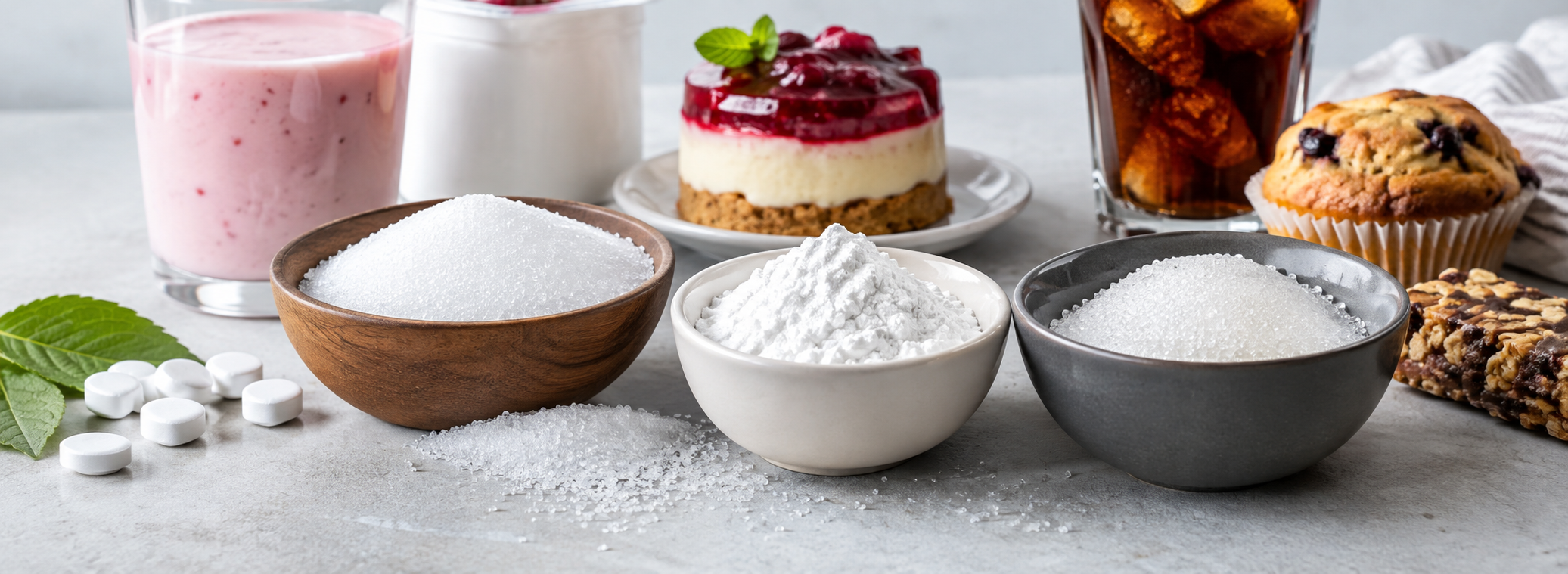
When you decide to create a sugar-free version of your product, the first question is what to replace sugar with. There are several options on the market, but three polyols most often come up as the solution: erythritol, maltitol and sorbitol. Each has its own advantages and drawbacks, and the right choice depends on the type of product, the desired texture and, of course, the price. This text is not just a dry list of facts. It is a practical guide that will help you understand how these polyols behave in real production and which one might work for you.
What Are Polyols and Why Do We Use Them?
Polyols, or sugar alcohols, are carbohydrates that occur naturally in fruits and vegetables but are industrially produced by hydrogenating sugars. What makes them particularly useful is that they provide bulk and texture similar to sugar, but with significantly fewer calories and a lower glycemic index. Unlike intense sweeteners like stevia or sucralose, polyols not only sweeten but also build the structure of the product. That is why they are indispensable in baked goods, chocolates, ice creams and confectionery. Without them, sugar-free products would often be dry, crumbly or lacking in body.
Erythritol: Fewest Calories, but Highest Price
Erythritol has established itself in recent years as one of the most sought-after polyols. It is about 60 to 70 percent as sweet as sucrose, making it mild but pleasant. What sets it apart is its extremely low caloric value of just 0.2 kcal per gram, while its glycemic index is practically zero. This means it does not cause blood sugar spikes, making it ideal for diabetics and people on a keto diet.
Erythritol's thermostability is excellent. It is stable at temperatures up to 180°C, does not brown or degrade, allowing baked goods to retain their natural colour. However, erythritol has a pronounced cooling effect in the mouth, similar to menthol. In chocolate or caramel, that effect can be unpleasant, while in chewing gums and mint products it is an advantage. Also, erythritol retains moisture poorly, which can lead to a dry and short texture. Its price is higher than sorbitol and maltitol, but it offers the best digestive tolerance because it is largely absorbed in the small intestine and does not cause bloating.
Maltitol: Closest to Sugar in Taste
Maltitol is the polyol closest to sucrose in sweetness, at about 80 to 90 percent that of sugar. This makes it attractive for products where consumers expect a full, sugar-like taste. Maltitol's thermostability is excellent up to about 200°C, after which slight browning may occur, but in practice it is stable in all standard baking and cooking processes. It does not participate in Maillard reactions, meaning it does not contribute to browning, but that can also be a drawback when you want to achieve a golden-brown crust.
Maltitol has low hygroscopicity, making it suitable for chocolates, creams and baked goods. Its caloric value is about 2.1 kcal per gram, and its glycemic index is around 35. Although lower than sugar, it is not negligible, so diabetics should consume it in moderation. Maltitol's price is lower than erythritol and xylitol, positioning it as a cost-effective replacement for sugar in sugar-free products. It is used in sugar-free chocolates, caramels, cakes, biscuits, chewing gums and ice creams.
Sorbitol: The Oldest and Most Affordable
Sorbitol is the oldest and most affordable polyol. It is about 50 to 60 percent as sweet as sucrose, making it the least sweet of the three. Its price is the lowest, often between 1.5 and 2 dollars per kilogram in wholesale. Sorbitol is highly hygroscopic, meaning it absorbs moisture from the environment. This can lead to stickiness or softening of the product during storage. On the other hand, that very property makes it an excellent humectant, a moisture-retaining agent, which is why it is often used in soft candies, fondants and pharmaceutical preparations.
Sorbitol's thermostability is good; it is stable at high temperatures and does not participate in Maillard reactions. Its caloric value is about 2.6 kcal per gram, and its glycemic index is around 9. Although it has a low glycemic index, sorbitol can cause digestive issues such as bloating and laxative effects if consumed in larger quantities. That is why it should be dosed carefully, especially in products consumed in larger amounts.
How to Compare These Three Polyols
When you compare erythritol, maltitol and sorbitol across several key dimensions, you get a clearer picture of which one fits your product. In terms of price per kilogram, sorbitol is the cheapest, followed by maltitol, while erythritol is the most expensive. However, considering that erythritol has the lowest caloric value and the best digestive tolerance, its higher price may be justified in premium products.
Sweetness is highest in maltitol, which is closest to sugar, while erythritol and sorbitol are mild. This means that to achieve the same sweetness, you will need more erythritol or sorbitol than maltitol, which further affects the cost per dose. Texture is the dimension where these polyols differ most. Maltitol provides body and softness, sorbitol retains moisture and gives a creamy texture, while erythritol gives a dry and short texture with a pronounced cooling effect. For baked goods that require a soft crumb, maltitol is the best choice. For products that require moisture retention, sorbitol is unbeatable. For products where low caloric value is a priority, erythritol is the best, but with a compromise in texture.
Thermostability is good in all three polyols, but with different nuances. Erythritol is stable up to 180°C, maltitol up to 200°C, and sorbitol is stable even at higher temperatures. All are stable over a wide pH range, making them suitable for various processes. Application depends on the combination of all these factors. For sugar-free chocolates, maltitol is the most cost-effective because it gives texture and sweetness closest to sugar. For baked goods, maltitol or sorbitol combined with an intense sweetener can give satisfactory results. For chewing gums and tablets, sorbitol and erythritol are the standard choice due to their ability to provide volume and stability. For beverages and low-calorie products, erythritol is the best choice.
Practical Recommendations for Selection
If you are developing sugar-free chocolate, maltitol is the most cost-effective choice because it gives texture and sweetness closest to sugar. If your priority is low caloric value and digestive tolerance, erythritol is a better choice, although it is more expensive and can give a dry texture. For products that require moisture retention, such as soft candies or cakes, sorbitol is the best choice, but you should be careful about digestive issues in sensitive consumers.
In many applications, a combination of polyols gives the best results. For example, a blend of maltitol and erythritol can provide sweetness and texture closer to sugar with reduced caloric value. A combination of sorbitol and maltitol can improve moisture retention and softness. Practical experience shows that there is no universal solution. What works in one product category may not work in another. That is why it is best to start from the target product profile and then choose the polyol that fits it best.
Conclusion
There is no universally best polyol. There is only the best polyol for your product, your process and your consumer. Erythritol offers the fewest calories and the best digestive tolerance, but at a higher price and with texture challenges. Maltitol is closest to sugar in taste and most cost-effective for chocolates and baked goods. Sorbitol is the cheapest and best for moisture retention, but it can cause digestive issues. When you frame polyol selection as a question of compatibility with your process and target product profile, rather than a question of preference, the decision becomes much clearer.