
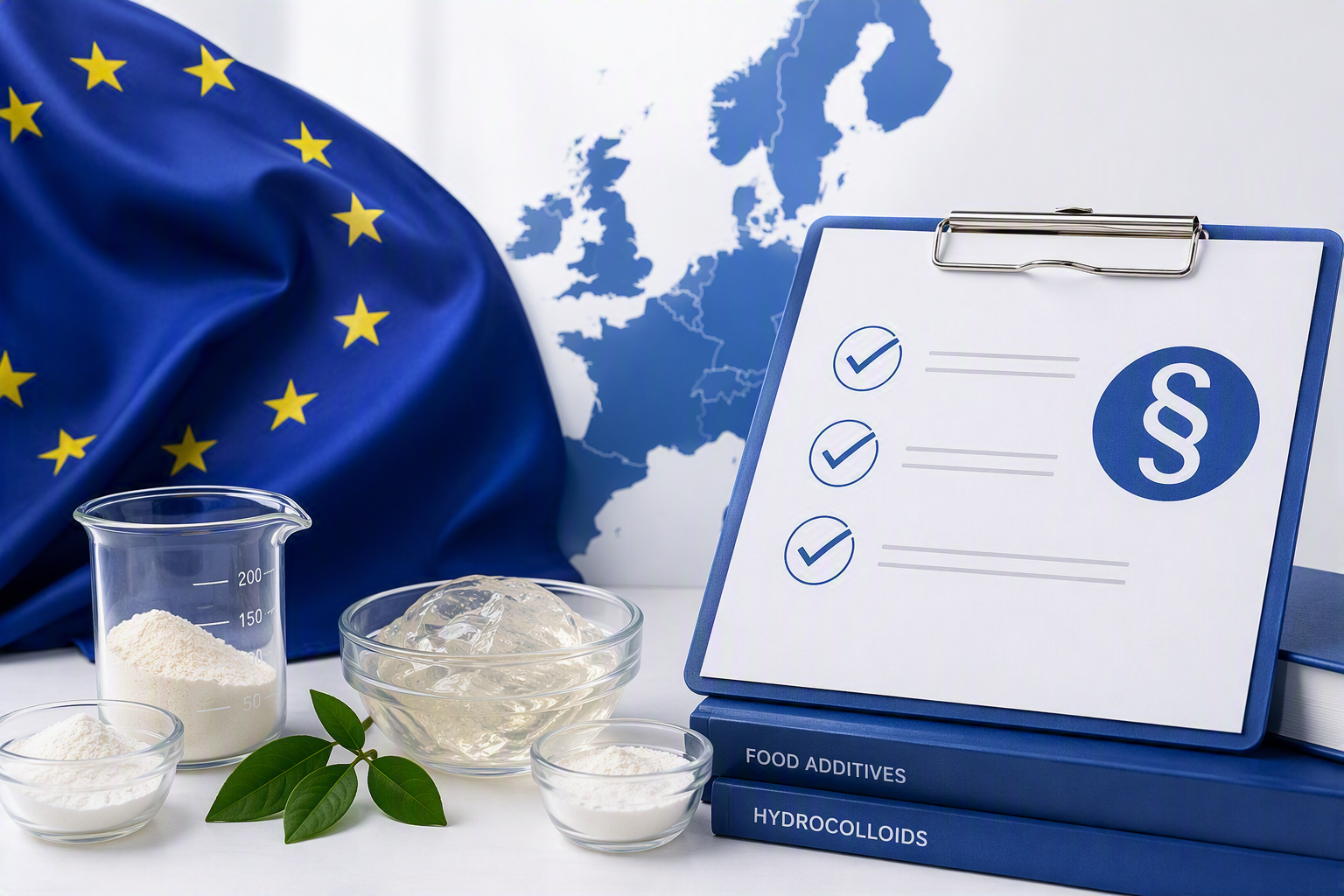
New EU rules for certain food additives will apply from 18 August 2026. The changes concern the use of specific hydrocolloids and other functional additives, including locust bean gum, guar gum, gum arabic, xanthan gum and pectins. For food manufacturers, this means that certain formulations, particularly in food categories intended for infants and young children, will need to be reviewed.
Hydrocolloids play an important role in the food industry. They are used for stabilization, thickening, texture control, water binding and improving the stability of different products. As a result, changes to their regulatory conditions can directly affect product formulation, raw material selection and the documentation manufacturers receive from suppliers.
From 18 August 2026, Commission Regulation (EU) 2026/196 will apply, amending Regulation (EC) No 1333/2008 on the use of certain food additives, as well as the specifications set out in Regulation (EU) No 231/2012. The Regulation covers carrageenan E407, locust bean gum E410, guar gum E412, gum arabic E414, xanthan gum E415, pectins E440 and starch sodium octenyl succinate E1450.
Commission Regulation (EU) 2026/196 – EUR-Lex
What exactly is changing from 18 August 2026?
The first thing to clarify is important. The new regulation does not mean that E410, E412, E414, E415 or E440 will be generally banned in the European Union.
The changes are much more specific. The Regulation modifies the conditions of use for these additives in certain food categories, while also changing their regulatory specifications. The most significant practical changes concern products intended for infants, young children and certain categories of food for special medical purposes.
This means that a manufacturer already using one of these additives should not automatically change the formulation simply because the regulation is changing. The first step is to check which food category the product belongs to and whether the new provisions apply to that specific category.
Specific changes for milk-based drinks intended for young children
One of the changes concerns the category of milk-based drinks and similar products intended for young children.
For this category, the Regulation introduces maximum levels for several additives. For carrageenan E407, the maximum level is 300 mg/kg, while locust bean gum E410, guar gum E412, gum arabic E414 and xanthan gum E415 are subject to a maximum level of 10,000 mg/kg. For pectins E440, the maximum level is 5,000 mg/kg.
However, there is an important detail that manufacturers should not overlook.
When several of these additives are used in the same product, the maximum level for each individual additive is no longer considered completely independently. The new provision introduces a proportional reduction of the maximum level when other additives from the same group are used at the same time.
In other words, a manufacturer cannot simply take the maximum permitted level for each individual additive and then use all of them at their respective maximum levels. When several additives are combined, their combined use has to be taken into account.
This is particularly important for technologists and R&D teams because combinations of different hydrocolloids are often used in practice to achieve the desired texture, stability or mouthfeel.
Guar gum E412 is subject to a particularly important change
One of the most specific changes concerns guar gum E412.
In the category of food intended for infants, or infant formula, the entry for E412 is removed from the permitted uses. This means that, once the new rules apply, guar gum can no longer be used in the same way in this category.
A similar change applies to food for special medical purposes intended for infants. In this category, E412 is also removed from the relevant provisions.
This is particularly important for manufacturers of infant formula and medical nutrition products because the change is not simply a question of maximum dosage. In certain categories, it changes whether the additive can be used at all.
Manufacturers using guar gum E412 in these products will therefore need to review their existing formulations and, where necessary, consider alternative technological solutions.
E410 and E440 remain important, but under more specific conditions
The changes are not limited to guar gum.
For food for special medical purposes intended for infants, the new Regulation specifies certain uses of locust bean gum E410 and pectins E440.
For E410, a level of 5,300 mg/kg is provided for products intended to reduce gastroesophageal reflux. For pectins E440, a level of 4,000 mg/kg is provided for products intended for the dietary management of gastrointestinal disorders.
This shows why it is not enough to simply say that an additive is "permitted" or "not permitted."
For food additives, it is always necessary to consider the combination of the additive, the food category, the intended use of the product and the maximum level applicable to that specific category.
The changes are not limited to conditions of use
Another important part of the new Regulation concerns the specifications of the additives themselves.
In addition to amending Regulation (EC) No 1333/2008, which governs the conditions of use of food additives, Regulation 2026/196 also amends Regulation (EU) No 231/2012, which establishes specifications for food additives. The changes to specifications concern locust bean gum E410, guar gum E412, gum arabic E414, xanthan gum E415, pectins E440 and starch sodium octenyl succinate E1450.
This part is particularly important for quality control and procurement.
For a manufacturer, it is not enough for a supplier to confirm that it sells, for example, E415 xanthan gum. It is necessary to verify whether the product being purchased complies with the applicable regulatory specifications and whether the supplier's documentation reflects the current requirements.
As a result, updated product specifications, COA documentation and communication with suppliers will become even more important for companies operating in the European Union or producing goods intended for export to the EU market.
What about existing stocks?
The new Regulation does not mean that all products and raw materials complying with the previous rules will suddenly become unusable on 18 August 2026.
The Regulation provides transitional provisions.
Additives E410, E412, E414, E415, E440 and E1450 that were lawfully placed on the market before 18 August 2026 may continue to be used in accordance with the previous rules until existing stocks are exhausted. Food that was lawfully placed on the market before 18 August 2026 may also remain on the market until the end of its minimum durability date or "use-by" date.
For E1450, there is a specific longer transitional provision under which certain food products that do not comply with the new requirements may continue to be placed on the market if they were lawfully placed on the market before 18 February 2028.
There are also specific transitional provisions for products containing guar gum E412 in certain categories of food intended for infants and young children. For this reason, manufacturers should not treat 18 August as a simple cut-off date for every product. The specific transitional provisions applicable to their particular food category should be checked.
What should food manufacturers check?
For most manufacturers, the most important question is not simply what the new regulation says, but what they actually need to do with their existing products.
The first step is to review formulations. If a product contains E407, E410, E412, E414, E415 or E440, the manufacturer should check whether the product belongs to one of the categories affected by the new provisions.
The next step is to review the amount of additive used in the formulation. Particular attention should be paid to products where several hydrocolloids are used at the same time, because the new rules for certain categories take their combined use into account.
The next step is to review supplier documentation. Product specifications, COAs and other technical documentation should correspond to the requirements that apply to the product and the market where it will be sold.
For manufacturers using guar gum in infant products or certain foods for special medical purposes, the review is even more important because the changes in these categories affect the possibility of using E412 itself.
What does the new regulation mean for hydrocolloid procurement?
Changes in regulatory requirements show why the procurement of food ingredients should not be based solely on the price per kilogram.
When a regulatory requirement changes, manufacturers need suppliers that can provide the appropriate specification, consistent quality and complete documentation.
This is particularly important for hydrocolloids because the same product name does not automatically mean that every material will be suitable for every formulation and every food category.
For manufacturers planning long-term procurement, it is important to know not only the price and MOQ, but also whether the supplier can provide a product that meets the required technological and regulatory specifications.
Does this mean manufacturers need to reformulate all their products?
No.
For most standard food products, the new Regulation will not automatically require a formulation change. The changes apply to specific food categories and specific conditions of use.
Therefore, it would be incorrect to view the Regulation as a general ban on certain hydrocolloids. It is much more useful to view it as a signal that manufacturers should review their formulations where the new rules directly apply.
Particular attention should be paid to products intended for infants and young children, food for special medical purposes and formulations that use combinations of several of the affected additives.
What should manufacturers do before 18 August 2026?
18 August 2026 is not simply another date on the regulatory calendar. From that date, Regulation 2026/196 will apply in all EU Member States.
Manufacturers should therefore review in advance whether their products fall into the food categories affected by the changes, whether their existing formulations comply with the new conditions and whether the documentation for the additives they use corresponds to the updated specifications.
Particular attention should be paid to products containing E407, E410, E412, E414, E415 and E440, as well as products belonging to categories intended for infants, young children or special medical purposes.
For companies using hydrocolloids across a larger number of products, this is also a good opportunity to review all additives currently used and the suppliers providing them, together with the R&D, QA and procurement teams.
The new rules do not mean that hydrocolloids will disappear from the food industry. Their functional role remains highly important. However, manufacturers operating in regulated food categories will need to connect formulation, regulatory requirements, raw material specifications and supplier documentation more carefully.
For food manufacturers, the biggest mistake is therefore not necessarily using the "wrong" hydrocolloid, but assuming that nothing has changed.
Commission Regulation (EU) 2026/196 applies from 18 August 2026, making now the right time for manufacturers to review their formulations, specifications and documentation for the affected additives.
Note: This article provides an overview of the main changes introduced by Regulation (EU) 2026/196 and is not a substitute for legal or regulatory assessment of a specific product. For a final assessment, the exact food category and applicable conditions of use under EU legislation should be verified.