
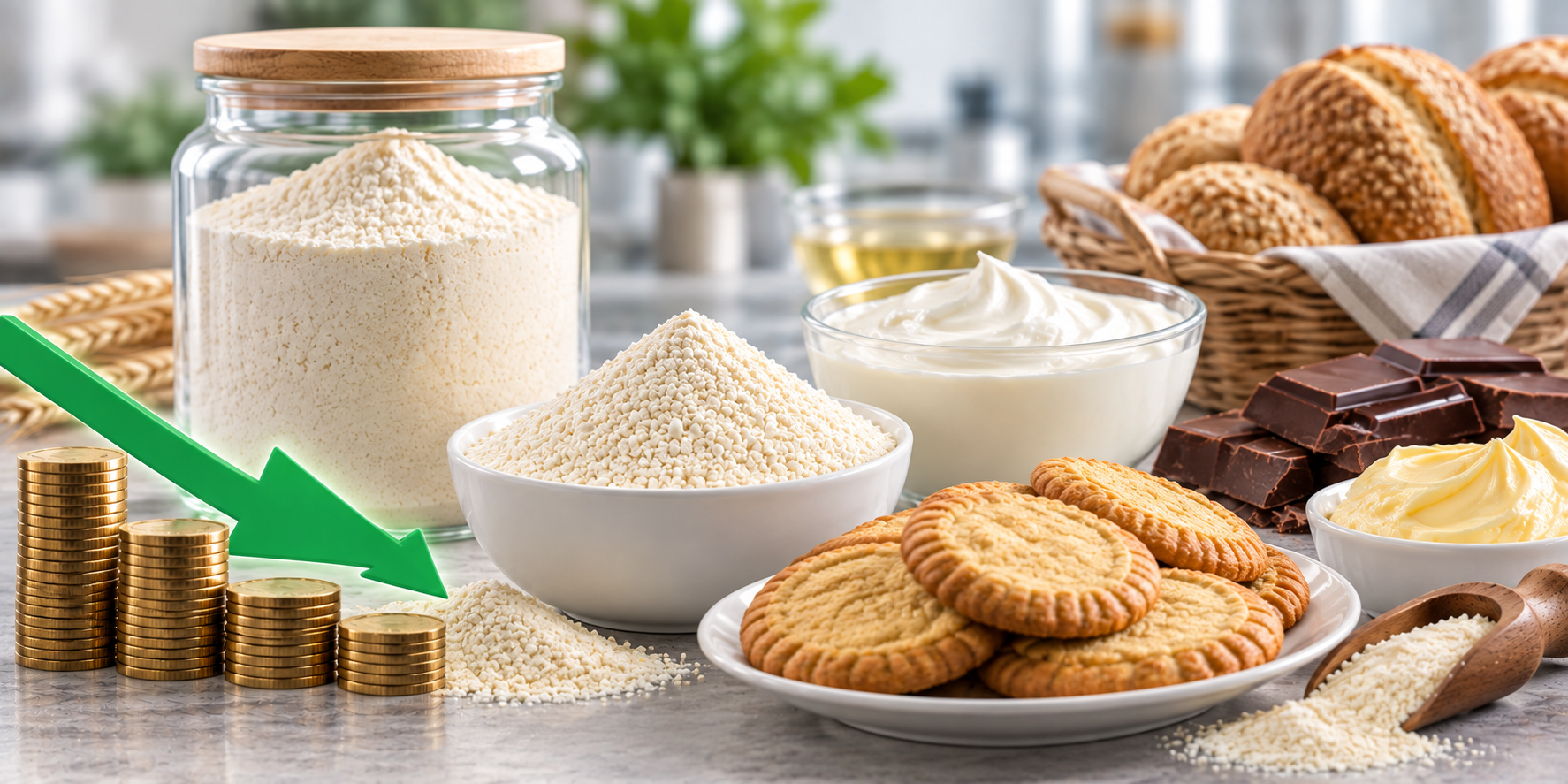
If you thought 2025 was challenging for cost planning in the food industry, 2026 brings a whole new level of complexity. The raw materials market feels like a rollercoaster ride, with whey protein prices in Europe surging over 50% since January 2026, and data from the European market clearly shows that the price of 100 kilograms of whey protein jumped from roughly 100 euros at the start of the year to about 160 euros. At the same time, producer prices for agricultural products in Serbia fell by 4.3% in May 2026 compared to the same month last year. This contradiction, where some raw materials spike while others drop, is putting pressure on margins like we haven't seen in years. Research indicates that over 60% of activities in the food and beverage sector are now focused on reformulation, and as many as 70% of developers are concentrated on cost reduction. So how can you cut recipe costs without the consumer noticing any difference? Here are seven strategies that have proven effective in the first eight months of 2026.
Forget static recipes, the era of adaptive formulations has arrived
The first and perhaps most important strategy lies in abandoning static recipes. Imagine your recipe isn't carved in stone but lives and breathes alongside your production. Generative artificial intelligence can now learn the structure of the human palate directly from large recipe datasets and create new products optimized for taste, sustainability, or nutritional value. A study published in June 2026 showed that artificial intelligence can create burgers that, in blind sensory evaluations, score the same or better for taste and texture than well-known brands, while simultaneously significantly reducing the ecological footprint. AI models are increasingly used for recipe generation, ingredient selection, and formulation optimization, reducing the need for expensive experimentation and accelerating development. Sodexo announced in August 2026 that it would use artificial intelligence to accelerate research and development as well as recipe optimization. This isn't a luxury for the big players anymore, it's becoming a fundamental competitive advantage.
Substitute smartly, not cheaply
The second strategy involves intelligent ingredient substitution, but not the kind that compromises product performance. Research published in late May 2026 showed that replacing just one to three ingredients in a meal can improve nutritional quality by about 10% while simultaneously reducing costs by 19 to 32%. In the world of food formulations, this means instead of looking for the cheapest replacement, you look for a functionally equivalent one. For example, with rising whey prices, manufacturers are increasingly turning to plant-based alternatives. The fermented protein market, which includes soy derivatives, is worth 3.8 billion dollars in 2026 and is growing at an annual rate of 12.6%. But caution is needed, substitution isn't always straightforward. A potential replacement must match in functional performance, nutritional profile, regulatory status, and consumer perception. Teams using ingredient scoring platforms have reduced ingredient research time by 64%.
Clean label isn't more expensive, it can be cheaper
The third strategy comes from an unexpected direction, clean label. For a long time, it was believed that cleaner labels automatically meant more expensive recipes, but 2026 paints a different picture. The global clean label ingredients market is estimated at 47.91 billion dollars in 2026, with a forecasted growth to 83.44 billion by 2034. Multinational giants like Nestlé have already eliminated artificial colors from their portfolio, replacing them with natural alternatives like beetroot juice. Mars has also embarked on eliminating synthetic colors from M&M, Skittles, and Starburst products. What's particularly significant is that manufacturers can find savings in clean label products by optimizing formulations to reduce more expensive components like dairy products and fats. For instance, one manufacturer switched to a clean label tomato sauce and achieved 10% savings by reducing tomato solids, made possible by clean ingredients like waxy corn starches and citrus fibers. In 2026, clean label is no longer just a marketing gimmick, it's becoming a tool for cost optimization.
Harness the power of enzymes and functional ingredients
The fourth strategy relies on technological innovations in food processing. The global bakery enzymes market is estimated at 2.05 billion dollars in 2026, with expected growth to 3.16 billion by 2033. These enzymes enable better digestibility of ingredients, reduced losses, and improved utilization of raw materials, especially in conditions of price volatility. For bakery manufacturers, targeted enzyme systems can reduce dependence on expensive or volatile ingredients. The use of plant-based texturizers is also growing, allowing manufacturers to reduce the use of more expensive components without losing texture and mouthfeel. The industry is increasingly turning to these solutions in response to rising traditional raw material prices.
Turn waste into a resource
The fifth strategy concerns upcycled ingredients, transforming by-products and waste into valuable inputs. This category is experiencing explosive growth, with the global upcycled food products market valued at 44.68 billion dollars in 2026 and projections to reach 79.51 billion by 2034. At the IFT FIRST conference in Chicago in July 2026, startups demonstrated how advanced extraction and on-site processing technologies are turning everything from sheep skins and wool to fruit pomace and bakery leftovers into premium ingredients with functional health benefits. The Ri-Flour project, which completed its feasibility phase in January 2026, transforms industrial bread crusts and leftovers into functional flour that goes back into production lines. This approach delivers savings in the form of 30 to 50% CO2 emission reductions compared to conventional flour and avoids approximately 18,000 tons of food waste annually. For manufacturers, this means access to raw materials at lower prices while simultaneously responding to growing consumer demand for sustainable products.
Fermentation, old technique, new economy
The sixth strategy comes from the renewed use of fermentation. The fermented protein market is worth 3.8 billion dollars in 2026 and is growing at a compound annual rate of 12.6%. What's particularly exciting are innovative technologies that enable mycelium growth in less than 24 hours, instead of the usual 3 to 7 days, with dramatic reductions in water consumption, energy use, and CO2 footprint. These technologies are especially relevant for hybrid meat analogs, but the principles can be applied to a wider range of products. Symbio Bioculinary has developed a vertically integrated platform that includes AI-powered biorefineries and high-performance fungal strains optimized for specific enzyme secretion profiles. Their pilot system in the baking industry converts all excess dough and products, both raw and baked, into sugar that can be used in its own production. The company's founder estimates that annual losses in food and agricultural processing amount to 137 billion dollars. Fermentation can deliver 25 to 33% savings in chocolate and bakery production.
Digital transformation of formulation
The seventh strategy ties all the previous ones together, and that is the digitalization of the recipe development process. Multidisciplinary frameworks for recipe optimization, presented in scientific papers from 2026, treat recipe design as a multi-objective problem integrating process, operation, and nutrition. The concept of Digital Twins for recipes uses artificial intelligence to model culinary recipes as living, evolving practices. These tools enable dynamic ingredient substitution adapted to changes in prices and availability. In practice, this means your R&D team no longer wastes time on manual database searches and internal communication. One CPG team used such a platform and reduced ingredient research time by 64%. Companies that fail to adopt these tools risk being left breathless in the race with competitors.
Conclusion
Reducing recipe costs without changing the final product in 2026 is no longer a question of if but how. The seven strategies we've covered, from AI-driven adaptive formulations, intelligent substitution, clean label optimization, enzymes, upcycled ingredients, fermentation, to digital transformation, don't operate in isolation. They complement and reinforce each other. The data speaks for itself, the upcycled products market is growing at an annual rate of 7.47%, the clean label ingredients market has similar potential, and fermented proteins are growing at an impressive 12.6%. What was once an advantage for the biggest players is now becoming accessible to medium-sized manufacturers as well. Each of these strategies requires a shift in mindset, from passively tracking prices to actively managing the formulation. Those who grasp this in time won't just survive 2026, they'll emerge stronger. Because at the end of the day, the best recipe isn't the cheapest one today, but the one that's most flexible for tomorrow.