
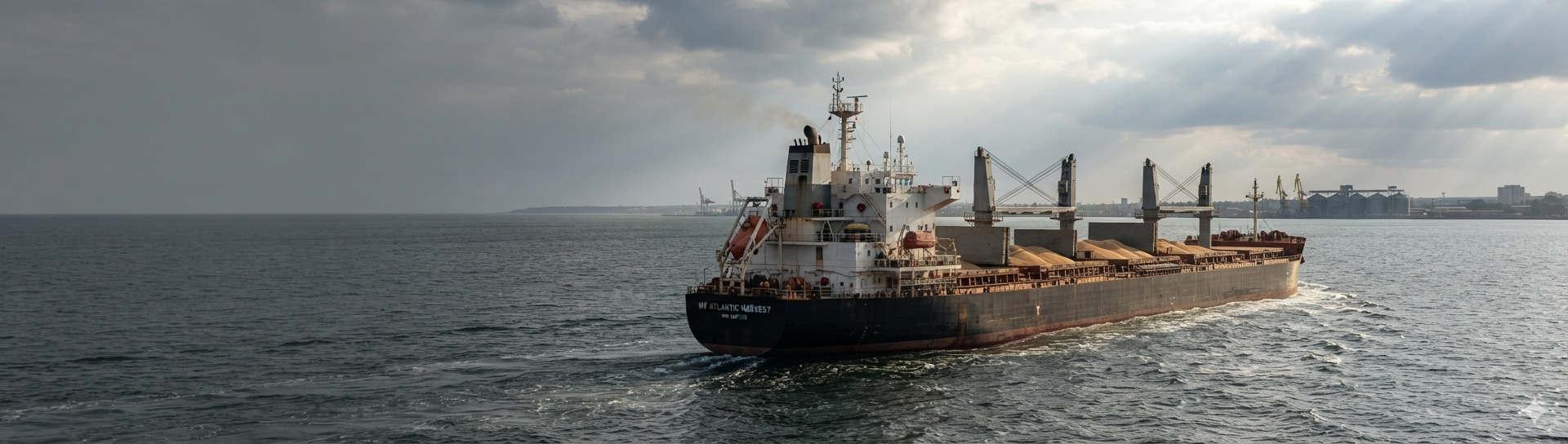
While global attention over the past few weeks has been fixed on drought pressures on crops in North America and Europe, the Black Sea has quietly but powerfully reemerged as an epicenter of instability threatening to disrupt global food supply chains. On Monday, August 3, 2026, the Cameroon-flagged Ro-Ro vessel Nadezhda, owned by a Turkish company, was struck by drones approximately 20 nautical miles off Russia's Black Sea port of Novorossiysk. This is not an isolated incident, just one day earlier, another vessel from the same company was also attacked by drones after departing from Novorossiysk. Turkey has already called on Russia and Ukraine to take concrete measures to ensure the safety of civilian navigation, warning that the escalation threatens not only regional stability but also global food security.
Immediate Market Impact and War Risk Premiums
The attack on the Nadezhda comes at a time when war risk insurance premiums for Black Sea routes were already at historically high levels. To put this in perspective, at least five fatal attacks on Turkish vessels were recorded in the region in July 2026 alone, and the Turkish seafarers' union warned that at least 15 seafarers had lost their lives in the Black Sea between late June and July 21. Each new incident further undermines the confidence of insurers, who are increasingly treating the northeastern Black Sea as a heightened risk zone, not just for tankers linked to Russian oil exports but also for dry cargo, including grain, corn, sunflower oil, and fresh fruit and vegetables. For grain traders, the key question is not only the price of the commodity itself but whether shipowners and charterers will be willing to accept new fixtures for ports like Novorossiysk without substantial additional compensation or security guarantees. Any reduction in available tonnage or diversion of vessels to alternative loading points could tighten effective export capacity for Russian wheat and sunflower oil, which would directly lift FOB values in the region.
Operational Implications and Port Congestion
Novorossiysk is not just any port, it is the primary outlet for Russian grain, sunflower oil, and other bulk commodities to the Mediterranean, the Middle East, and Africa. For months, Ukrainian drones have been targeting Russian vessels and oil infrastructure in the area, forcing terminals and refineries to suspend or curtail operations. The attack on the Nadezhda further deepens these operational problems. Higher perceived risk can lead to increased port congestion, as vessels wait for daylight passages, naval escorts, or improved risk assessments before entering or exiting high-risk zones. Some shipowners may temporarily avoid calls at Russian Black Sea ports or demand substantial war-risk compensation, which slows the turnover of grain and vegetable oil cargoes and delays deliveries to buyers who rely on these routes. The Turkish company that owns the Nadezhda has already informed its business partners on August 4 that it is temporarily suspending navigation to Russia, citing serious security risks to maritime transport. While this decision was made at the level of a single company, it could signal a broader trend, if other carriers follow suit, Novorossiysk's export capacity could shrink by 10 to 20 percent in the coming weeks, which would directly lift Black Sea wheat prices.
Commodities Under Pressure, From Grain to Fresh Produce
Although the Nadezhda was carrying fresh fruit and vegetables between Samsun and Novorossiysk, its significance extends beyond one type of cargo. Russia is the world's largest wheat exporter, and Novorossiysk is a key export point. Any hesitation by shipowners to call at the port or logistical slowdowns could tighten supply and support wheat prices at the regional level. Black Sea corn flows, including transshipments and coastal movements, face higher freight rates and stricter risk controls, raising landed costs for importers in the Mediterranean and the Middle East. Russia and Ukraine are also leading exporters of sunflower oil, repeated attacks on tankers and port infrastructure have already disrupted some flows, and increased war-risk pricing could further constrain vegetable oil exports. Even fresh fruit and vegetable cargoes, which require refrigerated containers and fast delivery, are now exposed to higher logistics costs and delays, which will ultimately be reflected in retail prices for Russian consumers.
Regional Trade Implications and Diversion of Flows
On the export side, Russian grain and vegetable oils shipped from Novorossiysk and nearby terminals will face higher freight and insurance costs relative to alternative origins. This could improve the relative competitiveness of EU, US, and South American suppliers for some destinations, particularly where buyers are sensitive to security-related disruptions. Turkey, as a regional maritime hub and a major food importer, finds itself in a unique position, Ankara's call for Russia and Ukraine to guarantee safe navigation reflects its interest in preserving Black Sea trade flows that underpin its role as a bridge between Black Sea producers and Middle Eastern and North African consumers. Importing countries in North Africa and the Middle East, which rely heavily on Black Sea wheat and vegetable oils, may increasingly diversify their procurement or build larger safety stocks if they perceive shipping risks to be trending higher. This could redirect some demand toward safer corridors in the Atlantic and Pacific basins, but with longer transit times and higher landed prices. Already, according to data from the International Food Policy Research Institute from August 3, wheat prices have risen sharply in recent weeks precisely due to the combination of drought and Black Sea shipping disruptions.
Short-Term Market Outlook
In the coming days, traders will closely monitor three key factors. First, whether further attacks on merchant vessels occur near Novorossiysk or along major grain and vegetable oil routes. Second, how war risk classifications and insurance premiums for the northeastern Black Sea will evolve. And third, whether major shipowners and commodity houses will continue to fix vessels for affected ports or follow the example of the Turkish company that has already suspended navigation. In the absence of clear de-escalation or credible security guarantees, a gradual tightening of available tonnage for Russian Black Sea cargoes appears likely, which supports a risk premium in regional FOB prices for wheat and vegetable oils. However, strong competition from other export origins and still relatively ample global stocks of some commodities could limit the magnitude of price moves, unless shipping losses or port closures become more systemic. Interestingly, Chicago wheat recorded a slight decline of 0.4 percent to $6.48 per bushel on August 4, after rising 1.8 percent the previous day, which suggests that the market is still trying to assess whether the attack on the Nadezhda signals a more lasting disruption or just another in a series of incidents already partially discounted in prices.
Conclusion
The drone attack on the Turkish vessel Nadezhda near Novorossiysk is yet another sign that civilian shipping in the Black Sea is increasingly entangled in the Russia-Ukraine conflict, with direct implications for agricultural commodity flows. For now, this event primarily reinforces existing risk premiums in freight and insurance rather than triggering an immediate supply shock. But it seriously erodes confidence in the reliability of one of the world's key food export corridors. Commodity traders, shipowners, and food importers should assume that sporadic disruptions and higher logistics costs will remain a structural feature of Black Sea trade in the coming months. Strategic responses may include diversifying origin portfolios, building greater inventory buffers, and incorporating scenario-based freight and insurance risk into forward pricing and procurement decisions for grains, oilseeds, and vegetable oils. Because what once seemed like a distant threat has now become a daily reality on the busiest maritime route for food in the world.