
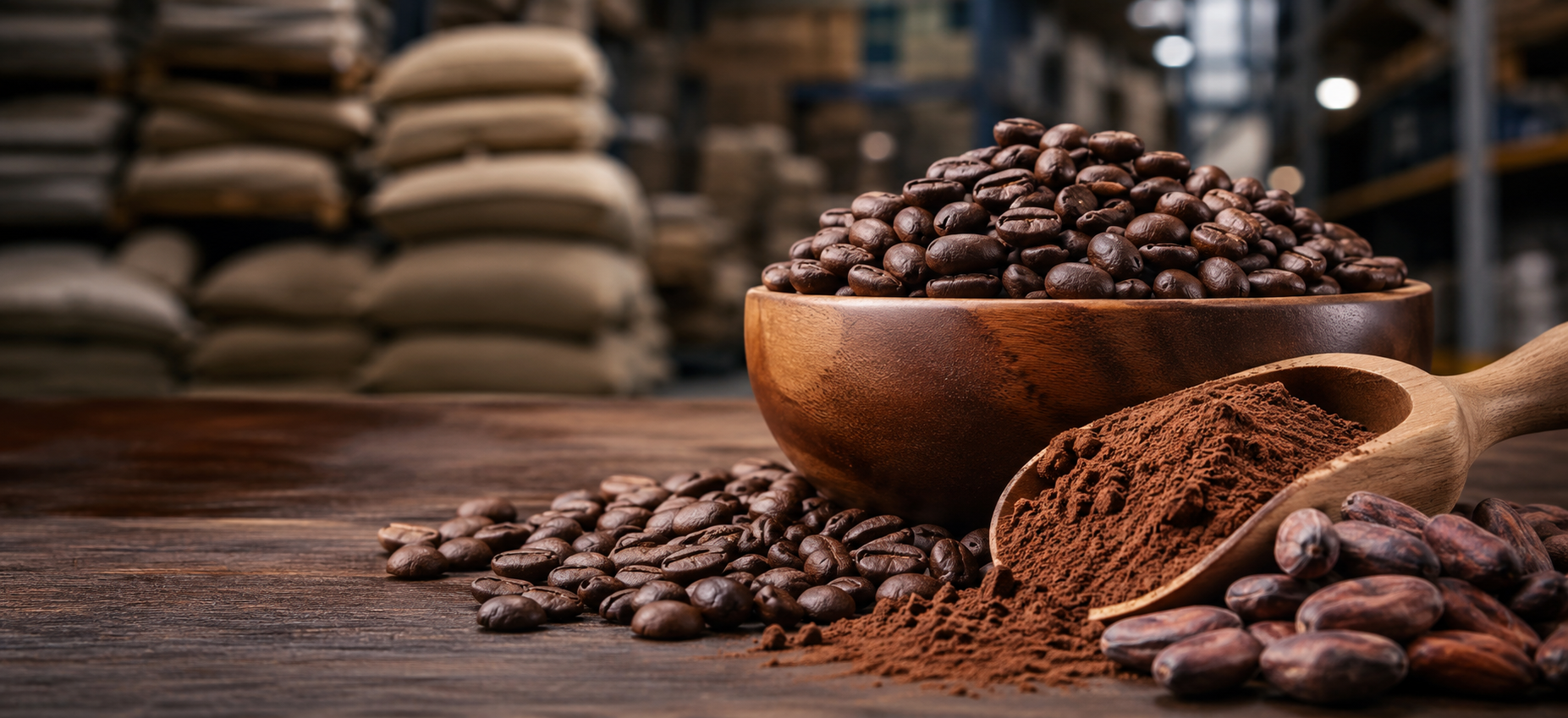
The coffee and cocoa markets are under the greatest pressure in several years. Prices for both commodities surged sharply during July, with the main culprit being the El Niño climate phenomenon, which threatens to disrupt harvests in key regions around the world. Investors are in a state of panic, and analysts warn that this could be just the beginning of a prolonged period of price increases.
What is actually happening in the market?
Coffee futures spiked by as much as 18.5 percent in a single day at the beginning of July, reaching $3.57 per pound. That is the largest intraday rise for this commodity since 2000. The total increase since 10 June stands at an impressive 48 percent. At the same time, cocoa futures rose 13 percent over the same period, hitting their highest level since January this year.
What particularly concerns market participants is the fact that these jumps are largely driven by speculation rather than purely by real problems on the ground. Financial firm StoneX warned that coffee futures have entered “meme stock territory” – a zone where prices are driven by strong speculative activity and massive buying from institutional investors and computer‑driven funds. Aggressive purchases have even overwhelmed heavy selling from producing countries.
Why does El Niño have such a strong impact on coffee and cocoa?
El Niño is a climate phenomenon that alters weather patterns across the planet. The U.S. National Oceanic and Atmospheric Administration confirmed that the phenomenon developed at the beginning of July, and forecasts show a 67 percent chance that this will be a “super El Niño,” among the strongest ever recorded. Some climatologists even estimate that this could be the most powerful El Niño in the last 75 years.
For coffee and cocoa production, this is bad news for several reasons. Brazil, the world's largest producer of arabica coffee, is already facing extreme weather conditions. In the Minas Gerais region, which accounts for the lion's share of global arabica production, unprecedented torrential rains were recorded at the end of June. Rainfall in a single week was nearly 20 times higher than the historical average. This has completely prevented machinery from entering the fields, seriously compromised bean quality, and slowed the harvest to 52 percent, compared with 60 percent at the same time last year. Immediately after that, a complete lack of rainfall followed in early July.
A similar situation is unfolding with cocoa. El Niño brings excessive rainfall to West Africa, a region that produces more than 60 percent of the world's cocoa. These rains, accompanied by dry and hot Harmattan winds, are seriously threatening crops. StoneX has already cut its forecast for the global cocoa surplus for the 2026/27 season to 149,000 tonnes, down from an earlier projection of 267,000 tonnes. Ivory Coast could see production fall to between 1.7 and 1.8 million tonnes, compared with the 2.2 million tonnes previously expected for 2025/26. Every strong El Niño over the past 55 years has reduced global cocoa production.
What does this mean for commercial buyers and producers?
For companies that source coffee and cocoa, this is the moment to rethink their supply strategies. Robusta coffee, which is mainly used for instant coffee and espresso, rose 8.8 percent to $4,044 per tonne. In London, robusta futures for September 2026 climbed $80 to $3,877 per tonne.
Goldman Sachs estimates that the strength of this El Niño could trigger a 15.8 percent spike in global agricultural commodity prices. In the eurozone, that would translate into a 1.3 percent rise in food prices. However, the full effect will not be visible immediately – analysts predict that the consequences will be “fully realised” only in the second half of 2028.
The reason for this delay lies in the different planting, growing and harvesting cycles for various crops, as well as in logistical challenges. Companies that rely on long‑term contracts may not feel the price increases straight away, but new contracts and the replacement of inventories at higher prices will deliver the real blow.
For producers in Brazil and West Africa, the situation is even tougher. Extreme weather conditions not only reduce yields but also threaten bean quality. This means that even what is harvested will likely be of lower quality, which further pushes up prices on the exchanges.
What does the future hold?
Climate models show that the peak of El Niño could occur between November 2026 and January 2027. UBS analysts warn that “even moderate supply disruptions can trigger larger price moves than historical patterns suggest.”
In the meantime, the market remains extremely sensitive to any news about the weather. One European coffee trader commented that some market participants who held short positions were forced to liquidate them to avoid higher margin calls. This only adds to the volatility.
For everyone involved in the coffee and cocoa supply chain, one thing is clear – El Niño has changed the rules of the game, and for the long haul. Prices are likely to remain elevated, and those who do not monitor developments on the ground risk being left without raw materials at favourable prices. It is time to adapt procurement strategies to the new reality.