
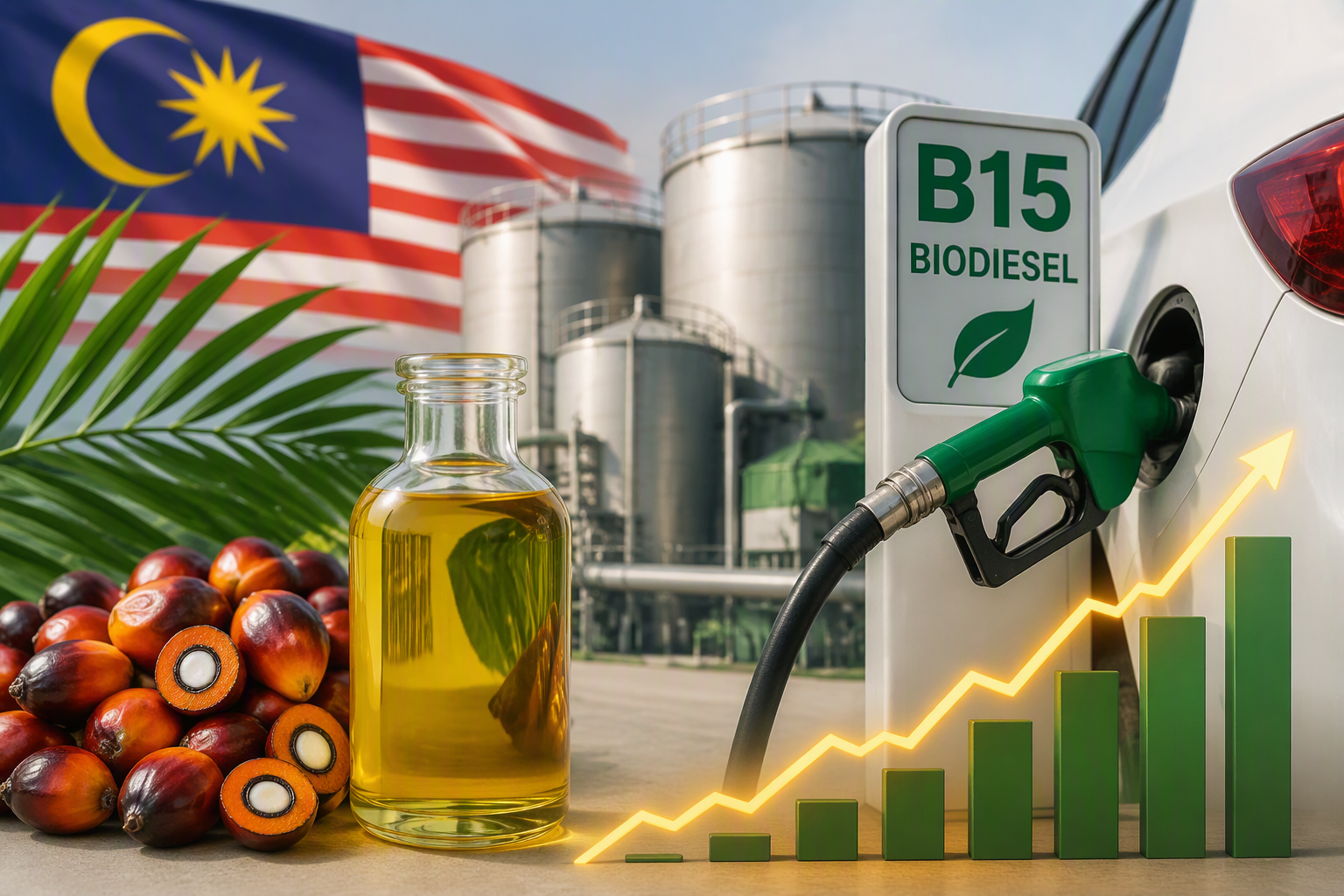
Malaysia, the world's second-largest producer of palm oil, is back in the global market spotlight. The announcement of the mandatory B15 biodiesel blending programme on the domestic market could add approximately 204,000 tonnes per year to domestic demand for crude palm oil (CPO). At a time when Malaysia's ending stocks for 2026/27 are estimated at 2.56 million tonnes, this change has the potential to significantly affect the supply-demand balance. Although B15 alone will not trigger a global shock, it represents a strong supporting factor for palm oil prices in the coming period.
What is B15 biodiesel?
B15 biodiesel refers to a blend of 15 percent biodiesel (produced from palm oil) and 85 percent conventional diesel. Malaysia currently applies B10 (10% biodiesel), and the move to B15 represents the next step in the strategy to increase domestic utilisation of palm oil.
This move is part of a broader policy that Malaysia and Indonesia have been implementing for years:
- Indonesia currently applies B35 and has announced a transition to B40
- Malaysia is on B10 and plans B15
- The goal is to reduce export dependence and stabilise domestic prices
How much is the actual demand increase?
According to S&P Global estimates, the shift from B10 to B15 would increase domestic palm oil consumption by an additional 204,000 tonnes per year. This is not a negligible quantity, but it needs to be viewed in context:
- Malaysia's ending stocks for 2026/27 are estimated at 2.56 million tonnes
- Additional demand of 204,000 tonnes represents about 8 percent of current stocks
- This is enough to reduce export pressure and support prices
How does B15 affect global prices?
Contrary to sensational headlines predicting "collapse" or "explosion" of prices, a more realistic scenario is a gradual supporting effect:
- Reduction of export surplus - additional domestic consumption absorbs part of the production that would otherwise go to exports, reducing supply on the global market.
- Support at lower price levels - B15 acts as a "safety net" that prevents excessive price falls, but does not necessarily push them to record highs.
- Psychological effect - the B15 announcement already influences market expectations and participant positioning, further supporting prices.
- Regional factor - Malaysia and Indonesia together account for about 85 percent of global palm oil production. Coordinated policies of these two countries have a significant impact on the global market.
Why B15 will not trigger a spike in global prices?
It is important to maintain a realistic perspective:
- Additional demand of 204,000 tonnes is significant, but not enough to cause a dramatic price surge
- The global palm oil market is about 80 million tonnes annually
- B15's share in the global context is relatively small
- Other factors (weather, production in Indonesia, prices of competing oils) have a greater impact
Link to competing oil prices
Palm oil prices do not exist in a vacuum. B15 comes at a time when:
- Soybean oil prices are rising
- Sunflower oil production in the Black Sea region is under pressure
- The global vegetable oil price index is rising
The combination of B15 with these factors creates a synergistic effect that further supports prices.
Is B15 safely implementable?
Although the B15 announcement is positive for the market, there are implementation challenges:
- Infrastructure – B15 distribution requires adapted logistics and storage
- Vehicle compatibility – older engines may have issues with higher biodiesel content
- Costs – B15 is more expensive than conventional diesel, which may cause consumer resistance
- Subsidies – the Malaysian government will need to provide subsidies to keep B15 price competitive
What does this mean for palm oil buyers?
For palm oil buyers, B15 represents a factor to consider when planning procurement:
- Expect more stable prices – B15 reduces the risk of sharp price declines
- Monitor implementation – the start date and implementation dynamics are key
- Consider long-term contracts – in conditions of supporting factors, long-term price fixing may be advantageous
- Alternative sources – if palm oil prices rise, consider switching to soybean or sunflower oil
Conclusion
Malaysia's B15 biodiesel will not cause a dramatic spike in global palm oil prices, but it will certainly represent a significant supporting factor. Additional domestic demand of 204,000 tonnes per year reduces export surplus, supports prices, and provides a safety net for the market. Combined with rising prices of competing oils and geopolitical risks in the Black Sea, B15 contributes to a positive outlook for palm oil producers. For buyers, this means that prices are unlikely to decline significantly, but neither will they explode, rather, they will move in a more stable, higher range. The key is to monitor further implementation developments and adjust procurement strategy to the new situation.