
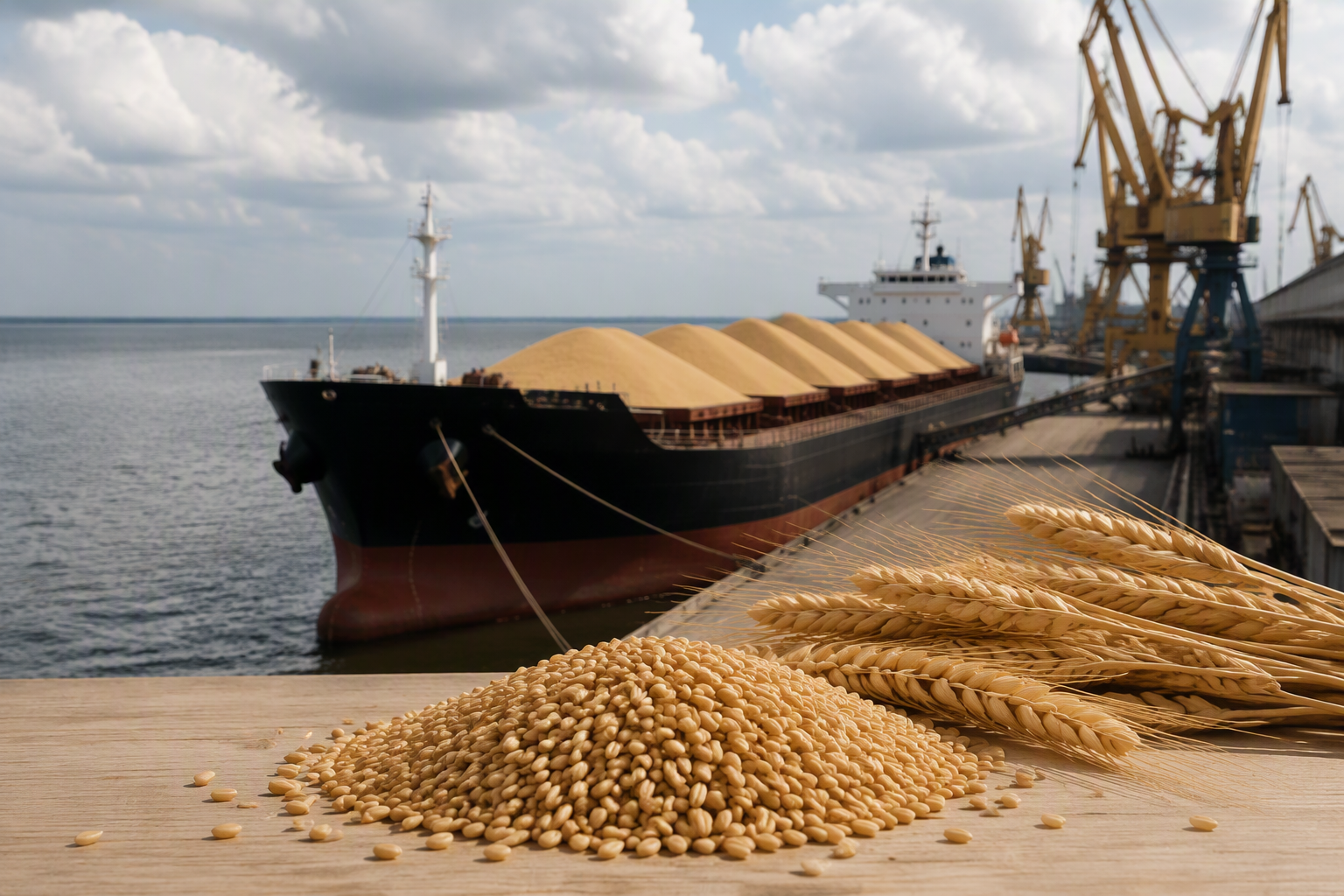
The Black Sea is once again becoming the epicenter of global food trade. Intensified Russian attacks on Ukrainian Black Sea ports and simultaneous Ukrainian strikes on Russian vessels in the Sea of Azov have created a situation the market has not seen since the start of the war. Export capacities have been reduced, shipowners are refusing to sail, prices are rising, and procurement is becoming increasingly risky. For anyone buying wheat, corn, or sunflower – this is not just news to follow, but a signal to urgently reassess supply strategy.
What Happened in Ukrainian Ports?
In recent weeks, Russia has intensified systematic missile and drone attacks on port infrastructure in the Odesa region. According to the Ukrainian Agrarian Council (UAC), Russia has begun systematically targeting port infrastructure, terminals, and the entire transport and logistics chain, continuously using ballistic missiles.
The attacks are not sporadic – they have been ongoing for days. Oleh Kiper, Governor of the Odesa region, stated that a "massive" Russian attack on the region lasted for the fifth consecutive day, targeting civilian, industrial, and port infrastructure. On July 19 alone, Russian forces struck an international cargo ship in the Black Sea, killing at least five crew members, with five more still missing. A day earlier, one person was killed in an attack on the port of Odesa, and the day before that, three people died in attacks on Odesa and Mykolaiv.
How Much Has Export Capacity Really Been Reduced?
Before the attacks, the three key Black Sea ports in the Odesa region transshipped approximately six million tons of cargo per month. Now, this capacity has fallen to just four million tons per month – a loss of one-third. Behind this figure are concrete impacts:
- Four out of 13 large grain terminals have suspended grain purchases
- Kernel, Ukraine's largest grain exporter, suspended operations at the Chornomorsk port due to a series of Russian attacks
- The number of railcars with grain heading to Odesa ports fell by 11 percent in the week of July 2–8 compared to the previous week, while exports themselves fell by 17 percent
Why Are Russian Wheat Exports Also Affected?
This is not just a Ukrainian problem. Russia, the world's largest wheat exporter, accounting for about 20 percent of global exports, is facing its own challenges. Ukrainian drones hit 20 Russian ships in the Black Sea over a single night, while in the Sea of Azov, as many as 116 vessels were struck during July.
These attacks have forced Russia to restrict shipping in the Sea of Azov – a route that typically handles about one-quarter of Russian grain exports. As a result, analysts have lowered their forecast for Russian wheat exports for July by 20 percent.
According to a French broker speaking to Platts, market participants increasingly believe that the current price increase is not another temporary Black Sea disruption but could represent a more prolonged market shift.
Impact on Prices, Freight Rates, Insurance, and Delivery Timelines
The combination of these developments has already triggered a wave of price increases:
- French wheat (FOB) was assessed on July 14 at €219.25 per ton – the highest level since Platts began assessing this market in July 2025
- Euronext wheat prices rose by four percent, reaching a six-week high
- Since the beginning of July, 901,300 tons of grain have been delivered to Ukrainian ports, less than in the same period the previous month
Beyond the commodity price itself, logistics costs are also rising. Shipowners are increasingly reluctant to sail into Ukrainian ports due to fears of further attacks, driving up freight rates. At the same time, the cost of war risk insurance for vessels in the region is increasing, which flows directly into the final delivered price of goods. Traders are facing problems with procurement, sales, shipment, accumulation of goods, and pricing.
What Can the European Harvest Compensate For – and What Can't It?
The European wheat harvest is underway, but it does not bring relief. The heatwave affecting the EU is further threatening crops. The French soft wheat harvest has progressed to 59 percent, but yield estimates have been reduced. The European Grain and Oilseed Traders' Association has lowered its production forecast for wheat (excluding durum) to 140.8 million tons, compared to the previous estimate of 143.7 million and significantly lower than the 149.8 million tons in 2025.
In other words, the European harvest cannot compensate for the Black Sea disruptions – and is itself under pressure. Meanwhile, Ukraine, which in recent seasons accounted for about 6 percent of global wheat exports and about 11 percent of global corn exports, cannot be easily replaced.
Recommendations for Procurement
In these conditions, monitoring only the exchange price is not enough. Buyers must verify the following:
- Loading port and alternative routes – is the cargo scheduled from a port under attack? Is there the possibility of redirecting to Danube ports or via Romania?
- Offer validity and delivery period – many offers may no longer be valid within the stated timeframe. Check whether the supplier is able to deliver within the agreed period.
- Freight and war risk insurance – are these costs included in the price? Is there a possibility they will be charged additionally later?
- Partial deliveries – is it possible to agree on smaller quantity deliveries to reduce risk per shipment?
- Alternative origin – consider additional sources from Romania, Bulgaria, France, or Hungary. Although prices are higher, supply security may be worth that premium.
Conclusion
The Black Sea has once again become a "black spot" for global food supply. Ukraine has lost one-third of its export capacity, Russia has been forced to restrict navigation in the Sea of Azov, and wheat prices are at multi-year highs. Additional pressure comes from Europe, where the heatwave is reducing yields.
For anyone involved in grain procurement – whether you are a processor, trader, or feed manufacturer – this is the moment to reassess your supply chains. Risks have increased, and prices have started moving upward. Those who recognize the signals in time and adjust their strategy will have an advantage in the coming months. Those who remain passive risk being left without goods or paying significantly higher prices.