
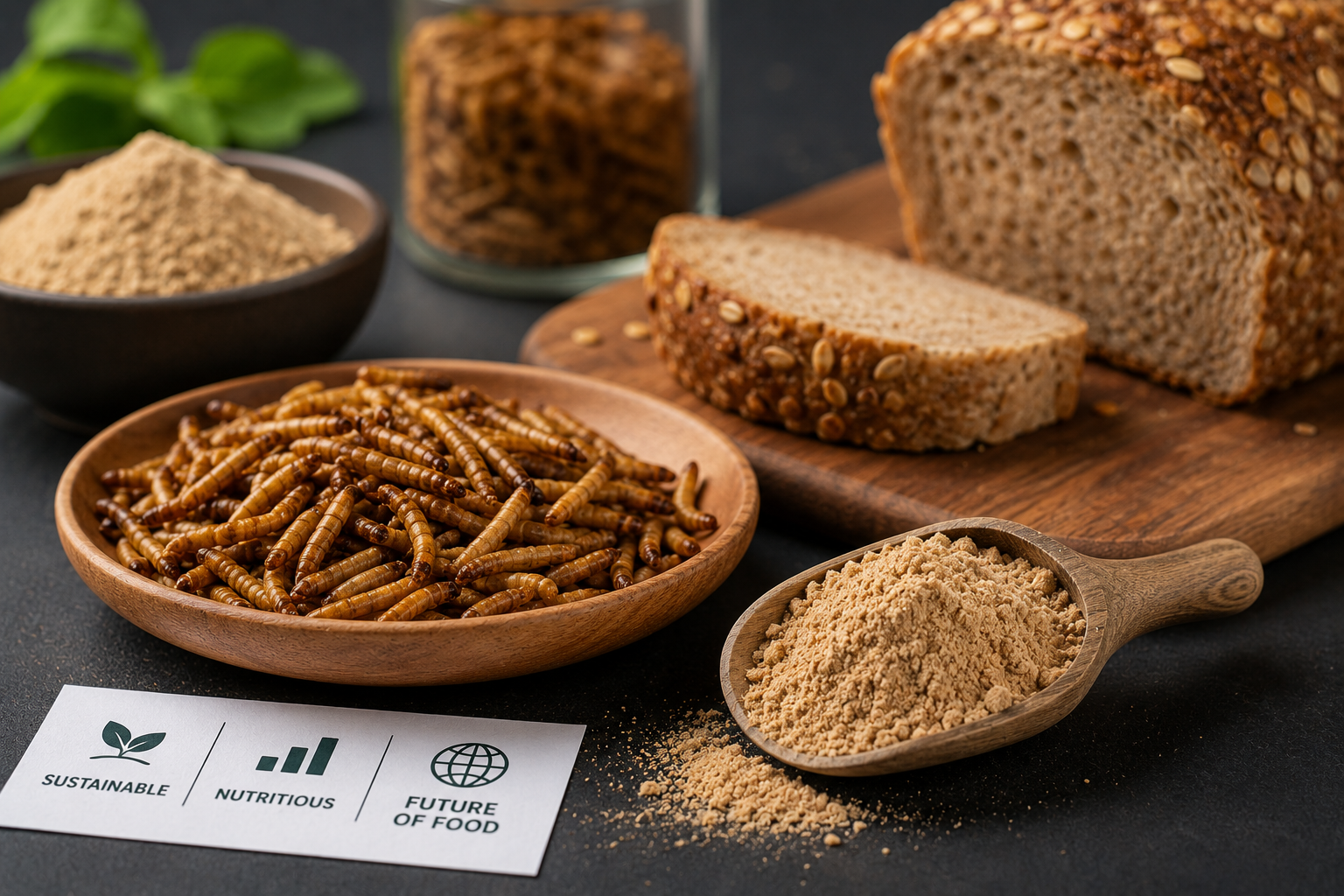
Imagine a scenario where the bread, pasta, or even jams you eat are produced with the addition of insect flour. This is no longer science fiction. At the beginning of 2025, the European Union officially approved the use of UV-treated powder from yellow mealworm larvae (Tenebrio molitor) as a novel food. While news about "insects in food" has sparked strong reactions, the reality is far from sensationalism. The EU is not forcing anyone to eat insects; it is simply opening the door to innovations that could address one of the key challenges of the 21st century – how to feed a growing global population in a sustainable way.
What Has Actually Been Approved?
The European Union has so far approved several insect species for use in food:
- House cricket (Acheta domesticus)
- Migratory locust (Locusta migratoria)
- Yellow mealworm (Tenebrio molitor) – larvae
- Lesser mealworm (Alphitobius diaperinus) – larvae
These insects can be used in various forms – frozen, dried, as a paste, or in powder form. Under the new regulation, bread and rolls can contain up to 4 grams of mealworm flour per 100 grams of product, while cakes can contain up to 3.5 grams. Products must be clearly labelled, with a mandatory warning for individuals allergic to crustaceans and dust mites.
Which Raw Materials Are Needed for Production?
Unlike conventional livestock farming, the supply chain for insects is completely different and involves specific inputs:
Substrate for Rearing (Insect Feed)
This is the most important raw material and simultaneously the largest cost. Insects are extremely efficient at converting organic matter into protein. Agricultural by-products (brewers' spent grain, fruit and vegetable processing residues, corn and soybean meal), food industry waste, and specific mixtures tailored to the species can be used as substrate. The key parameter is the carbon-to-nitrogen ratio, which for optimal growth should be in the range of 14:1 to 18:1.
Rearing and Processing Equipment
Insect protein production requires specialized equipment – climate-controlled chambers with regulated temperature, humidity, and lighting, drying systems, milling and protein fractionation equipment, as well as systems for separating proteins, lipids, and chitin. Companies such as Alfa Laval and Hosokawa already offer solutions for industrial processing.
Additives and Enhancers
Depending on the final product, enzymes for flavour modulation, preservatives, and ingredients for texture improvement may be required.
Why Are Insects Attractive?
The nutritional profile of insects is impressive. In dried form, they contain a high percentage of protein, often higher than conventional meat. They are rich in essential amino acids, minerals (iron, zinc), and vitamin B12. From an environmental perspective, insect farming requires significantly less land, water, and feed compared to cattle or pigs, with considerably lower greenhouse gas emissions.
Market Potential
The edible insect market is experiencing explosive growth. The global market is projected to grow from $2.22 billion in 2025 to over $16 billion by 2034, with an annual growth rate of over 25 percent. Companies such as Poland's HiProMine are already planning production capacities of 50,000 to 60,000 tonnes per year.
But Let's Be Realistic – Where Are the Problems?
For all the enthusiasm, there are several serious reasons for caution.
First, the price. Farmed insects are currently more expensive than soy flour or conventional protein sources. Until this ratio becomes more favourable, mass adoption in an industry that is extremely sensitive to input costs will be difficult to expect.
Second, consumer resistance. Although the EU insists on clear labelling, surveys show that the majority of Europeans remain sceptical about insects in food. The "yuck factor" is a serious barrier that marketing cannot easily overcome. Have you ever seen an advertisement for bread with mealworm flour? You probably won't anytime soon.
Third, allergens. People allergic to crustaceans, molluscs, and dust mites may also react to insect proteins. This is not a small group. Manufacturers must be careful about cross-contamination in production facilities, which further complicates manufacturing.
Fourth, the regulatory framework is still in its infancy. Each new insect species or new method of use requires separate approval. This slow and costly process can slow down innovation and increase uncertainty for manufacturers considering investment.
Finally, the question remains – is this really a solution for global nutrition or just another passing trend? Let's not forget that algae proteins were also touted as the next big thing, but they have yet to gain traction in mass production.
Conclusion
Edible insects as a protein source are no longer a futuristic topic but a reality slowly entering the European food industry. The EU has opened the door, and the market is responding with growth and investment. However, the path to mass adoption is long and full of obstacles. High cost, consumer resistance, allergens, and regulatory uncertainties are serious challenges that should not be taken lightly. For food manufacturers and procurement professionals, this is a time to monitor developments. The question is not whether this will happen, but when – and the answer to that question may not be as close as some enthusiasts would like to present.