
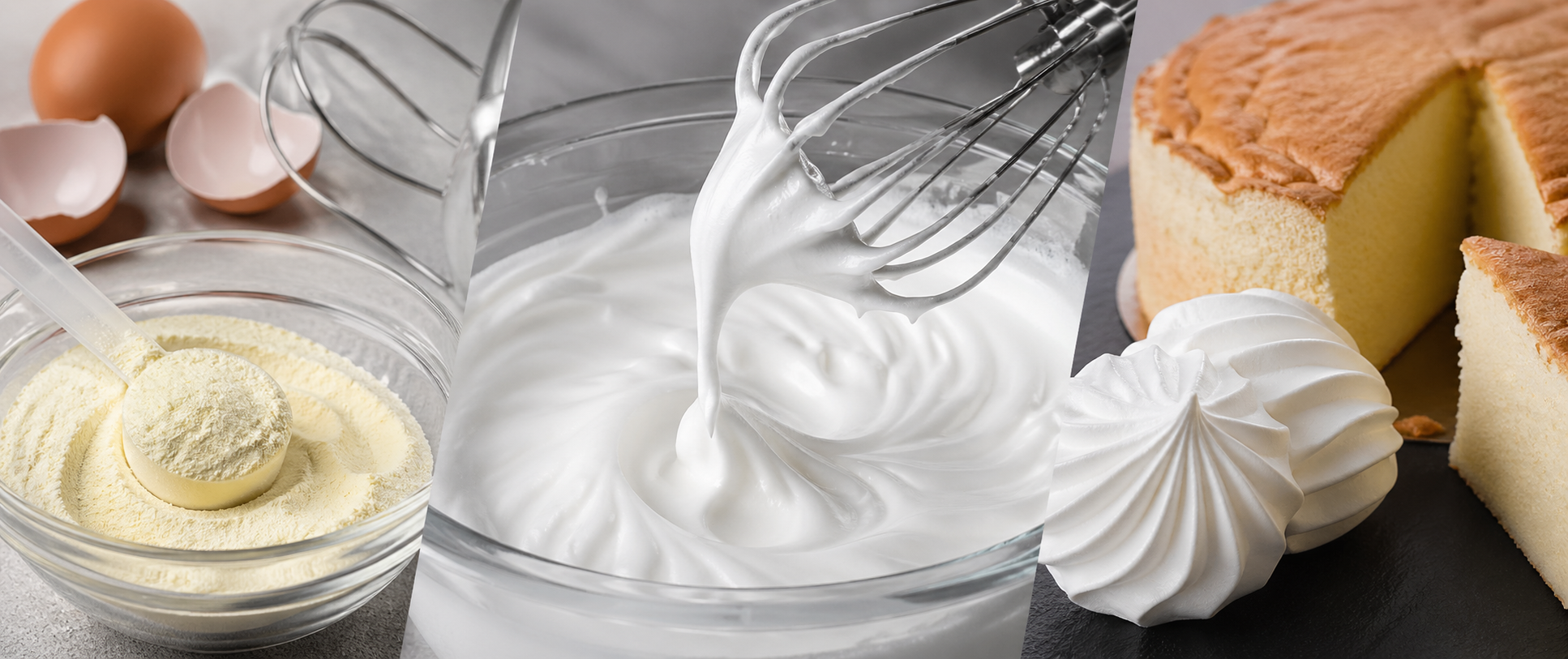
Aerated confectionery products such as meringues, macarons, aerated fillings for biscuits and cakes, whipped toppings and foams depend heavily on egg white functionality. In industrial production, liquid egg white is increasingly replaced with egg white powder due to longer shelf life, easier logistics and better microbiological safety. At the same time, this substitution raises a number of technological questions: how exactly does egg white powder influence foam formation, how stable is the foam during processing and baking, and how does it affect texture, porosity and shelf life.
Understanding the role of egg white powder in foaming systems is crucial for confectionery technologists aiming to achieve high and stable foam, fine structure and consistent quality from batch to batch.
Protein structure of egg white and the basis of foam formation
Egg white proteins, primarily ovalbumin, ovotransferrin and other fractions, are amphiphilic molecules with both hydrophilic and hydrophobic segments. During whipping, they migrate to the air–water interface, partially denature and reorganise into an elastic film that coats the air bubbles.
In egg white powder, these same proteins undergo drying and thermal treatment. This step can change their solubility, initial degree of denaturation and adsorption rate at the interface. A well-designed egg white powder retains the ability to rehydrate effectively and form a cohesive film around bubbles, which is a prerequisite for high and stable foam.
The elasticity, strength and cohesion of the protein film determine whether the foam will withstand mechanical stress during deposit, transport on the line and thermal treatment typical for confectionery production.
Rehydration of egg white powder – the first condition for good foam
For proteins from egg white powder to fully express their functionality, they must be properly rehydrated. If rehydration is incomplete, part of the proteins remains practically “inactive”, which leads to poorer air incorporation, lower foam height and a less stable structure.
For aerated confectionery products, rehydration is a dedicated technological step. Water temperature, hydration time and mixing intensity of the solution before whipping affect the rate and completeness of dissolution. A typical approach is to add egg white powder into water with moderate mixing, avoiding overly aggressive shear, and then allow it to rest for a defined time so that the proteins fully hydrate.
The quality of this step directly affects the initial rate of foam formation. Sufficiently hydrated proteins migrate faster to the bubble surface, form the film and provide higher foam volume under the same whipping conditions. In industry, it is useful to treat rehydration as a key process parameter with clearly defined time and temperature, not as an incidental operation.
Foam formation: behaviour of egg white powder during whipping
During whipping, egg white powder in solution performs two key functions: it enables incorporation of large amounts of air into the system and stabilises the newly formed bubbles. In the early stages of whipping, the foam formation rate dominates, while stability is not yet at its maximum. As whipping continues, the protein film becomes thicker, more elastic and better crosslinked, which increases the foam’s ability to retain its volume.
A characteristic of confectionery systems is high sugar content, presence of acids and often other components that affect rheology. Egg white powder must function within these constraints and, despite high solids and increased viscosity, enable formation of numerous fine air bubbles.
In products such as meringues and macarons, high foam volume combined with relatively fine structure depends directly on the performance of egg white powder. Whipping parameters such as speed, time and mass temperature must be aligned with the ability of egg white to build foam. Too aggressive or too long whipping can lead to structural breakdown, water release from the film and ultimately foam destabilisation.
Foam stability before baking – protein–sugar relationship
After formation, the foam must withstand a period of standing and handling: holding in tanks, transport through pipes or hoses and depositing into shapes or moulds. In this phase, in addition to egg white proteins, sugars present in the confectionery formulation are key.
Proteins from egg white powder provide the basic network around bubbles, while sugars influence the viscosity of the aqueous phase and its ability to retain water. Higher viscosity slows down drainage of water from upper to lower layers, so the bubbles remain stable for longer. The protein film does not stretch beyond its elasticity limit, so the foam does not lose significant volume before entering the oven or dryer.
Sucrose, dextrose, glucose syrup powder and maltodextrin have different effects on rheology and crystallisation, but in combination with egg white powder they create a matrix that dictates foam behaviour. A well-designed confectionery formulation implies a harmonised ratio of egg white powder to type and level of sugars, so that sufficient protein film strength and optimal density of the aqueous phase are achieved.
Transition from foam to solid confectionery structure
The critical stage in aerated confectionery products is baking or drying. For meringues and macarons, temperatures are relatively low and times extended, to slowly remove water while proteins and sugars form a firm but not overly brittle structure.
Egg white powder proteins further denature during thermal treatment and form a three-dimensional protein network that “locks” air bubbles in place. At the same time, sugars dissolve, redistribute and influence whether the final structure is more crystalline or amorphous. Stable foam at this stage means that bubbles do not rupture massively, do not coalesce into large voids and that there is no significant collapse in product height.
If the protein film formed from egg white powder is too thin or mechanically weak, bubbles may rupture already in the early baking phase, causing sinkage and large pores. If, on the other hand, the film is too thick and rigid, the texture may become hard and brittle, with a glassy fracture on biting. Aligning egg white powder dosage, sugar level and baking regime (temperature profile, baking time and drying phases) is therefore central to product development.
Fine foam structure and impact on sensory properties
Consumers often intuitively evaluate the quality of aerated confectionery products through appearance and mouthfeel: fine and uniform porosity, absence of large voids, pleasant crispness and melting in the mouth. Egg white powder has a direct impact on these characteristics.
Fine porosity is achieved when whipping generates a large number of small bubbles evenly distributed throughout the matrix. For this, egg white powder must exhibit good solubility, adequate adsorption rate at the interface and a sufficiently stable film under small deformations. In systems with higher sugar content and potential hydrocolloids, the desired fine structure is achieved by combining an optimised whipping profile and controlled mass viscosity.
Sensory properties are also influenced by how the protein network fractures on biting. An elastic but not rubbery structure of proteins and sugars provides the desirable crisp fracture and gradual melting in meringues and macarons. An overly rigid network can give a glassy, sudden break, while too soft a structure results in a chewy impression. Adjusting egg white powder level, the type and ratio of sugars and any hydrocolloids allows fine control of these sensory nuances.
Interactions with hydrocolloids and starch in foamed systems
In modern aerated confectionery systems, especially in creamy aerated fillings, hydrocolloids and modified starches are often used in addition to egg white powder and sugars. Their role is to further control viscosity, drainage, syneresis and stability during storage.
Egg white powder provides the basic protein network around bubbles, while xanthan gum, guar gum, locust bean gum or modified starch enhance water retention and prevent syrup separation from the structure over time. In creamy foams, this combination yields stable systems that do not significantly change shape and texture throughout shelf life.
In meringues and macarons, hydrocolloids are less frequently used, but carefully dosed additions can correct mass rheology, shell formation, cracking behaviour and occurrence of voids. It is crucial not to impair the foaming ability of egg white powder, so pilot trials with small dosage adjustments are necessary.
Practical focus for development of aerated confectionery
Looking at the entire process chain, it becomes clear that egg white powder is not just a “protein source”, but a tool for precise foam engineering. In practice, this means that key parameters must be considered together: quality and type of egg white powder, rehydration regime and time, whipping profile, egg white-to-sugar ratio, presence of hydrocolloids and modified starch, and the baking or drying programme.
Establishing an internal functional test for each new batch of egg white powder (standard formulation, defined whipping regime, measurement of foam volume and stability) helps translate raw material variability into small recipe or process adjustments. In this way, aerated confectionery products remain consistent, and egg white powder becomes a reliable carrier of volume, texture and stability throughout the entire product life cycle.