
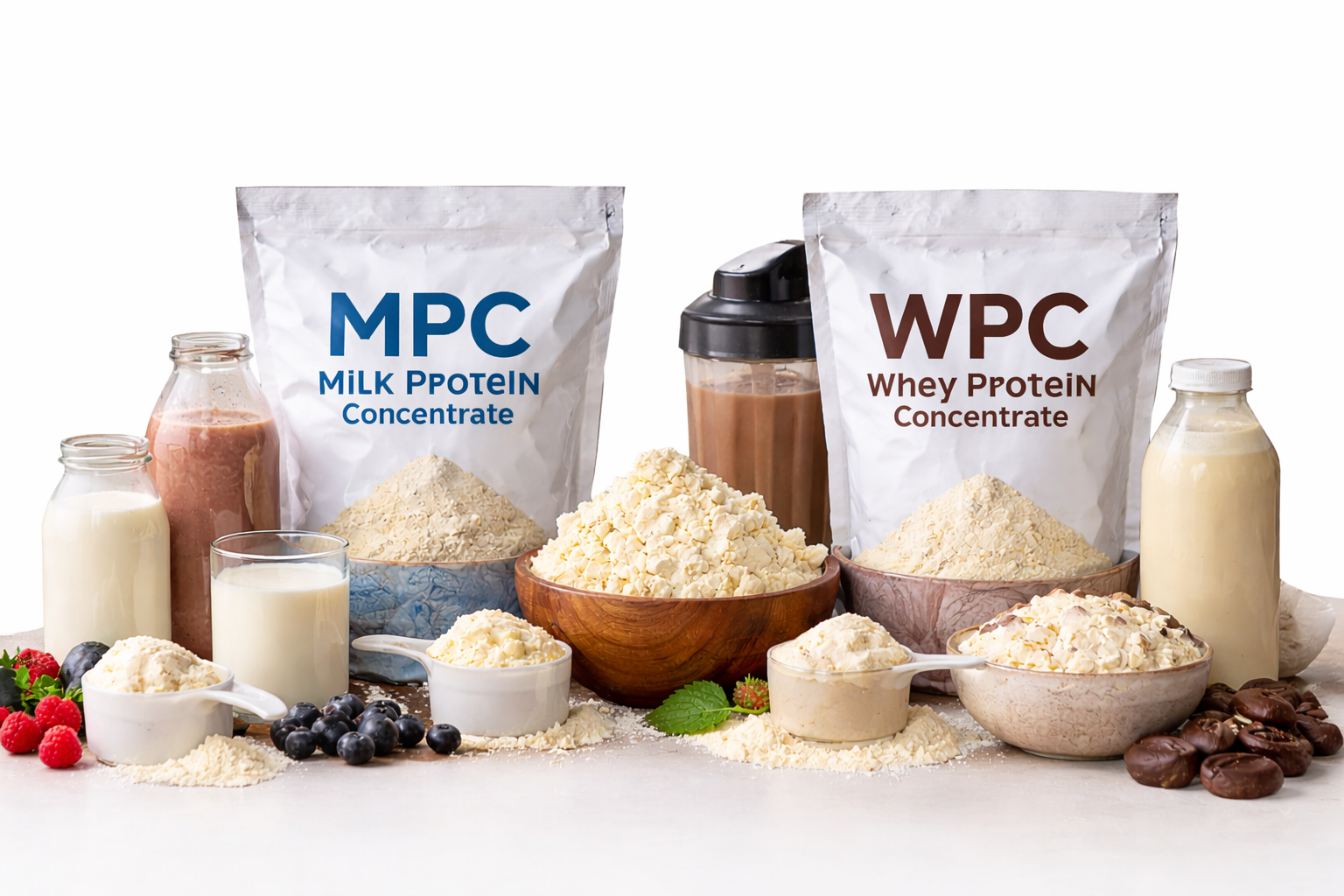
Protein drinks, high‑protein yogurts and dairy desserts are now a standard part of major manufacturers’ assortments. Behind these products lies a simple question that is technologically quite complex: how to ensure a high protein content while keeping texture, stability and taste at a level consumers will accept. At the center of this dilemma are usually two ingredients – MPC (milk protein concentrate) and WPC (whey protein concentrate).
A common mistake in practice is to treat MPC and WPC as mutually interchangeable proteins. This approach often leads to sediment in bottles, rubbery yogurt texture, syneresis or a sandy mouthfeel. The following sections focus on the differences that actually impact formulation and processing, with an emphasis on drinks, yogurts and protein‑enriched products.
What MPC and WPC really are
MPC comes directly from milk. Through membrane filtration, part of the lactose and minerals is removed while proteins are concentrated. The key point is that the casein:whey protein ratio remains approximately the same as in milk. This gives MPC milk‑like behavior and functionality, but with a higher protein level.
WPC is a product of whey, a by‑product of cheese or casein production. WPC is dominated by whey proteins, while casein is practically absent. WPC can have different protein levels (e.g. 35%, 50%, 80%), which affects nutritional density but also functional properties.
For product development, it is important not to look at MPC and WPC only through the percentage of protein, but through the structure they build: casein from MPC is the main builder of gel networks, while whey proteins from WPC primarily contribute to solubility and fine textural adjustments.
Solubility in beverages: WPC has the edge
In protein drinks, especially RTD, solubility and absence of sediment are critical for consumer experience. WPC generally hydrates more easily, forms a fine dispersion and provides a smooth texture, assuming it is added and hydrated correctly. This makes it suitable for lines with limited mixing time and without complex hydration systems.
Because of its high casein content, MPC hydrates more slowly and is more sensitive to the way it is dispersed. Inadequate hydration leads to lumps and sandy mouthfeel. In drinks this is seen as non‑uniform cloudiness and sedimentation during storage.
In neutral protein beverages, WPC is the most common choice as a protein base, while MPC is introduced selectively when a fuller, more “milky” character and higher viscosity are required.
Heat treatment and stability
In products undergoing UHT, high pasteurization or sterilization, protein behavior under heat is critical.
Whey proteins from WPC denature at lower temperatures and form aggregates in the process. Under mild conditions this can contribute to a creamier texture, but in UHT drinks it can lead to sandy mouthfeel, increased viscosity or coagulation during storage.
Casein from MPC is more heat‑stable at neutral pH. This can help reduce the risk of extreme denaturation in some RTD systems, but only if pH, mineral balance and overall formulation are carefully controlled. Otherwise, unwanted gelling may occur, with a “pudding in a bottle” effect.
In demanding RTD concepts, a combination of MPC and WPC is often used, with a precisely defined heating profile, controlled pH (often slightly below neutral) and, if necessary, stabilizers. The simple decision “MPC or WPC” without considering heat treatment usually results in an unstable product.
MPC in yogurts: the backbone of firm structure
Yogurt is essentially a casein gel, so MPC is a logical ingredient for high‑protein variants. Increasing the MPC content raises the casein concentration before fermentation, which during acidification leads to a denser, firmer network.
The result is yogurts with higher firmness, lower tendency to syneresis and better water‑holding capacity. For Greek‑style and high‑protein yogurts, MPC is in practice almost a standard route to high protein levels without extreme concentration or water evaporation.
With MPC, it is often possible to achieve the desired texture and stability without heavy use of starches or hydrocolloids, which is an advantage in terms of labeling and consumer perception.
WPC in yogurts: textural fine‑tuning
Whey proteins do not build the main backbone of yogurt, but they can significantly affect fine texture and water‑holding if incorporated correctly into the process.
When WPC is denatured before or during heat treatment prior to fermentation, whey proteins bond to the casein network and improve water retention. This reduces syneresis and yields a softer, creamier texture, particularly important for spoonable and “premium” yogurts.
However, excessively high WPC levels without optimized heat treatment can result in yogurt with a rubbery or slimy structure and a higher tendency to whey separation during shelf life. For this reason, WPC in this category is most often a complement to MPC, not its direct replacement.
Protein drinks and RTD products: typical formulation strategies
In RTD protein drinks, the goals are relatively similar: 20–30 g of protein per serving, as low viscosity as feasible, smooth texture and stability throughout shelf life.
For sports‑oriented products, which consumers perceive as a ready‑to‑drink version of a protein shake, WPC is a natural choice. Solubility is good, the flavor profile is easy to adjust, and consumer expectations are already aligned with a whey‑type product.
In drinks that should be closer to a milkshake or dessert, with pronounced body and creaminess, MPC becomes more important. In practice, a combination is used: WPC for easy mixing, smoothness and efficient protein boost, MPC for body and dairy character. The ratio of these two proteins is often a key development parameter and directly influences required homogenization pressure and UHT profile.
For clear protein beverages, casein from MPC is a problem due to cloudiness and milky color, so reliance on special WPC fractions is standard.
Sensory aspects: how the difference feels in the mouth
MPC delivers a flavor profile and mouthfeel that is close to milk. In yogurts, puddings and dairy desserts this is a major advantage: the product feels naturally dairy, with a stable yet pleasant resistance when spooned or swallowed.
WPC provides smoothness but a somewhat lighter, “thinner” mouthfeel. In sports drinks this is often desirable, as the product is perceived as a functional beverage, not a dessert. In neutral dairy drinks, too high a WPC fraction may require more careful flavor work to avoid an undesirable whey note.
In practice, when the target is a broad consumer audience, MPC is used to set the basic dairy character, while WPC is used to adjust texture and bring total protein content up to the desired level.
Declaration and product positioning
From a regulatory standpoint, both ingredients are clearly dairy and carry the same allergen status. Differences are more related to perception.
Products designed for everyday consumption, families or seniors are easier to position as “milk‑based protein sources” when they rely on MPC, precisely because it is sensorially and conceptually closer to milk. WPC is still associated in many consumers’ minds with sports supplements and the fitness segment.
If the goal is to communicate the product as a dairy dessert with added nutritional value, MPC helps make that message more convincing. When targeting the sports or performance niche, WPC is fully accepted and even expected.
Key guidelines for choice in new product development
For yogurts and fermented drinks, MPC is the primary tool to increase protein content and gel stability, while WPC is used to fine‑tune texture and reduce syneresis.
For neutral RTD protein drinks, WPC is the starting point due to solubility, and MPC is introduced to achieve dairy body and differentiation from a typical “sports shake”. The MPC:WPC ratio directly affects viscosity, required homogenization and sensitivity to UHT.
For protein puddings and desserts, combinations are practically standard: MPC builds structure, WPC allows high protein levels without excessively firm or rubbery texture.
In all cases, the decision should not be reduced to cost per kilogram of protein, but to how a specific MPC or WPC fits into the entire system: pH, type of heat treatment, target viscosity, sensory expectations and planned on‑pack communication.
What this means for your next development project
If you are developing a high‑protein yogurt, MPC should be the first protein you consider, with possible WPC supplementation to adjust texture. For an RTD protein drink, you will most likely need WPC as a base, with careful testing of whether a smaller MPC addition can improve mouthfeel without causing stability issues.
Understanding the roles of casein and whey proteins in product structure allows MPC and WPC to be treated as complementary tools rather than just two rows in an Excel sheet with different prices per kilogram. Seen this way, the chances that your first industrial trial runs without surprises become significantly higher.