
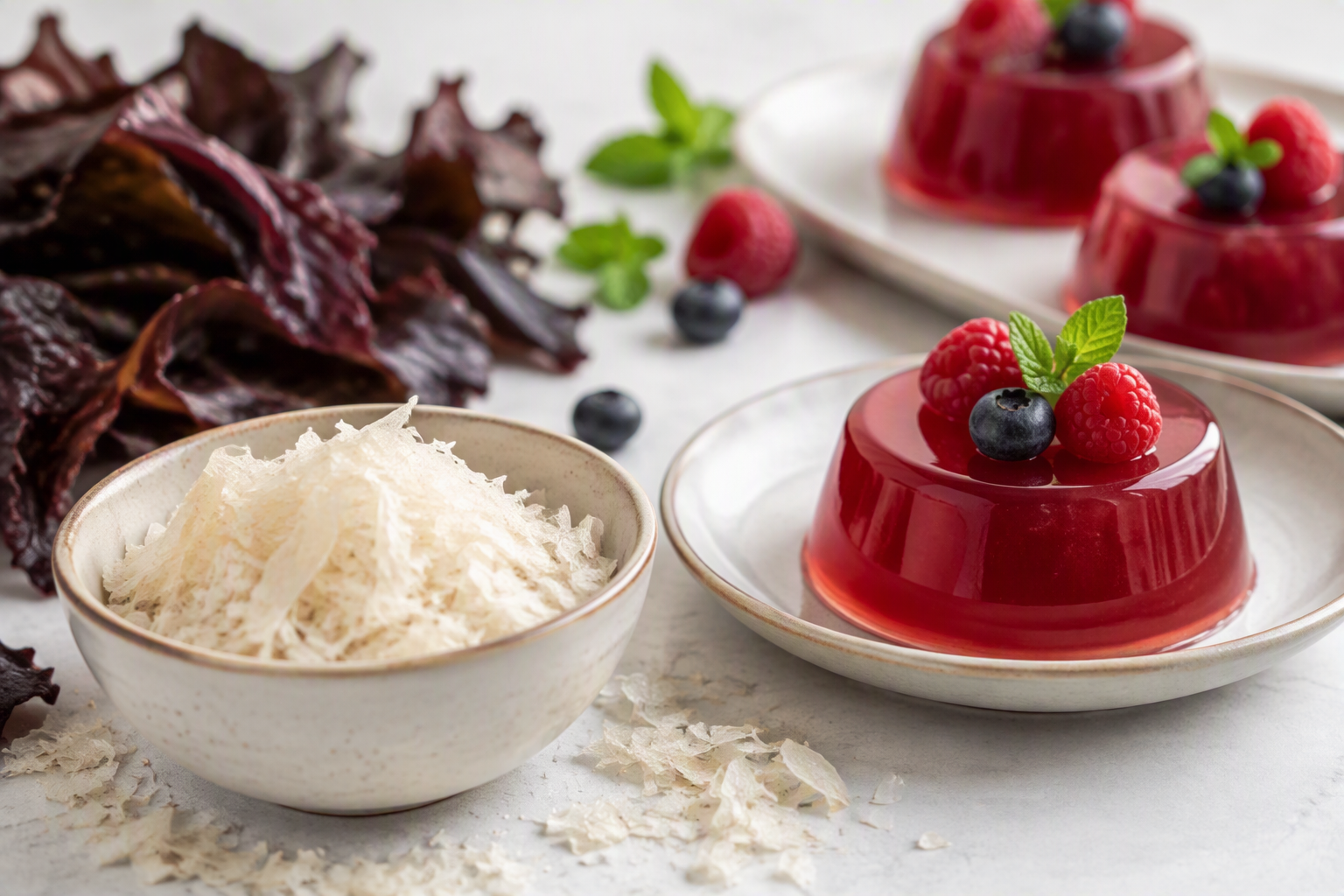
Agar agar is a natural hydrocolloid obtained from red seaweed. It has been used in Asian cuisine for decades, and in recent years it has become increasingly common in the European food industry. The reason is simple. Agar agar forms firm, clear gels at low dosages, and at the same time it is completely plant-based. For manufacturers looking for a gelatine replacement or a clean label solution, agar agar is becoming an indispensable ingredient.
Why It Replaces Gelatine
Gelatine is animal-derived, which makes it unacceptable for vegan, vegetarian, and halal products. Agar agar has no such restrictions. In addition, agar agar gels at higher temperatures than gelatine, meaning the gel remains stable even at room temperature. This makes it ideal for products that are not refrigerated. Also, agar agar does not require cooling to set, which simplifies production.
Where It Is Used
Agar agar is used in the confectionery industry for jelly candies, fruit gums, and marshmallows. In the dairy industry, it is used to stabilise yoghurt, puddings, and ice cream. In bakery, it is used as a gelling agent for fruit fillings and glazes. In beverage production, it is used for stabilisation and texture. It is also used in plant-based meat and fish alternatives, where it replaces gelatine and improves texture.
How to Dose It
Agar agar is extremely efficient. Unlike gelatine, which is used in amounts of 1 to 2 percent, agar agar is used in amounts of 0.5 to 1 percent. This means less ingredient is needed to achieve the same effect. However, agar agar requires heating to a temperature of 85 to 95 degrees Celsius to activate. After that, the gel forms upon cooling.
What to Consider
Agar agar has one characteristic to keep in mind. The gel it forms is firm and brittle, unlike gelatine which gives an elastic texture. In some applications this can be an advantage, while in others it may require combining with other hydrocolloids, such as xanthan gum, to achieve the desired elasticity. Also, agar agar is sensitive to acidity. In highly acidic products, the gel may be weaker, so the dosage needs to be adjusted.