
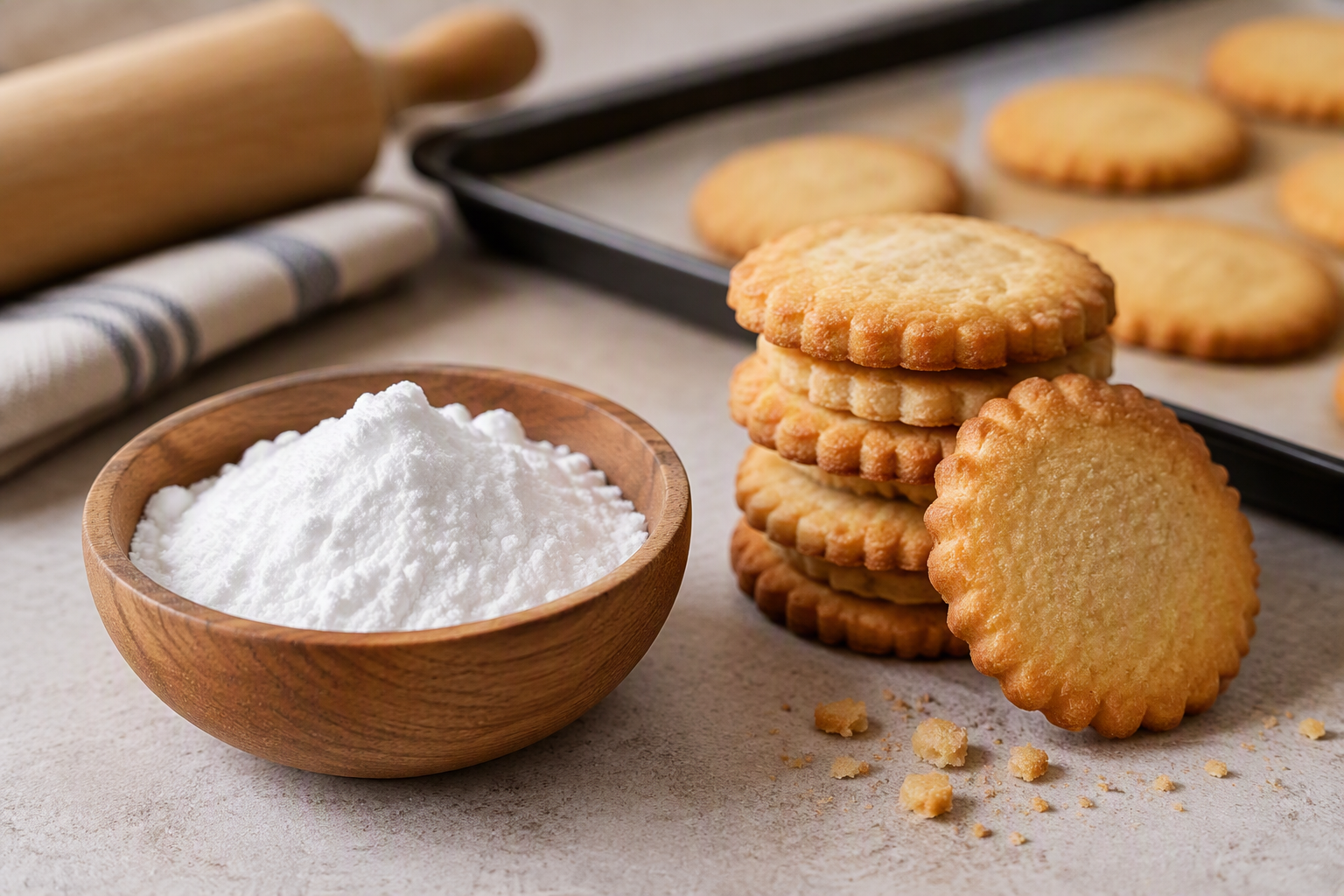
There is an ingredient responsible for that perfect, brittle texture of your favourite biscuit or cracker, and you are probably not even aware of it. It is not butter, sugar, or flour. It is ammonium bicarbonate, a compound bakers have used for decades as a leavening agent. Its role is so specific that nothing else can fully replace it in the production of dry, crispy products.
How It Works
Unlike regular baking soda or baking powder, ammonium bicarbonate works in a completely different way. When the dough is heated, it decomposes into three gases: ammonia, carbon dioxide, and water vapour. These gases create bubbles that give the dough volume and porosity. What makes it special is that it leaves no solid residue in the product. While baking soda can leave a trace of sodium carbonate that gives a slightly bitter taste, ammonium bicarbonate completely evaporates during baking. The result is a clean, neutral taste and a perfectly dry texture that snaps under the tooth.
Where It Is Used
Because of its ability to completely evaporate, ammonium bicarbonate is ideal for products with low moisture content. This includes hard biscuits, crackers, wafers, pastry sheets, and traditional Christmas pastries like German Spekulatius or Scandinavian gingerbread. In these products, there is not enough water to retain the ammonia, so it fully escapes from the dough during baking. However, in moist products like cakes or bread, the ammonia cannot be fully released. It dissolves in the water and remains trapped in the product, giving it an unpleasant, sharp smell and taste. That is why ammonium bicarbonate is never used in moist bakery products.
Advantages in Production
Another advantage of ammonium bicarbonate is its speed of action. It begins to decompose at temperatures as low as 35 to 60 degrees Celsius, meaning it reacts very early in the baking process. This allows for rapid dough expansion and the formation of a fine, uniform porous structure. For industrial bakers, this is crucial because it allows precise control over the final height and shape of the product. Also, since it does not act before the dough enters the oven, it prevents premature dough rising during mixing or standing, which is important in automated production lines.
Regulation and Dosage
In the European Union, ammonium bicarbonate is registered as additive E503(ii) and is permitted for use as a leavening agent in all foodstuffs, in accordance with the quantum satis principle, meaning as much as necessary. The typical dosage in biscuit production ranges from 2 to 6 grams per kilogram of flour, depending on the recipe and desired texture. Like all additives, it is subject to strict purity requirements. E503(ii) must contain at least 99 percent active substance, with strictly defined maximum levels of impurities such as heavy metals.
For manufacturers seeking perfect crispiness, ammonium bicarbonate is not just an additive, but a tool that enables achieving a texture that cannot be obtained by other means. The next time you bite into a perfectly crispy biscuit, remember that a small, invisible ingredient played a big role in that moment.