
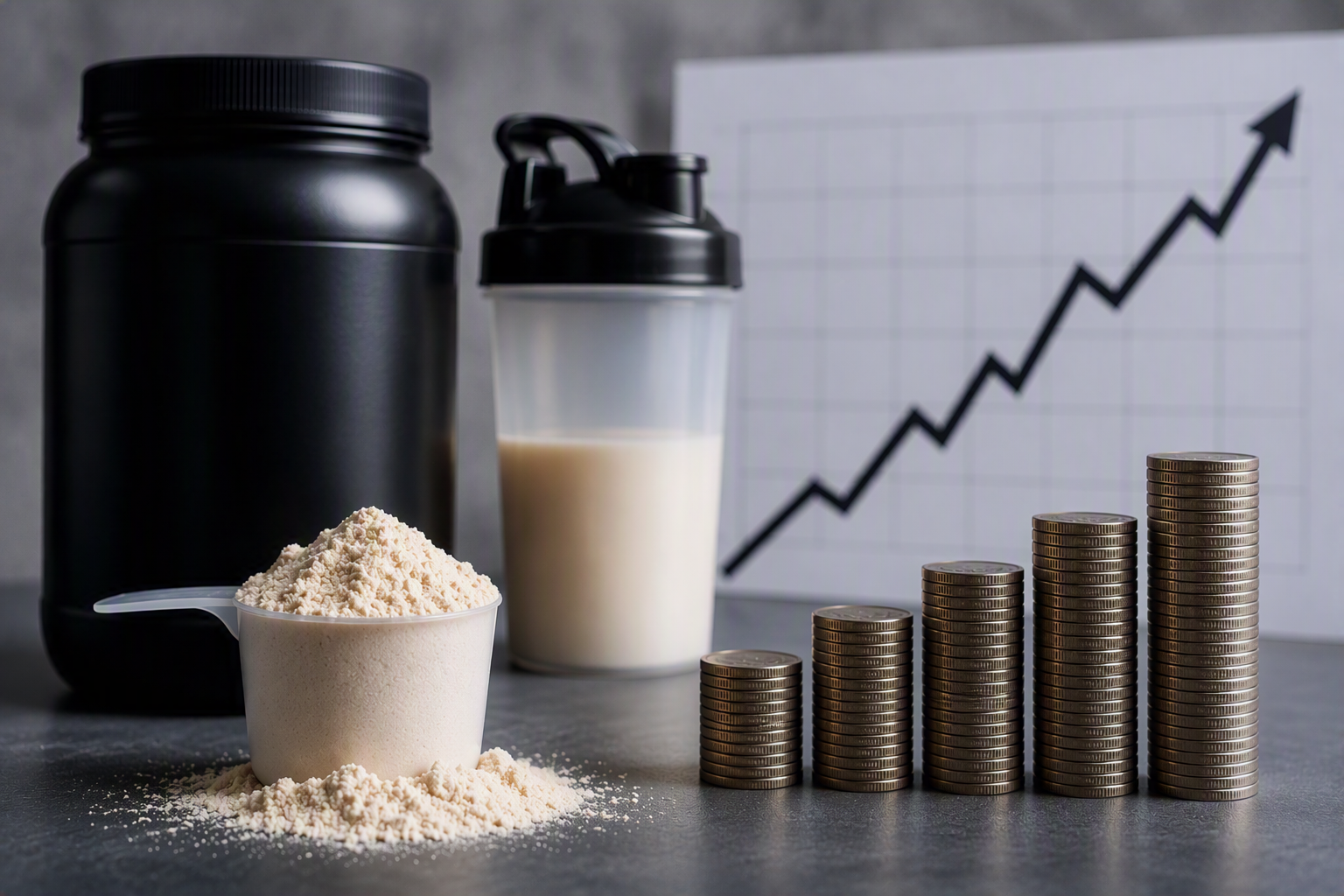
The whey protein market is undergoing the most dramatic transformation in its history. What was once a byproduct of cheese production has today become a strategic raw material whose price is rising at an unprecedented rate. At the center of this change are GLP-1 weight-loss drugs, which have created an entirely new dimension of demand for proteins. Many manufacturers are wondering whether this is just a temporary spike or a lasting change. The answer is clear, this is not a cyclical rise, but a structural shift that will last for years.
What Has Happened to WPC 80 Prices
Current market data shows that WPC 80, whey protein concentrate with 80 percent protein, has recorded a price increase of 120 percent in the period from October 2025 to July 2026. The price rose from around €12,500 per tonne to as much as €27,500 per tonne. Premium instant-quality WPC 80 on the spot market is already approaching values of €29,000 per tonne, and analysts believe the €30,000 per tonne threshold is only a matter of time.
WPI, whey protein isolate with 90 percent protein, is also seeing serious growth, from around €20,500 to over €32,000 per tonne, an increase of nearly 60 percent. MPC, milk protein concentrate, has risen from €9,700 to €12,000 per tonne. These figures are not just statistics, they represent a serious challenge for all manufacturers who use whey proteins in their formulations.
Why GLP-1 Drugs Are Changing the Rules
The cause of this wave of price increases lies in the explosive popularity of GLP-1 drugs such as Mounjaro, Ozempic and Wegovy. These drugs, originally developed for diabetes treatment, are now being used on a massive scale for weight loss, and their use has reached a level that experts describe as a boom.
The problem arises because these drugs significantly reduce appetite, leading to lower overall food intake. Health professionals therefore advise GLP-1 users to increase their protein intake to help preserve muscle mass while losing weight. This has created enormous demand for protein supplements and protein-enriched foods.
Market intelligence shows that the price of whey has risen fivefold to record levels as companies race to secure supplies amid a boom driven by growing use of GLP-1 drugs. Some suppliers are already sold out for the rest of 2026, indicating significant pressure on inventories. Estimates suggest that protein demand related to GLP-1 drugs has "consumed" about 15 percent of the global whey supply, a huge chunk of the market that has permanently disappeared from other channels.
Why the Price Won't Return to Old Levels
What makes this situation particularly challenging is the fact that this is a structural, not a temporary trend. GLP-1 drugs are ubiquitous and their use continues to grow. The resulting demand for proteins is not a short-term fad, but a permanent change in consumer habits.
The industry is trying to respond. Massive investments of over $11 billion have been directed into 53 new or expanded dairy processing facilities expected to come online by 2028. Dutch giant FrieslandCampina recently announced a €90 million technological upgrade of its production network. Irish cooperative Tirlán is committing €126 million to build a new processing facility.
However, these capacities will not be available before 2027. Until then, the market will remain in a seller's regime. Manufacturers must plan for continued volatility in the coming period. Even when new capacities do come online, the question remains how much they will be able to offset the enormous deficit that has formed. The demand created by GLP-1 drugs will not disappear, it will only increase as more people use these medications.
An additional challenge lies in production dynamics. Whey cannot be manufactured without simultaneously producing cheese. As dairies maximize throughput to capitalize on record whey prices, there is a serious risk of creating a massive cheese surplus on the market, which could lead to falling cheese prices and additional instability. This creates a vicious cycle, high whey prices encourage greater cheese production, which can lead to lower cheese prices, which in turn can reduce production and thus whey supply.
What This Means for Food Manufacturers
For manufacturers using WPC 80, WPI or other whey proteins, this is a time for serious strategy. Prices will not return to old levels anytime soon. On the contrary, all signals point to further increases.