
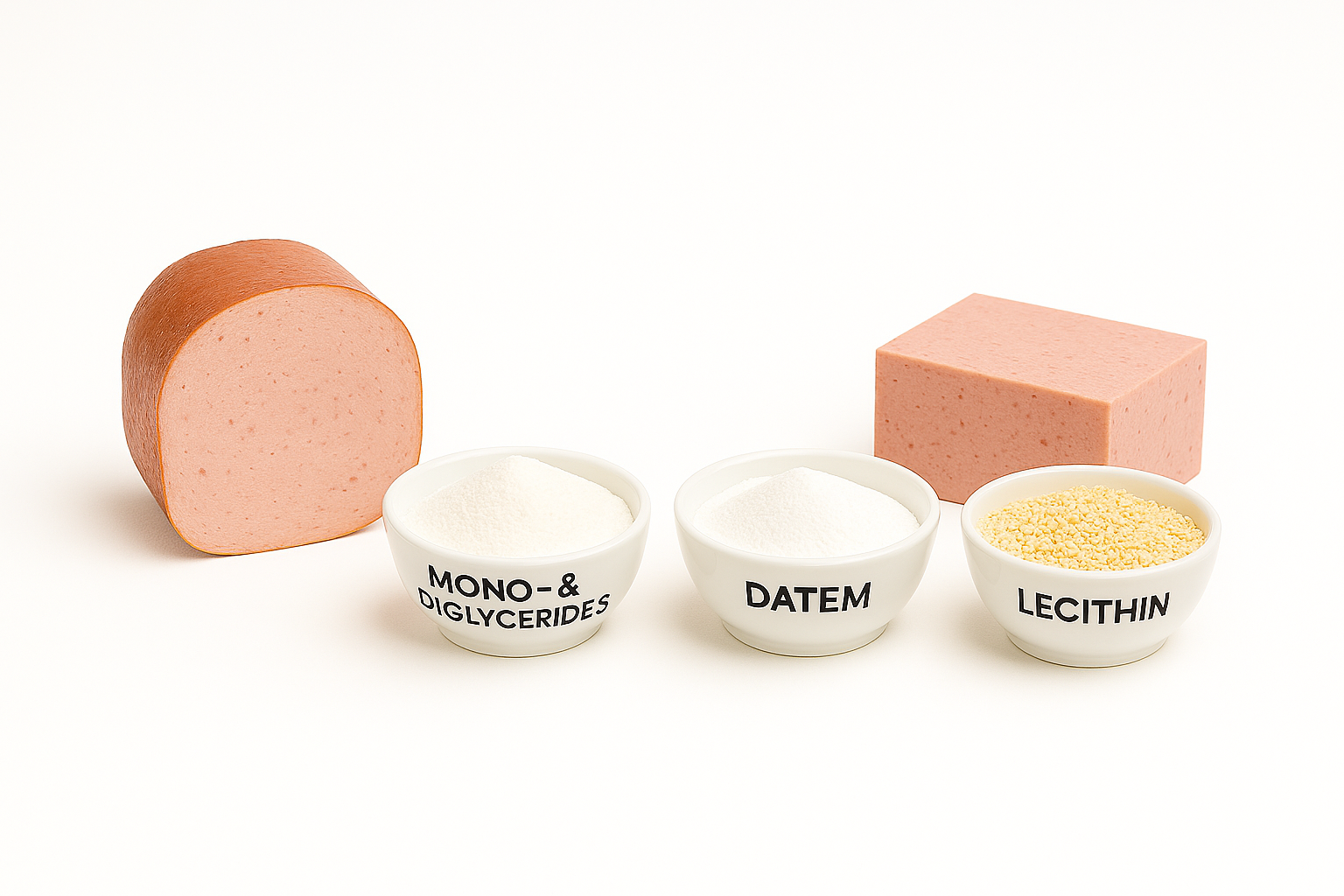
A stable meat emulsion is the foundation of quality in many sausages and pâtés. Whether we talk about cooked sausages, hot dogs or fine pâtés, control of water and fat binding directly affects texture, juiciness, slice appearance and shelf life. In this system, emulsifiers play a key, but often not fully understood, role. This is especially true when, in addition to natural meat emulsifying proteins, additional fats, plant proteins or raw material replacers are introduced.
This text focuses on the use of three groups of emulsifiers in meat emulsions: mono- and diglycerides of fatty acids, DATEM and lecithin. We will analyze how they function in sausages and pâtés, when their use is justified and how they affect texture, stability and process performance.
What is a meat emulsion and why does it need emulsifiers
A meat emulsion is a multiphase system in which fat is dispersed in a continuous aqueous phase, stabilized by a protein network. Myofibrillar meat proteins (actin, myosin, etc.) are the primary “natural emulsifiers”: they coat fat droplets and create an elastic structure that retains water and fat during heat treatment.
In practice, however, conditions are often far from ideal. The quality of raw meat varies, MDM is present, plant and dairy proteins are added, there are changes in fat and moisture levels, as well as economic pressure to reduce the share of expensive raw materials. Under such conditions, additional emulsifiers can help stabilize the emulsion, reduce the risk of fat separation, fat “pockets” and gelatinous zones, and improve texture and sliceability.
Mono- and diglycerides: the basic workhorses of emulsions
Mono- and diglycerides of fatty acids (E471) are among the most commonly used emulsifiers in the food industry. From a chemical standpoint, they are partially esterified forms of glycerol and fatty acids, with a hydrophilic and a lipophilic part in the same molecule. This enables them to position themselves at the oil-water interface and lower interfacial tension.
In meat emulsions, mono- and diglycerides complement the action of myofibrillar proteins. They improve the fineness of fat dispersion and help fat droplets distribute more evenly and adhere better to the protein network. This reduces the risk that during heat treatment fat will form larger agglomerates or “leak” into the space between the casing and the mass.
In cooked sausages, a properly selected and dosed E471 contributes to a smooth cut surface, uniform colour and fewer defects such as pinholes, voids, gelatinous pockets or visible “fat balloons”. In pâtés, mono- and diglycerides help to form a more stable fine emulsion, facilitate spreadability and reduce fat separation on the surface or under the lid.
It is critical not to see them as a replacement for good protein extraction. If chopping and salting conditions are poor and the temperature of the batter is not properly controlled, even powerful emulsifiers will not fully stabilize the emulsion. They deliver the best results when used as part of a well-optimized technological process.
DATEM: targeted improvement of structure and emulsion robustness
DATEM (diacetyl tartaric acid esters of mono- and diglycerides, E472e) is an emulsifier originally used in bakery applications, but it is also used in some meat systems where additional stability and a specific type of structure are required. Chemically, it is a modified mono-/diglyceride with tartaric and acetic acid esters, which gives it a different affinity toward proteins and fats.
In meat emulsions, DATEM can enhance interactions between the protein network and fat, contributing to a more robust gel that is more resistant to mechanical and thermal stress. In practice, this may manifest as a firmer, more compact texture of cooked sausages with fewer defects in the cut, better sliceability and lower cooking losses.
However, it is not a universal solution for all products. In fine, spreadable pâtés, an overly “tight” network can lead to a structure that feels dense or “rubbery”, which is a sensory drawback. DATEM is primarily useful in systems where extra emulsion stability and a more structured texture are desired, for example in industrial sausages exposed to demanding heat treatment and cold chain conditions.
Due to its more intense action, DATEM dosing requires careful optimization and good coordination with other functional ingredients (proteins, phosphates, starch). Excessive doses can result in an overly firm and even brittle texture, especially in combination with higher levels of added proteins.
Lecithin: a bridge between fat, water and proteins
Lecithin is a natural emulsifier, most commonly derived from soy or sunflower. Structurally, these are phospholipids with pronounced amphiphilic character, highly effective at the oil-water interface. In the food industry, lecithin is particularly valued for its “more natural” image and broad applicability.
In meat emulsions, lecithin can help to achieve a finer dispersion of fat, improve homogeneity and reduce fat separation during processing and storage. In pâtés, in particular, it supports spreadability and smoothness by enabling the formation of fine, stable fat droplets integrated into the protein-starch network.
In sausages, lecithin is more often used in combination with other emulsifiers and stabilizers, and less frequently as the only emulsifier. Its contribution can be visible in reducing surface fat film in vacuum packs and in improving the visual homogeneity of the cut surface. In product concepts where “cleaner label” is important, lecithin often has an advantage over synthetic emulsifiers, albeit at the cost of somewhat weaker effect intensity and higher price per kilogram.
It is important to consider the origin of lecithin (soy/sunflower) in the context of allergens and labelling, as well as its interaction with other ingredients. This is especially true for plant proteins and fibres, where useful synergies can occur, but also viscosity changes that impact the filling process.
Emulsifiers in sausages: focus on sliceability and absence of defects
In cooked sausages, the goal is an emulsion that remains stable during heat treatment and cooling, with no “fat leaks”, voids or gelatinous pockets. Emulsifiers here have a primarily stabilizing role, “helping” proteins do their job under often challenging conditions: variable meat quality, mechanical stress in the cutter, high temperatures and high-speed filling lines.
Mono- and diglycerides are the most common choice because they provide good basic stability at reasonable dosage and have a relatively neutral impact on flavour and colour. In more demanding formulations, for example with lower meat content and higher levels of plant protein or starch, the addition of DATEM can increase emulsion robustness and help maintain uniform texture.
Lecithin in sausages typically acts as a supplementary emulsifier, improving the fineness of fat dispersion and potentially contributing to a softer, more pleasant “bite”. When formulating, it is important to consider the overall hydrophilic-lipophilic balance of the system: selection and ratio of emulsifiers, type and amount of fat, level and type of proteins and starches, as well as the salt-phosphate system.
Emulsifiers in pâtés: spreadability and control of fat separation
Compared to sausages, pâtés are even more complex emulsions, with very finely comminuted particles of meat, offal, fat and water, often with a significant addition of plant proteins, starch and hydrocolloids. Here, emulsifiers are key to achieving a fine, homogeneous dispersion of fat and preventing formation of a separated fat layer on the surface during storage.
Mono- and diglycerides provide basic stability and reduce the tendency of fat to separate under temperature fluctuations or during sterilization/pasteurization. Lecithin further improves spreadability and delivers a “creamier” mouthfeel, which is important for sensory perception. In some concepts, a combination of E471 and lecithin yields a better balance between stability and spreadability than either component alone.
DATEM in pâtés occupies a niche in formulations where a firmer, less spreadable structure is needed, for example in products intended for slicing rather than spreading. However, in classic spreadable pâtés, milder emulsifiers (mono- and diglycerides plus lecithin) are usually more suitable, with the necessary support from hydrocolloids that form the gel.
When developing a formulation, it is important to monitor not only stability immediately after production, but also behaviour throughout shelf life: whether fat separates under the lid, a watery layer appears, the structure compacts or spreadability changes. Emulsifiers must be adjusted in parallel with the type of proteins, starch and hydrocolloids to achieve an optimal profile.
Impact on process, shelf life and labelling
Emulsifiers also affect technological process parameters. In sausages, a more stable emulsion allows tougher heat treatment conditions and faster lines with lower risk of defects. In pâtés, a properly selected emulsifier can reduce viscosity during filling (better flow) while giving a firmer gel after heat treatment, which facilitates automation.
As for shelf life, a well-stabilized emulsion is less prone to physical changes during storage: fat separation, syneresis, texture changes. This affects not only visual appearance, but also microbiological stability, since zones with separated water or fat can create microenvironments with different conditions for microbial growth.
On the label, mono- and diglycerides and DATEM appear as E471 and E472e, placing them among “classic” additives. Lecithin, on the other hand, often enjoys a more favourable image, especially when labelled with an explicit reference to its plant origin (e.g. sunflower lecithin). In “clean label” concepts, manufacturers sometimes prefer lecithin and functional proteins over synthetic emulsifiers, accepting a partial trade-off in process robustness or shelf life.
How to practically choose an emulsifier for sausages and pâtés
The starting point is to define the product target: texture (firm, elastic, spreadable), visual appearance of the cut, acceptable fat level and expected shelf life. Then it is necessary to analyse the existing functional system: how much natural meat protein is available, what is the share and type of fat, which plant and dairy proteins and starches are present, and whether hydrocolloids are used.
In classic cooked sausages with a solid share of quality meat, mono- and diglycerides are usually sufficient to provide the desired stability. In more demanding “economy” formulations with more replacement raw materials, introducing DATEM may be justified to further “reinforce” the structure. In pâtés, a combination of E471 and lecithin generally gives the best balance between a fine, creamy mouthfeel and fat stability, with needed support from hydrocolloids and starch.
It is crucial to plan pilot production runs under real line conditions, to track cooking losses, cut appearance, stability during storage and sensory evaluation. Based on this, emulsifiers can be finely adjusted by type and dose, often together with corrections in protein, starch and hydrocolloid systems.
Conclusion
Emulsifiers in meat emulsions are not “magic”, but precise tools which, when used correctly, enable stable, uniform sausages and pâtés. Mono- and diglycerides provide basic stability and finer fat dispersion, DATEM can reinforce structure and emulsion robustness in demanding systems, while lecithin brings smoothness, better spreadability and a more favourable label image.
Successful use of these emulsifiers requires understanding their role relative to natural meat proteins, starches and hydrocolloids, as well as careful alignment with technological process parameters. When all these components are brought into balance, the result is products with stable texture, good yield and reliable shelf life, with labelling tailored to the target consumer group.