
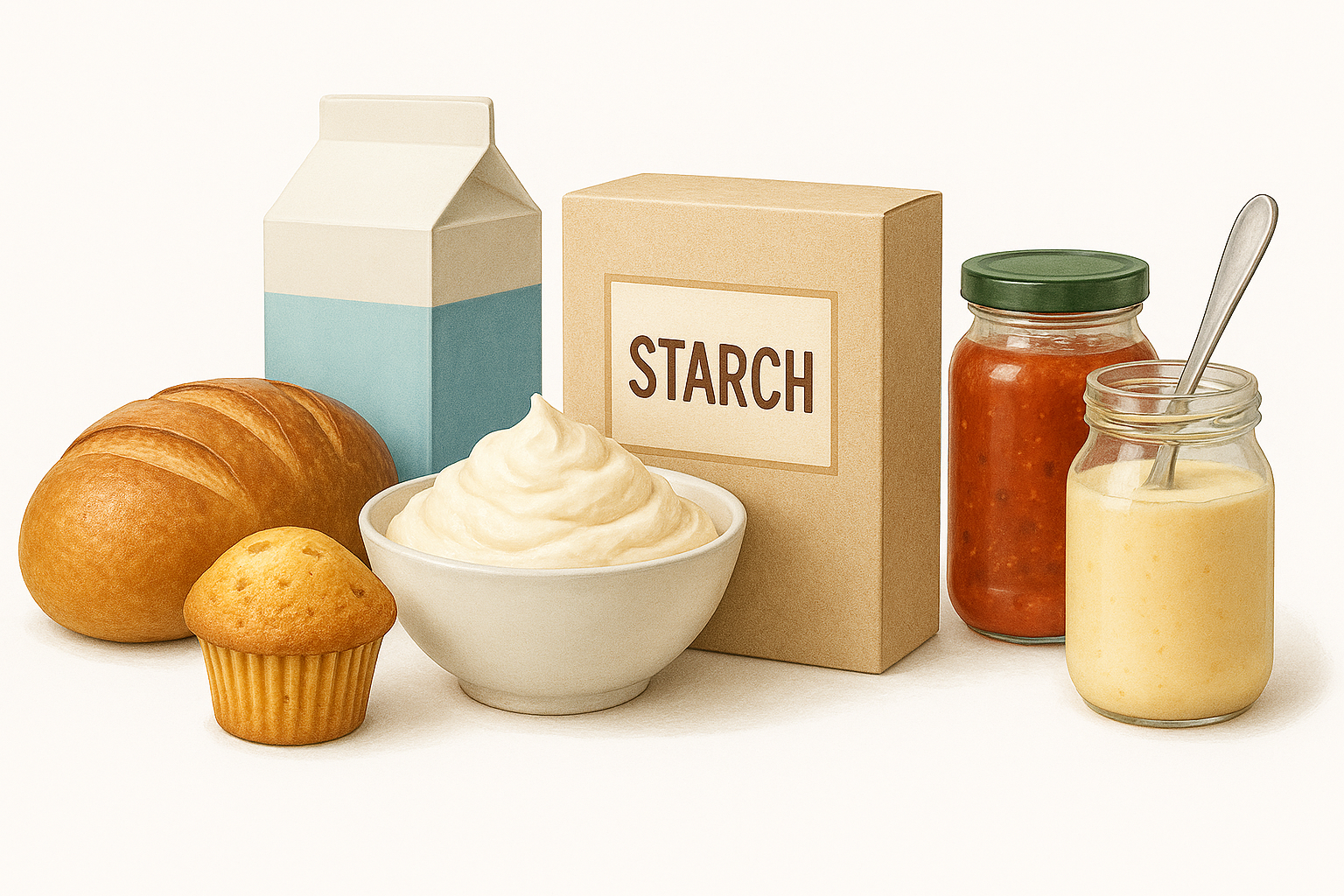
In industrial production, starch is rarely “just a thickener”.
It impacts structure, moisture, stability, freeze‑thaw behaviour, shelf life and even perceived freshness. Choosing the wrong starch often leads to dry or crumbly bakery products, dairy desserts that separate, or sauces that turn watery or grainy after a few days.
For R&D, QA and procurement, the real question is not “native or modified?”, but:
- what is the process,
- what texture is needed,
- how will the product be stored and used,
- and what cost and label constraints exist.
Below is a practical guide to choosing starch for three major application groups: bakery, dairy and sauces.
Key factors to clarify before you choose any starch
Before looking at product types, it helps to be clear on a few basics. They determine whether a starch will actually work in your system:
- Processing conditions: temperature, shear, pH, presence of enzymes
- Storage and distribution: ambient, chilled, frozen, freeze‑thaw cycles
- Desired texture: short and crumbly, elastic and chewy, creamy and spoonable, thick and pourable
- Shelf life: how long the product must stay stable without syneresis or staling
- Labelling and cost: clean label vs modified starches, cost per kilo of finished product
Once these are defined, it becomes much easier to decide what type and functionality of starch you need in each category.
Starch for bakery products
In bakery, starch is structurally critical. It interacts with gluten (or its replacers in gluten‑free products), binds water, affects crumb texture and plays a central role in staling.
What bakery products need from starch
In most industrial baked goods you need starch to:
- support dough handling and machinability
- build the desired crumb structure (fine, open, elastic, short)
- control water binding and softness over shelf life
- reduce crumbling and slow down staling
- survive baking temperatures and, in some cases, freezing and thawing
Different product types will prioritise different aspects. For example, sandwich bread needs softness and resilience, biscuits need short bite and crispness, cakes need fine, soft crumb with good volume.
Native vs modified starch in bakery
Native wheat or corn starch can work well in many standard bakery applications, especially when processing is mild and shelf life is relatively short.
However, in more demanding conditions you often see limitations:
- loss of softness over time due to retrogradation,
- crumbling in sliced bread,
- weak structure in freeze‑thaw or chilled dough applications.
Modified starches designed for bakery can:
- improve crumb softness and resilience,
- provide better freeze‑thaw stability in frozen dough and par‑baked products,
- reduce crumbling in sliced and packaged bread,
- help in gluten‑free recipes by building network and structure in absence of gluten.
Practical guidelines for bakery starch choice
- For standard fresh bread and rolls with limited shelf life: a suitable native starch (wheat, corn) often meets basic needs, sometimes combined with enzymes or emulsifiers.
- For extended‑shelf‑life packaged bread, cakes and sweet bakery: functional or modified starches that control retrogradation and water migration can significantly improve softness and sliceability over time.
- For gluten‑free bakery: a system of starches (corn, potato, tapioca) plus hydrocolloids is usually needed to mimic gluten structure and avoid a dry, crumbly product.
- For frozen dough and par‑baked products: starches with improved freeze‑thaw stability and reduced syneresis help maintain volume and crumb after baking at the consumer.
In procurement terms, the right starch often reduces the need for other texturising ingredients and can materially improve perceived quality and shelf life – which directly affects returns and waste.
Starch for dairy products
In dairy, starch is used to build body and stability in yogurts, desserts, puddings, creams and some types of processed cheese. The main challenge is to balance creaminess and stability without creating a pasty or “floury” mouthfeel.
What dairy systems need from starch
Typical expectations from starch in dairy include:
- creamy, smooth texture without graininess
- stability during heat treatment (pasteurisation, UHT, sterilisation)
- resistance to low pH in fermented products
- good freeze‑thaw behaviour in frozen desserts
- minimal syneresis during shelf life
Dairy processes are often harsh: high temperatures, homogenisation, sometimes low pH and long shelf life. Not all starches can survive that without losing viscosity or creating defects.
Native vs modified starch in dairy
Native starch can be used in some mild dairy applications, but it has clear limits when:
- heating is intense or prolonged,
- pH is low (yogurts, sour creams),
- product is stored for a long time or frozen.
Modified, cook‑up or instant dairy starches are engineered for:
- heat stability under pasteurisation or UHT,
- acid stability at lower pH,
- controlled viscosity and creaminess,
- reduced syneresis over time.
Instant starches are particularly useful in cold‑processed or post‑addition systems, such as stirred yogurts or chilled desserts where you want to avoid additional heating steps.
Practical guidelines for dairy starch choice
- For stirred yogurts and dairy desserts with heat treatment: choose an acid‑stable modified starch that can withstand the specific temperature‑time profile and pH of your process, while giving a creamy, smooth mouthfeel.
- For UHT desserts, puddings and creams: use starches with proven high heat stability and low retrogradation, to avoid thickening in the pack or gelation during shelf life.
- For frozen dairy desserts (e.g. ice cream mixes): look for starches or starch systems that provide freeze‑thaw stability and help control ice crystal growth alongside other stabilisers.
- For clean‑label concepts: carefully selected waxy or specific native starches can work, but they often require more precise processing control and may not match the performance of modified starches in very demanding conditions.
For both technologists and buyers, it pays to test starch options in your exact thermal and pH conditions, as small differences in process can lead to big differences in texture and syneresis.
Starch for sauces and culinary applications
Sauces, gravies and ready meals rely heavily on starch for viscosity and appearance. Here, performance must be judged not only in the kettle, but also after filling, storage, transport, reheating and sometimes freezing.
What sauces need from starch
In sauce applications, starch is expected to:
- build the right viscosity profile (from spoonable gravies to pourable sauces)
- provide gloss and good appearance
- resist breakdown under shear (pumping, filling, mixing)
- tolerate heating, cooling and possibly re‑heating by the consumer
- maintain stability in ambient, chilled or frozen storage
- resist syneresis in chilled and frozen ready meals
The difference between a good and a weak starch is often visible only after several days on shelf or after a freeze‑thaw cycle.
Native vs modified starch in sauces
Native starches can work in simple, short‑life, low‑shear sauces, but they are vulnerable to:
- viscosity loss under high shear,
- breakdown at higher temperatures,
- retrogradation and syneresis during storage, especially if cooled and reheated.
Modified starches for sauces are designed for:
- improved process tolerance (high shear, high temperature),
- stable viscosity in both hot and cooled state,
- better freeze‑thaw behaviour,
- reduced syneresis in chilled and frozen products.
Specialty “instant” starches can thicken without cooking and are used in cold sauces or to adjust viscosity after cooking.
Practical guidelines for sauce starch choice
- For hot‑filled, ambient sauces with moderate shelf life: a cook‑up modified starch with good heat and shear stability is often the safest choice.
- For chilled soups, sauces and ready meals: choose starches with low retrogradation and good cold‑storage stability, to avoid gelation and water separation over time.
- For frozen ready meals and sauces: use starches with documented freeze‑thaw stability to prevent watery thawed sauces and phase separation.
- For clean‑label culinary products: carefully selected native or “functional native” starches can deliver good performance, but process conditions must be adapted to protect them.
From a commercial standpoint, a slightly more expensive, more robust starch can pay back quickly by reducing complaints, returns and the need for over‑formulating.
Bringing it together: how to make a smart starch choice
Across bakery, dairy and sauces, the same logic applies:
- Start from the product and process
Define process conditions, storage, target texture and shelf life first. Avoid choosing starch purely based on price or what is already in stock.
- Decide on clean‑label vs modified
If the brand and regulatory environment allow modified starches, you have more functional options, especially for demanding processes. If not, focus on native or “functional native” starches and be ready to adapt processing parameters.
- Use application‑specific starches
Bakery, dairy and sauces rarely have the same optimal starch. Use starches that are developed for your category: bakery‑focused for crumb control, dairy‑stable for low pH and heat, sauce‑stable for shear and freeze‑thaw.
- Look at cost per function, not just cost per kilo
Evaluate how much starch is needed to reach the target texture, how it affects shelf life and quality, and whether it can reduce other costs (less waste, fewer returns, fewer additional texturisers).
- Test in real conditions
Always validate starch performance under real‑life processing, storage and re‑heating conditions. Lab tests at small scale and simplified conditions often hide problems that appear only later in production or distribution.