
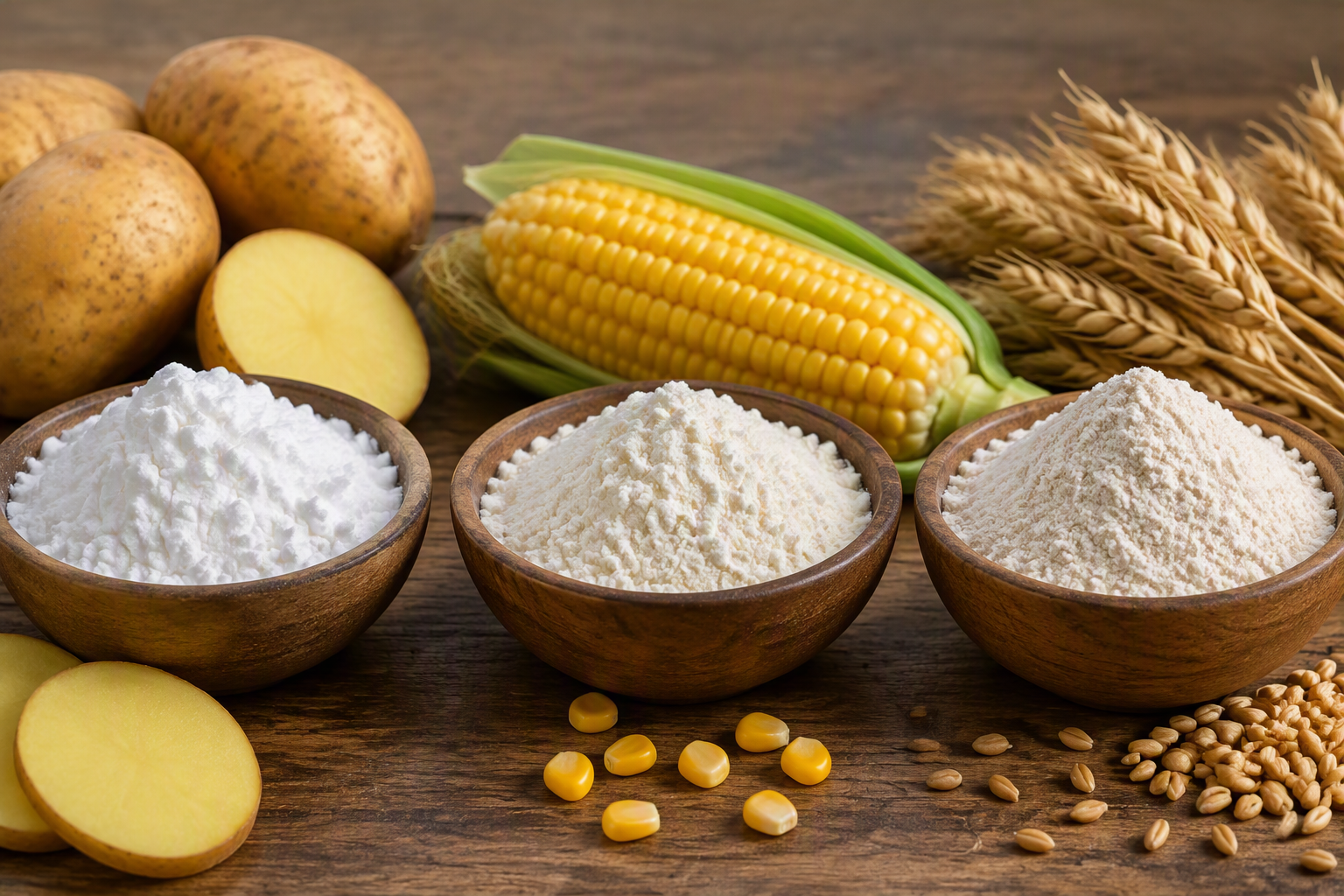
When you need to choose a starch for your production, the first question is which type will give the best results in your product. Although all starches seem to do the same thing at first glance, their behaviour in production differs significantly. The choice between potato, corn and wheat starch directly affects texture, stability and the final quality of the product. This guide helps you understand the differences and make a decision that will work in your production.
What Makes Them Different?
The differences between these three starches come from their origin and granule structure. Potato starch has the largest granules, which gives it the ability to bind a large amount of water and create high viscosity. This makes it an extremely efficient thickener, but also more sensitive to mechanical stress during mixing. When potato starch is mixed for too long or too vigorously, the granules can break down, leading to loss of viscosity.
Corn starch, on the other hand, has smaller granules and a higher amylose content. This gives it greater stability at high temperatures and in processes involving intensive mixing. That is why corn starch is often the first choice in industrial conditions where consistency and resistance are required. Its granule is more compact, so it better withstands thermal and mechanical challenges.
Wheat starch falls somewhere in between. It has medium-sized granules and contains both proteins and lipids that can affect the colour and taste of the final product. Its main advantage is that it is naturally present in wheat flour, so it behaves predictably in bakery products without requiring additional recipe adjustments. Also, wheat starch has the ability to form a gel that is more elastic than corn starch gel, which can be an advantage in certain applications.
Potato Starch: When Is It the Best Choice?
Potato starch is most commonly used in food products where a clear texture and neutral taste are required. It is excellent for thickening soups, sauces and dressings, as well as for stabilising cakes and puddings. In gluten-free products, potato starch often replaces wheat flour because it provides softness and moisture. However, due to its large granules, it does not tolerate prolonged mixing at high temperatures well.
In the confectionery industry, potato starch is used for the production of jelly candies, where it provides a clear and elastic texture. In the bakery industry, it is added to gluten-free breads and cakes to improve structure and extend freshness. In the meat industry, it is used as a binder in sausages and pâtés, where it helps retain water and improves juiciness.
What to watch out for with potato starch is its sensitivity to mixing. If used in processes involving intensive mixing or pumping, viscosity can drop. Also, potato starch tends to form a gel that is less stable during freezing and thawing, which can be a problem in frozen product production.
Corn Starch: When Is It the Best Choice?
Corn starch is indispensable in industrial processes where stability and resistance are required. It is used in the production of sauces, creams, fruit fillings and confectionery products. Its ability to withstand high temperatures and mechanical stress makes it ideal for products subjected to pasteurisation or sterilisation. Corn starch is also used in the pharmaceutical industry as a binder in tablets.
In the bakery industry, corn starch is used as a means to improve crust and crumb texture, especially in the production of biscuits and crackers. In the beverage industry, it is used as a stabiliser in fruit juices and drinks, where it prevents sedimentation and improves texture. In snack production, corn starch is the basis for extruded products, where it provides crispness and structure.
What to watch out for with corn starch is its tendency to retrograde, meaning the formation of crystals during cooling. This can lead to cloudiness of the gel or the formation of solid particles in the product. Also, corn starch may require more energy for gelatinisation than potato starch, which can affect production costs.
Wheat Starch: When Is It the Best Choice?
Wheat starch is most prevalent in the bakery industry. It is used in the production of bread, cakes, biscuits and pasta, where it contributes to structure and texture. In the meat industry, wheat starch helps bind water and improves the juiciness of products. Its use is limited in gluten-free products, but in conventional bakery products it gives excellent results.
In pasta production, wheat starch is key to achieving an elastic and firm texture. In cracker and biscuit production, it contributes to crispness and prevents cracking during baking. In the sauce industry, wheat starch is used as a thickener, but it can give a slightly cloudy texture.
What to watch out for with wheat starch is the presence of gluten, which makes it unsuitable for gluten-free products. Also, wheat starch may contain residual proteins that can cause allergic reactions in sensitive consumers. In production, wheat starch requires careful dosing because it can affect the colour and taste of the final product.
What to Know Before Choosing?
When choosing a starch, it is useful to pay attention to a few practical things. Potato starch provides the highest viscosity but is sensitive to mixing and high temperatures. Corn starch is the most stable in industrial conditions and best withstands processes involving heat and shear. Wheat starch is the best choice when the product is wheat-based and when natural compatibility with flour is important.
For producers in Serbia and the region, availability and price also play a role. Corn starch is the most prevalent on the market and has the most stable supply. Potato starch is somewhat more expensive but offers functional advantages that can justify the difference. Wheat starch is often the most cost-effective in bakery applications because it is obtained as a by-product of wheat processing.
Practical Examples by Industry
In the bakery industry, a combination of wheat and corn starch often gives the best results. Wheat starch provides structure and elasticity, while corn starch improves stability and extends freshness.
In the confectionery industry, potato starch is indispensable for jelly candies and fruit gums, while corn starch is used to stabilise creams and fillings.
In the meat industry, corn and potato starch are often combined to achieve optimal texture and water retention. Wheat starch is used in products where the presence of gluten is permitted.
In gluten-free product production, potato and corn starch are essential ingredients, often in combination with rice flour or other gluten-free starches.
Conclusion
There is no universally best starch. There is only the best starch for your product, your process and your consumers. Potato starch provides viscosity and clarity, corn starch provides stability and resistance, and wheat starch provides compatibility with bakery products. When you frame starch selection as a question of compatibility with your process, rather than a question of habit, the decision becomes much clearer.