
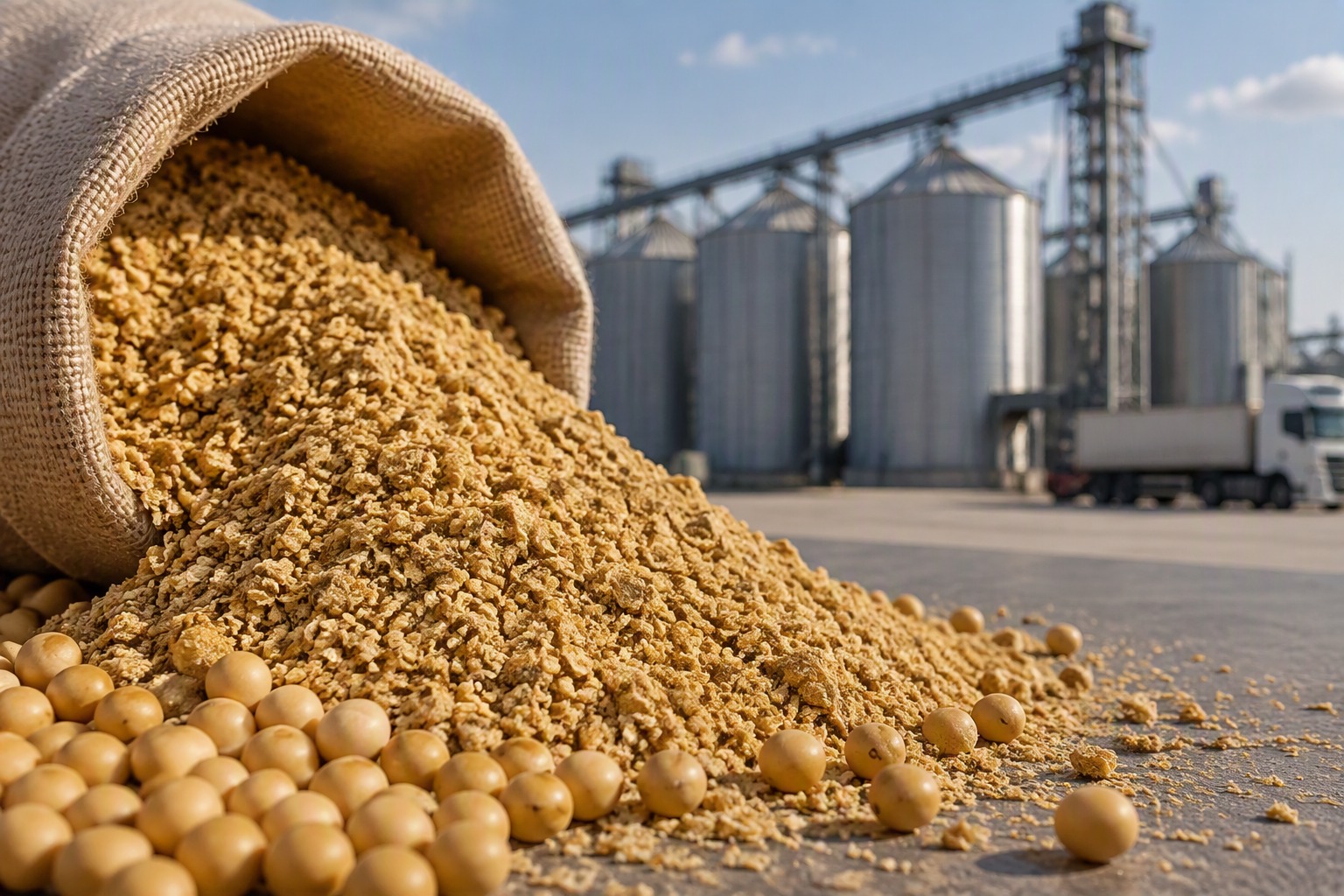
The European feed market is facing a serious challenge that could change the rules of the game in the coming year. According to the latest estimates, the European Union could face a deficit of at least five million tonnes of soybean meal in the 2026/27 marketing year. That is roughly a fifth of total consumption, an amount that cannot be easily replaced.
What Is Behind This Deficit?
The situation is the result of a combination of several factors that have coincided. The first is the drought that hit large parts of Europe during the summer. High temperatures and a lack of rainfall reduced yields not only of cereals but also of forage crops, which further increased pressure on feed supplies.
The second factor is the disruption to trade through the Black Sea. Key ports and routes that have served for years as the main channel for supplying Europe with cereals and oilseeds are now at high risk. Alternative routes, such as road and rail transport, cannot compensate for the lost capacity.
The third factor is the new European deforestation regulation, known as EUDR. This regulation, due to come into force at the end of December 2026, introduces strict requirements to prove that soy and other products do not come from recently deforested land. Although the goal is noble, practical implementation creates serious logistical and administrative challenges for importers and processors.
What Are the Real Costs?
Estimates suggest that the direct additional costs of sourcing soy compliant with the new rules could reach around 1.05 billion euros. When the effects on rapeseed and sunflower meal prices are added, the total impact on feed supply chains is estimated at around 1.4 billion euros.
These costs will not remain only at the level of importers. They will gradually spill over to feed producers, and then to farmers. In the end, the heaviest burden could be felt by pork and poultry producers, as they are the largest users of soybean meal in animal feed.
Why Does This Matter for the Region?
For producers in Serbia and the region, the situation is particularly relevant for several reasons. First, Serbia has been identified as a low-to-medium risk area in terms of EUDR compliance, which could be an advantage compared to some other suppliers. Second, domestic feed producers are themselves exposed to price pressures, as part of the raw materials is imported, while part comes from local production, which is also affected by drought.
Third, if the deficit on the European market deepens, there could be increased demand for alternative proteins, which opens space for domestic sources such as sunflower meal or pea protein. However, replacing soybean meal is not simple because it has a specific amino acid profile that is not easily reproduced with other raw materials.
What Can Be Expected?
The market situation is likely to tighten further before it stabilises. There are several scenarios. In the best case, the European Commission could approve simplified EUDR implementation for soy and postpone its application to palm kernel expeller, which would reduce pressure on supply chains. In the worst case, if such measures are not taken, the deficit could cause serious supply disruptions and further increases in food prices.
For feed producers and the meat industry, this is a period when procurement should be carefully planned and diversification of sources considered. Those who react in time will be in a better position than those who wait for the situation to resolve itself.