
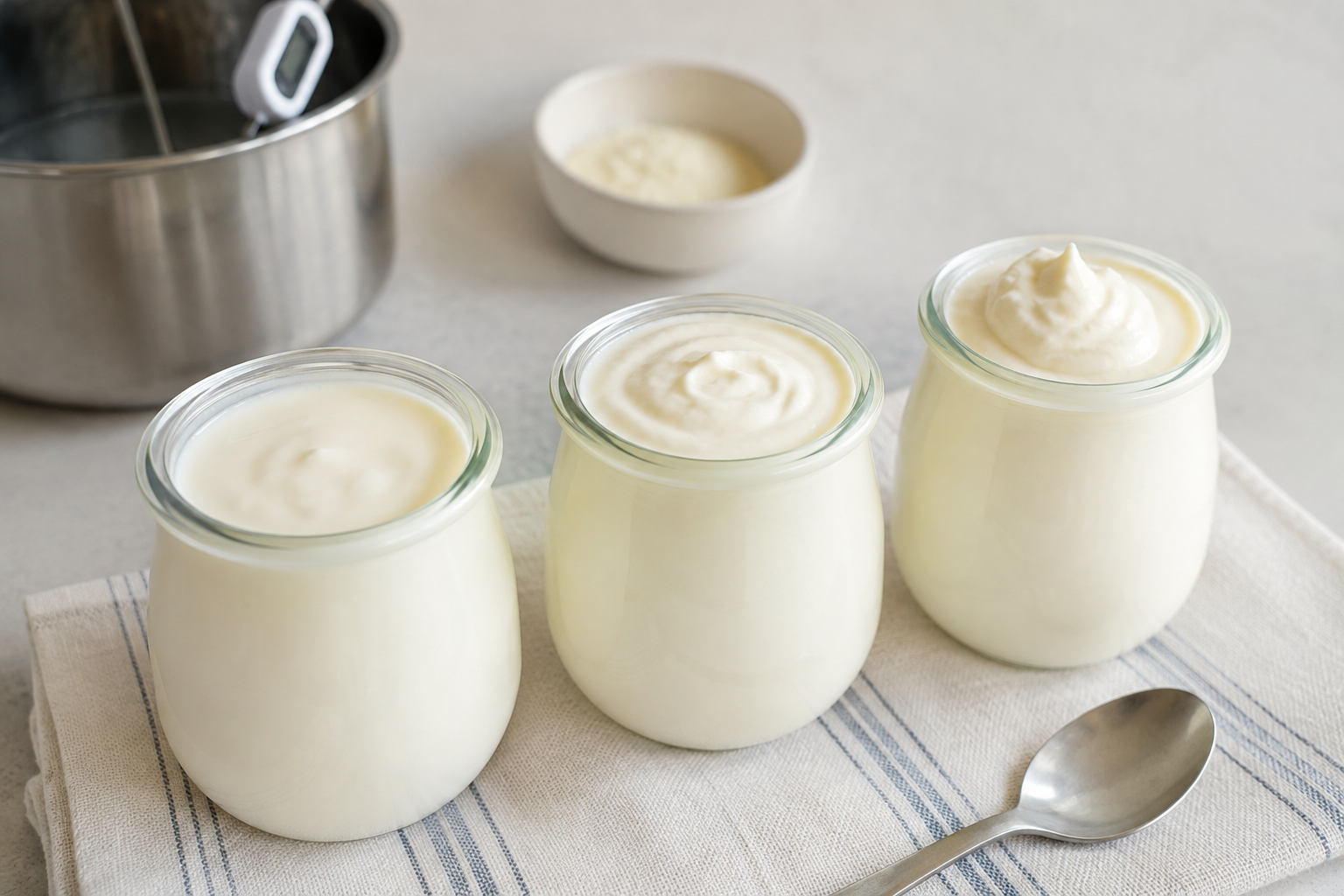
Yogurt texture is not a coincidence. It is the result of a carefully guided process where every degree of temperature, every bacterial strain, and every minute of fermentation leaves its mark. Although it seems simple at first, fermentation is a delicate balance that determines whether the yogurt will be creamy and smooth or grainy and watery. Understanding the role of temperature, starter cultures, and related process parameters is the key to achieving the desired texture.
Starter Cultures: The Symbiosis That Creates Yogurt
Yogurt cannot exist without its main actors, the lactic acid bacteria. Two species are essential: Streptococcus thermophilus and Lactobacillus delbrueckii subsp. bulgaricus. They work in symbiosis, meaning that one stimulates the growth of the other. S. thermophilus initiates the fermentation, creating conditions for L. bulgaricus, which then takes over and gives yogurt its characteristic taste and aroma. They are responsible for reducing lactose content by 20 to 30 percent and producing lactic acid, which leads to milk coagulation.
The ratio of strains in the starter culture is not fixed and can be adjusted. Research has shown that the ratio of S. thermophilus to L. bulgaricus affects the acidification rate. Mixed cultures acidify faster than single strains, and different strains of the same species can have significantly different acidification activities. One S. thermophilus strain can complete fermentation in 7 hours, while another may take up to 24 hours. An optimal starter ratio of 4:4:3 (likely referring to different strains) at 37°C has been found most suitable for yogurt production.
In addition to these, modern production increasingly uses additional strains, such as those that produce exopolysaccharides (EPS). EPS strains are particularly important because they create substances that bind water, resulting in a creamier texture and reduced whey separation (syneresis). Yogurts produced with an EPS culture have better water retention even at lower fermentation temperatures compared to those without the EPS culture. The starter culture significantly influences the texture and flavor of yogurt, making the selection of appropriate strains crucial.
The Influence of Temperature on Texture
Fermentation temperature is arguably the most important parameter shaping the texture. It directly affects the rate of bacterial activity and the structure of the gel that forms. Studies have shown that gel firmness and viscosity differ significantly depending on the fermentation temperature.
- Higher temperatures (42 to 45°C): This is a common range for industrial production. At higher temperatures, the culture's metabolism is faster, shortening the fermentation time. However, this often results in a denser but coarser, more grainy texture. Higher temperatures lead to shorter gelation times but also to lower apparent viscosity of the yogurt. At 43°C, the gel structure is coarse, while at 33°C it is much finer and smoother. The optimal temperature for acidification and EPS production is often 42°C.
- Lower temperatures (32 to 39°C): When fermentation occurs at lower temperatures, the process is slower, allowing for the formation of a finer protein network. The result is a yogurt that is creamier, smoother, and less grainy. Yogurt fermented at 37°C has better texture and reduced post-acidification during storage. Also, the graininess of stirred yogurt decreases when fermentation is carried out at 38°C instead of 42°C. A lower temperature (40°C) leads to a slightly longer gelation time, but the final product is firmer and more viscous.
- Optimum at 42°C: Research shows that gel firmness is maximised at 42°C, regardless of the culture type. This is why 42°C is often the sweet spot in production, offering a good balance between fermentation speed and final product firmness. At this temperature, bacteria multiply rapidly and produce significant amounts of EPS.
Process Parameters That Shape Texture
In addition to temperature and starter culture, several other process parameters have a direct impact on yogurt texture.
Inoculation (starter dose): The amount of starter culture added affects the fermentation rate and final texture. Higher inoculation speeds up the process but can lead to a coarser texture. The optimal dose is typically between 2 and 3 percent.
Fermentation time: The duration of fermentation directly affects acidity and texture. Over-fermentation leads to an overly acidic product and grainy texture. Under-fermentation results in an insufficiently firm gel. Typical fermentation time at 42°C is 4 to 6 hours. At lower temperatures, the time is extended.
pH as a control parameter: The end of fermentation is most often determined based on pH value, rather than time. Fermentation is stopped by cooling when the pH reaches the target value, usually between 4.4 and 4.6. This ensures consistency of texture regardless of minor variations in time.
Heat treatment of milk: Before fermentation, milk is heated to 85-95°C to denature whey proteins, which improves water-binding capacity and gel firmness. Heat treatment at 85°C for 30 minutes results in significantly better overall acceptability of yogurt.
Mechanical treatment: After fermentation, stirred yogurts are subjected to mechanical treatment (pumping, homogenization, stirring) that breaks the gel and affects final viscosity and creaminess. This treatment can improve textural attributes by 2 to 15 times.
Post-acidification: After cooling, yogurt continues to acidify during storage, which can affect texture. The use of strains with reduced post-acidification helps maintain texture stability throughout shelf life.
How These Factors Combine
The interaction between temperature, starter culture, and other process parameters is crucial. For example, using EPS cultures at lower temperatures can produce exceptionally creamy yogurts with little whey separation. On the other hand, a combination of non-EPS cultures and higher temperatures can lead to a firmer but also grainier product.
Optimal conditions for yogurt production are often: temperature 42°C, inoculation 2-3%, fermentation time 4-6 hours to reach pH 4.4-4.6, followed by rapid cooling to 4°C. However, these parameters can be adjusted depending on the desired texture profile.
Conclusion
Yogurt texture is a direct product of carefully selected starter cultures, precisely controlled temperature, and optimised process parameters. The bacteria S. thermophilus and L. bulgaricus are the foundation, while specific strains, such as those producing EPS, can significantly improve creaminess and reduce syneresis. Temperature, in turn, determines the speed of the process and the fineness of the protein network. Additional parameters such as inoculation, time, pH, heat treatment, and mechanical treatment provide further control over the final product. Understanding this complex relationship allows manufacturers to precisely create yogurt with the desired characteristics, whether it is a creamy dessert or a firm, classic product.