
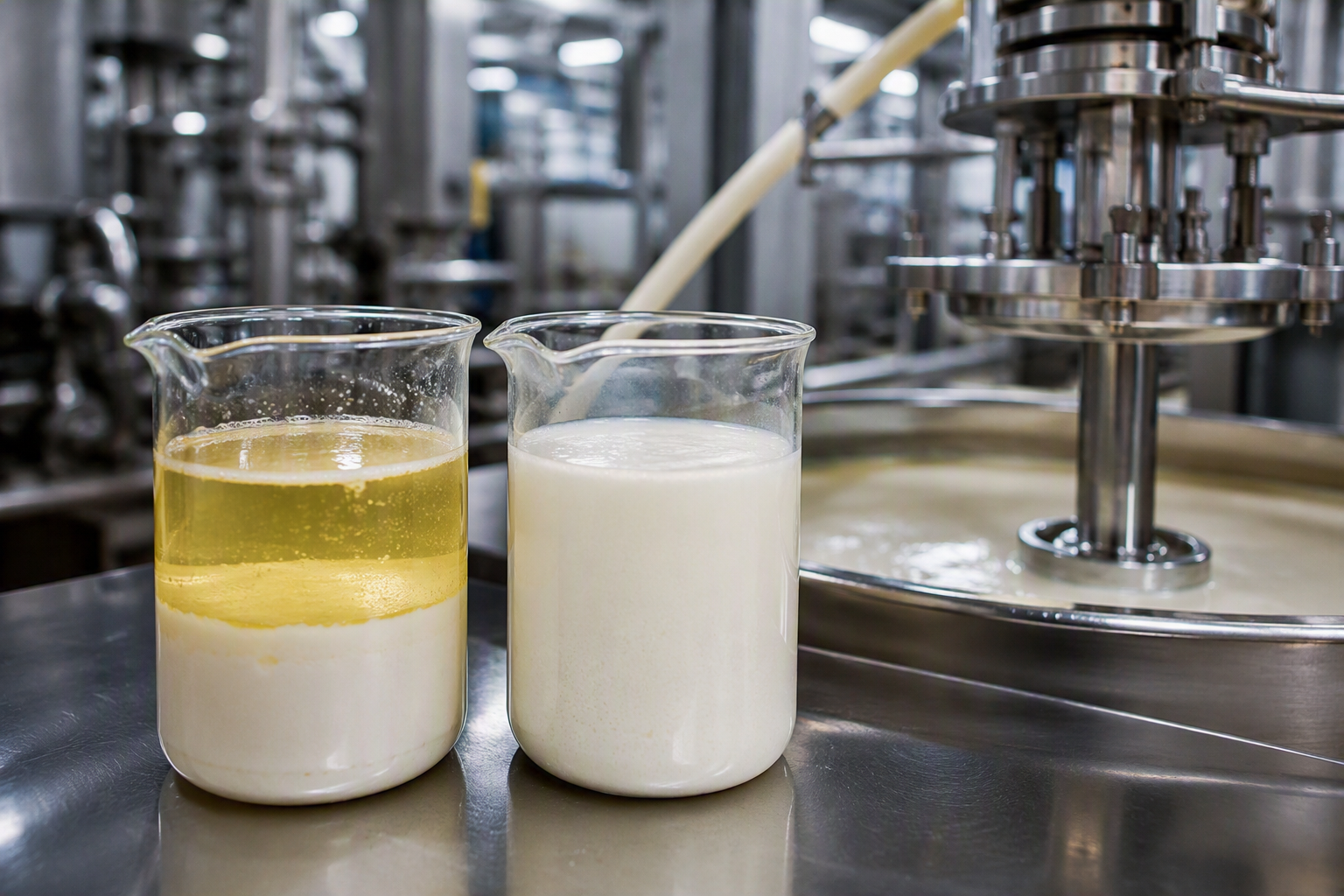
The production of mayonnaise, dressings, sauces, dairy beverages and plant-based milk alternatives is one of the most demanding processes in the food industry. What appears at first glance to be a simple mixing of oil and water is in reality a complex engineering challenge. Emulsions are thermodynamically unstable systems – two immiscible phases that constantly tend to separate in order to reduce their interfacial free energy. The manufacturer's goal is not to achieve permanent stability, but to slow down the separation process long enough for the product to maintain its quality throughout its entire shelf life.
What Actually Happens When an Emulsion Separates?
Emulsion separation is not a single event, but several different physical processes occurring simultaneously. Each of them has a different cause and requires a different approach to resolution.
Gravitational separation is the most visible form of instability. It is described by Stokes' law, which states that the rate of separation increases with the square of particle size and with the density difference between phases. This means that larger oil droplets or solid particles rise or sediment much faster than smaller ones. This is why droplet size is one of the key parameters of stability.
Flocculation is a process in which droplets cluster together without actually merging. Although the droplets remain separate, their grouping accelerates gravitational separation because the clusters behave as larger particles.
Coalescence is the most serious form of instability – the irreversible merging of droplets into larger units. When coalescence occurs, the total interfacial area decreases, and the emulsion is irreversibly destroyed. In mayonnaise, for example, this manifests as oil separation on the surface.
Ostwald ripening is a process in which large droplets grow at the expense of smaller ones. Although more common in nanoemulsions, it can also contribute to instability in classic food emulsions.
In plant-based beverages, a particular problem is protein aggregation into insoluble clusters, which further accelerates sedimentation.
Why Do Some Emulsions Separate Faster Than Others?
The differences in stability between products can be enormous. One study showed that the resistance to gravitational separation between the most stable and the least stable commercial product differed by more than forty times. These differences arise from several key factors.
Droplet size is arguably the most important factor. As Stokes' law shows, the rate of separation increases with the square of droplet diameter. The finer the droplets, the more stable the emulsion.
Density difference between phases also plays a crucial role. Whether it is fat rising to the surface or dense protein aggregates sinking to the bottom – both processes are accelerated by a large density difference.
Viscosity of the aqueous phase directly slows down droplet movement. A thicker, more viscous aqueous phase provides greater resistance to movement and slows down separation.
Surface charge of droplets creates electrostatic repulsion that prevents their approach and merging. When the pH approaches the isoelectric point of proteins, this charge disappears and droplets begin to stick together. This is why monitoring zeta potential is an important tool for understanding and predicting emulsion stability.
Plant-based beverages are particularly challenging because their proteins are less soluble and less surface-active than milk casein. Heat treatment further promotes protein aggregation, which accelerates separation.
How to Solve the Separation Problem in Production?
Solving emulsion separation requires a combination of proper raw material selection, appropriate process equipment and optimization of production parameters.
- Reduce droplet size by applying appropriate shear
Conventional mixing is not sufficient to create a stable emulsion. Propeller mixers generate low shear rates, typically below 50 s⁻¹, which is not enough to break up oil droplets in the aqueous matrix. Stable emulsion requires high-shear equipment operating in the range of 3,000 to 100,000 s⁻¹.
Rotor-stator technology, with rotor peripheral speeds reaching 20 to 30 meters per second, generates extreme hydraulic turbulence that breaks droplets down to sizes of 200 to 50 microns in standard emulsions, and even below 10 microns in micronization processes.
It is important to note that droplet size reduction is not linear with time. Once the equilibrium size for a given power input is achieved, further mixing only adds heat (which can damage proteins such as those from eggs) without further reducing droplet size.
- Choose the right emulsifier
Emulsifiers are molecules that position themselves at the oil-water interface and prevent droplet merging. The choice of emulsifier depends on the type of product.
Lecithin is one of the most commonly used natural emulsifiers. Egg yolk, rich in lecithin, is the key emulsifier in mayonnaise. For plant-based products, pea, soy or yeast proteins are increasingly used as emulsifiers.
Modified starches also have excellent emulsifying properties and improve stability during storage.
Hydrocolloids such as xanthan gum, guar gum and modified starches not only thicken the aqueous phase but also stabilize the emulsion.
- Adjust pH value
pH affects droplet charge and emulsion stability. When pH approaches the isoelectric point of proteins, electrostatic repulsion weakens and aggregation occurs. It is therefore important to maintain pH sufficiently far from the isoelectric point to preserve repulsion between droplets.
- Increase aqueous phase viscosity
Addition of hydrocolloids (xanthan gum, guar gum, modified starches) increases the viscosity of the aqueous phase and slows down droplet movement. This is particularly important for pseudoplastic and thixotropic systems, such as most dressings and sauces.
- Control temperature
Thermal stress is one of the greatest enemies of emulsions. Elevated temperatures accelerate all separation mechanisms, cause loss of viscosity, weaken electrostatic repulsion and denature proteins. Therefore, it is important to control temperature during production and storage.
- Optimize ingredient addition order
The order of ingredient addition can significantly affect stability. For example, research has shown that adding vinegar after emulsification produces a firmer and more stable mayonnaise compared to adding it before emulsification.
What Are the Most Common Mistakes in Industrial Production?
Insufficient shear is probably the most common mistake. Manufacturers often underestimate the amount of energy required to create a stable emulsion and rely on conventional mixing instead of high-shear equipment.
Wrong emulsifier selection can lead to instability, especially if the HLB (hydrophilic-lipophilic balance) value of the emulsifier is not considered in relation to the oil phase.
Neglecting pH often leads to sudden aggregation and separation during storage, particularly in protein systems.
Over-mixing after the optimal droplet size has been achieved only adds heat and can damage sensitive ingredients such as proteins.
Incorrect ingredient addition order can destabilize the emulsion at an early stage of production.