
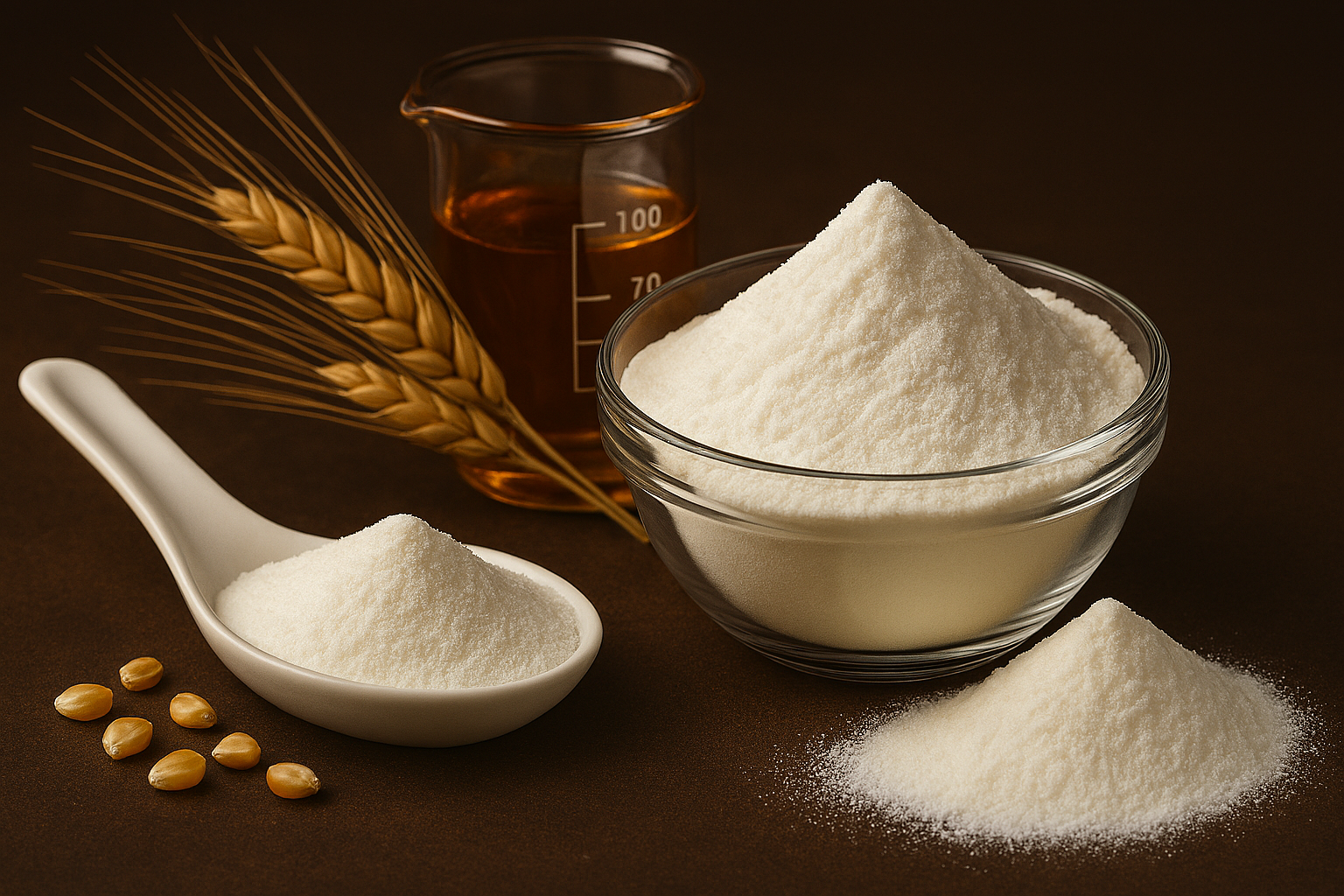
Maltodextrin is one of the most widely used ingredients in the modern food industry. It is present in powdered drinks, soups, confectionery fillings, meat and dairy products, snacks and food supplements. Yet it is often viewed in an oversimplified way – merely as a “cheap carrier” or a “neutral carbohydrate”. In reality, a proper understanding of its function, especially in relation to DE value, is crucial for successful product formulation.
This article focuses on what maltodextrin is, how DE value affects sweetness, solubility, viscosity and hygroscopicity, and how to choose the right type of maltodextrin for different applications in practice.
What maltodextrin is and how it is produced
Maltodextrin is a mixture of short- to medium‑chain carbohydrates obtained by partial hydrolysis of starch, most commonly corn starch, but also wheat, potato or tapioca starch. Through controlled hydrolysis of starch molecules, dextrins, malto‑oligosaccharides and a smaller fraction of glucose are formed, with the degree of hydrolysis expressed via the so‑called DE value (Dextrose Equivalent).
Unlike glucose or glucose syrups, maltodextrin has low to very low sweetness. It typically appears as a white, powdered ingredient, with a slightly sweet or almost neutral taste and very good water solubility. This combination of neutral flavour and functional properties makes it an extremely useful tool in formulation.
DE value: the key to understanding maltodextrin behaviour
DE value represents a measure of the degree of starch hydrolysis, i.e. the approximate share of reducing sugars expressed as glucose equivalent. The higher the DE, the shorter the average carbohydrate chain, and the sweeter, more soluble, more hygroscopic and more chemically reactive the product is in Maillard reactions. The lower the DE, the longer the chain, the lower the sweetness and the more the behaviour resembles native starch.
Maltodextrin is typically defined as a product with a DE value below 20. In commercial practice, however, “low DE” maltodextrins (e.g. DE 4–8), medium (DE 8–12) and higher within the maltodextrin range (DE 12–19) are often distinguished. Above this range we usually talk about glucose syrups, which have a different profile of functionality and sweetness.
Understanding DE value helps technologists predict solution rheology, browning rate during baking, stability in spray drying, impact on water activity, as well as the effect on texture, especially in dry and low‑moisture systems.
Functions of maltodextrin in formulation
Maltodextrin performs multiple functions at the same time, often even at relatively low levels. One of its basic roles is to increase solids content without significantly increasing sweetness. This is useful in beverages, dairy products and ice creams where the goal is to adjust “body”, mouthfeel and viscosity without disturbing the sweetener profile.
Another important function is its role as a carrier and encapsulant. In flavourings in powder form, instant drinks, vitamin preparations and sensitive lipid fractions, maltodextrin serves as a matrix that stabilises the active component and enables dosing, dissolution and protection from oxidation or volatilisation.
In confectionery products and fillings, maltodextrin affects texture and prevents sugar crystallisation, helps control stickiness and enables the desired short or creamy structure. In some applications it partially replaces fat, contributing to cost savings and modification of the nutritional profile.
In instant soups, sauces and savoury blends, maltodextrin stabilises the system, facilitates dosing and blending of powdered components, affects thickening upon rehydration and contributes to uniform dispersion of lipids and spices.
How DE affects sweetness, viscosity and hygroscopicity
As DE value increases, perceived sweetness increases, but low‑ to medium‑DE maltodextrins remain significantly less sweet than sucrose or glucose syrup. For formulators it is useful to know that DE 4–8 maltodextrins practically do not contribute to sweetness, while those closer to 18–19 can provide a mild sweet note.
Solution viscosity decreases with increasing DE, because shorter chains move more easily in solution. This means that low‑DE maltodextrins give thicker solutions at the same solids level compared to higher DE values. In practice, for powdered beverages or applications where low viscosity and easy solubility are required, maltodextrins of medium to higher DE are often chosen.
Hygroscopicity generally increases with DE, affecting caking, stickiness and the stability of the product in powder form. Low‑DE maltodextrins are usually less prone to clumping and behave better under elevated relative humidity, while higher‑DE products require more careful packaging selection and control of storage conditions.
Maltodextrin in beverages and instant drinks
In the beverage industry, maltodextrin is used to adjust the “body” of drinks, correct sweetness and as a carrier for flavours and vitamins in powdered products. In instant drinks, such as fruit drink powders or functional beverages, maltodextrin enables high solids, good powder flowability and rapid dissolution.
For these applications, maltodextrins of medium to somewhat higher DE (for example DE 10–18) are often chosen, depending on the desired solubility and impact on sweetness. Higher DE facilitates rehydration and contributes to a cleaner taste, but also increases hygroscopicity, which requires appropriate barrier packaging.
In isotonic and sports drinks, maltodextrin is also used because of its metabolic profile: it provides energy with lower immediate sweetness compared to sucrose, which is desirable in drinks that consumers ingest in larger volumes during physical activity.
Maltodextrin in dairy products and ice cream
In the dairy sector, maltodextrin is used in functional and protein drinks, fermented dairy drinks, desserts and ice creams. In such systems it affects viscosity, body and texture, and often stability during freezing and thawing.
In ice cream, maltodextrin is part of a complex system of sugars and stabilisers where it influences freezing point depression, ice crystal size and creamy structure. Low‑DE maltodextrins, due to their higher molecular weight, affect freezing point less than sugars and help reduce overall sweetness while maintaining desired solids and texture.
In protein drinks and yogurts, maltodextrin can contribute to a smoother texture and reduction of grittiness with certain protein systems, as well as improved sensory perception in reduced‑fat products.
Maltodextrin in confectionery products and fillings
In confectionery, maltodextrin is often used in cream fillings, toppings, jellies and caramel masses. Its role is to influence viscosity, prevent undesired sucrose crystallisation and help control chewy or creamy texture.
Low‑DE maltodextrins can contribute to higher firmness and body without increasing sweetness, while higher DE values bring mild sweetness, softer texture and easier melting in the mouth. In biscuit fillings, where preventing excessive hardening during storage is important, careful selection of maltodextrin type and dosage helps maintain a stable, uniform structure.
In products where stable and appealing flavour is important (for example fruit‑filled cookies), maltodextrin is also used as a carrier for flavour components, facilitating their dispersion and reducing the risk of migration and phase separation during shelf life.
Applications in bakery and snacks
In bakery products, maltodextrin is used in instant mixes, fillings, toppings and partly in dough itself. Its role is to stabilise the system, influence browning, volume and moisture distribution. Higher‑DE maltodextrins, thanks to their higher share of short‑chain sugars, can contribute to more intense crust colour via Maillard reactions, whereas low‑DE products act more as a neutral bulking agent.
In snacks and extruded products, maltodextrin helps to form the appropriate structure during extrusion, influences porosity and crispness, and serves as a carrier for seasonings and lipid components in coatings. DE value affects how maltodextrin behaves at high temperatures and low moisture, as well as the tendency of coating systems to stick and cake.
Maltodextrin in meat and savoury products
In meat products, maltodextrin has several roles: it increases solids in brines, affects viscosity and water‑binding capacity, stabilises emulsions and enables uniform distribution of spices, phosphates and other functional ingredients. Low to medium DE values are common in these applications to minimise sweetness and avoid undesired caramelisation during heat treatment.
In soups, sauces and savoury mixes, maltodextrin improves powder dispersibility, affects thickening during cooking and helps achieve uniform, slightly viscous mouthfeel. For instant soups and sauces, the right DE selection ensures stable powder, good rehydration and expected thickness after water addition.
Choosing maltodextrin by application: practical criteria
For proper selection of maltodextrin, technologists should start from a few key questions: target sweetness, desired viscosity, type of processing (heat, drying, extrusion), sensitivity of components that maltodextrin should carry or protect, and storage conditions of the finished product.
In beverages and instant drinks, maltodextrins of medium to higher DE are often suitable, ensuring good solubility and easy handling of powders with controlled sweetness. In dairy desserts and ice cream, low‑DE maltodextrins are typically used for texture control and limited influence on freezing point. In confectionery fillings, selection depends on desired firmness and sugar crystallisation dynamics, while in meat and savoury products the focus is on neutral taste, water binding and stability during cooking.
Laboratory and pilot‑scale trials, comparing different DE values and inclusion levels in the recipe, enable fine‑tuning of functionality and finding the optimal compromise between technological requirements, cost and sensory quality.
Conclusion
Maltodextrin is far more than a “neutral carbohydrate” or cheap filler. By understanding its structure and DE value, it becomes possible to precisely control sweetness, viscosity, hygroscopicity, browning and stability of numerous food systems. Correctly selected maltodextrin facilitates the development of new products, from beverages and dairy desserts, through confectionery fillings and bakery systems, to meat and savoury blends. For R&D and technical teams, it represents a flexible tool which, when used thoughtfully, delivers both technological and economic benefits while maintaining or improving the sensory experience of the final product.