
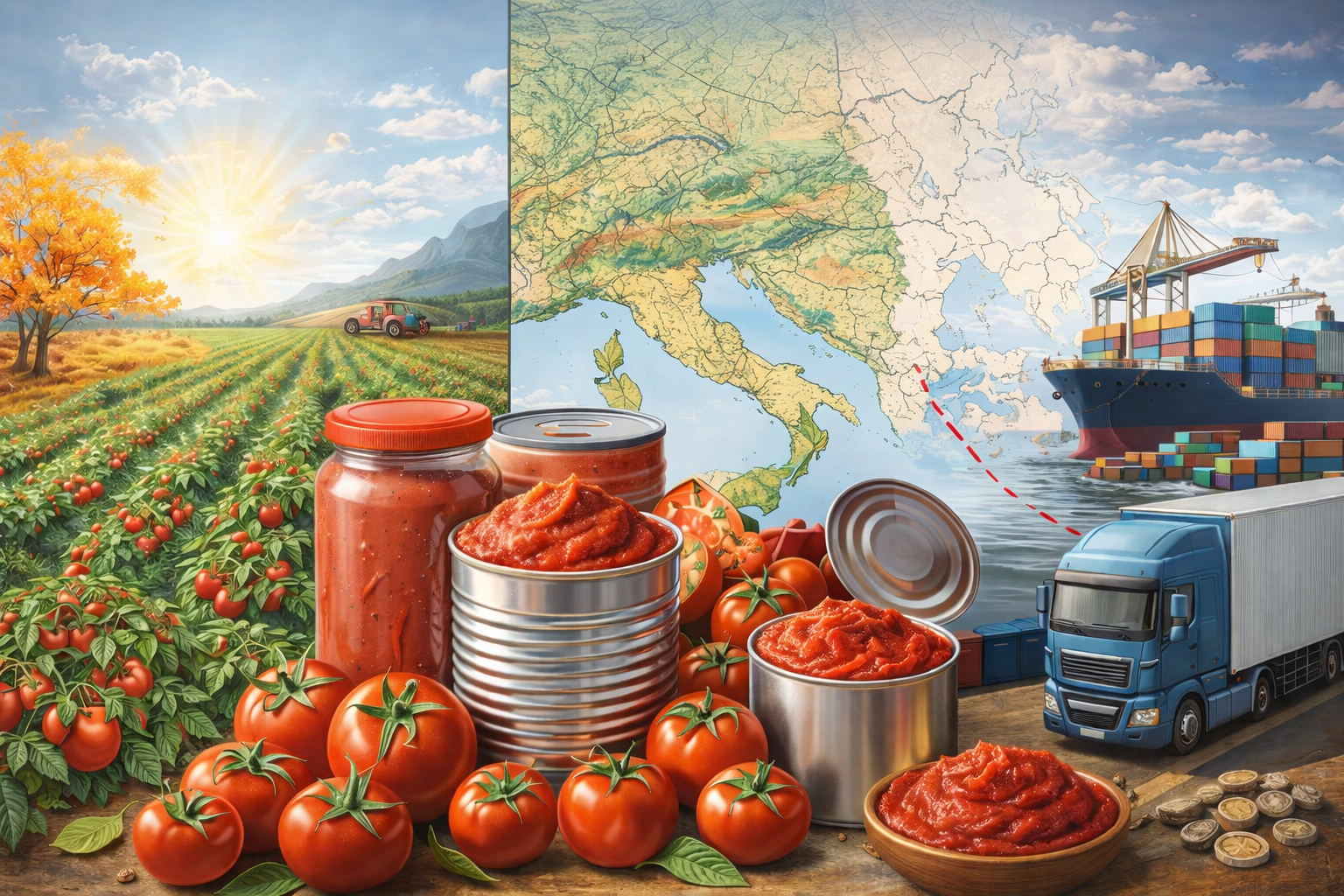
Tomato paste and tomato derivatives (passata, diced tomatoes, concentrates with different Brix levels) are among the key raw materials for a wide range of food products. They are used in sauces, ketchups, ready meals, soups, meat products and ready dishes for the HoReCa sector. For procurement and R&D teams, any change in the price of these raw materials directly impacts final product costing, margins and competitiveness. Understanding what exactly affects the price of tomato paste helps with contract planning, specification choices and formulation optimisation.
This article focuses on industrial tomato paste (concentrates from 28–30 Brix up to 36–38 Brix and higher) and related derivatives, with emphasis on the factors that shape the price the most: season, region of origin, Brix concentration and logistics.
Season and agricultural yield as primary price drivers
Tomato is a highly seasonal crop. In most major producing regions, processing fresh tomatoes into industrial paste takes place during a limited period of the year. The quantity of tomatoes processed, raw material quality and weather conditions during the season directly affect the available paste volumes for the entire following year.
When conditions are favourable, yields per hectare are high, dry matter content is stable and the industry receives sufficient raw material. Competition between processors and exporters is then stronger, so prices tend to stabilise or slightly decrease. In years with poor weather, extreme heat, drought, hail or disease pressure, yields and dry matter content decline. More fresh tomato is required to obtain the same kilogram of paste at a given Brix, which increases production costs and the final price.
For the industry it is important to understand that most of the price is effectively “locked in” during the processing season. Contracts signed during the campaign period often secure better conditions than purchasing on the spot market later in the year, when product may prove to be scarce. Therefore, coordination between sales planning, procurement and R&D is crucial in order to define volumes and specifications on time.
Region of origin: climate, standards and cost structure
The region of origin of tomato paste is one of the most visible but also one of the most complex price factors. Major global producers include Italy, Spain, Portugal, the United States (California), China, as well as certain producers in Türkiye and the wider Mediterranean region. Each region has a specific combination of climatic conditions, cost structure, labour availability and quality standards.
Regions with favourable climates and a long tradition of industrial tomato cultivation often show high production efficiency. However, in countries with stricter regulatory frameworks, labour, environmental and food safety standards, the total cost per tonne of paste can be higher, which is reflected in the price. At the same time, these regions often provide more stable and predictable quality, better traceability and compliance with EU and other relevant regulations, which is essential for brands operating in the EU or exporting to demanding markets.
On the other hand, countries with lower labour and energy costs can offer more competitive raw material prices, but the buyer must carefully assess parameters such as microbiological quality, colour stability, presence of foreign matter, compliance with pesticide MRLs and other regulations. In practice, many factories combine sources from different regions, balancing price, quality and supply risk.
Concentration (Brix): how much dry matter you really pay for
The Brix value of tomato paste (for example 28–30 Brix, 30–32 Brix, 36–38 Brix) indicates the content of dissolved solids, primarily sugars and soluble solids. In industrial practice, Brix directly affects the economics of use in formulations, because it is the dry matter that is effectively being paid for and used.
Higher Brix means more concentrated solids in the same volume of paste. At first glance, a higher Brix product appears more expensive per tonne, but when the price is converted to the cost per kilogram of dry matter, higher Brix often proves more cost‑effective and technologically efficient. In applications such as ketchup, thick sauces or industrial toppings, the possibility to use more concentrated paste shortens evaporation times, reduces energy consumption and optimises equipment capacity.
Conversely, for certain applications, maximum Brix is not necessary. In mild sauces, soups or products where tomato is not the dominant component, it can be more economical to use a medium Brix and adapt the recipe with additional water or other components. The key is to view the price in the context of the final formulation: how much the target dose of tomato dry matter per kilogram of finished product costs, rather than just the price per tonne of paste.
Concentrate quality: colour, flavour and processing behaviour
Even when the headline discussion is about price, quality is inseparably linked to overall economics. Paste with the same Brix value from different sources can have significantly different colour, flavour intensity and processing behaviour. Paste with a stronger, more stable red colour allows lower dosages in ketchups and sauces for the same visual impact, which lowers the effective cost in the final formulation.
Viscosity stability during heat treatment, resistance to phase separation and behaviour in combination with thickeners, starches or hydrocolloids also influence paste utilisation. If a high‑quality paste can reduce the cost of additional processing, colour or flavour corrections, or enable a cleaner label without certain additives, this has measurable value, even when the purchase price per tonne is somewhat higher.
For industry professionals, it is therefore practical to think in terms of total formulation cost and process performance, rather than focusing solely on the nominal price on the invoice.
Logistics: transport, storage and packaging
The logistics component is often underestimated, even though it can account for a significant part of the final cost per kilogram at the customer’s plant. Tomato paste is supplied in different forms: aseptic bags in steel drums, IBC containers, tankers and even smaller packs for specific industrial or HoReCa needs.
The distance from the producer to the end user’s factory directly affects transport costs, especially during periods of high fuel prices and limited availability of containers or trucks. Sea transport from distant regions can be cheaper per kilogram, but requires longer planning horizons, capacity bookings and inventory financing. Regional sources usually offer shorter lead times and greater flexibility, but may be more expensive in terms of product unit price.
Packaging does not only affect the cost, but also losses. Inadequate packaging, poor filling or handling can result in oxidation, colour changes, microbiological problems and rejected deliveries. Any product write‑off, additional filtration or reprocessing increases the real cost per kilogram of usable paste. In this sense, it can be worthwhile to pay more for a reputable supplier with strong logistics, a stable cold chain where required and an efficient shipment tracking system.
Impact of exchange rates and global supply chains
Although not explicit in the title, exchange rates and global supply chain dynamics significantly affect price, especially when tomato paste is imported. Prices are often quoted in US dollars or euros, so exchange rate movements directly affect the local currency price. Disruptions in supply chains, such as container shortages, port congestion or geopolitical tensions, further increase transport costs and extend lead times.
For food manufacturers, this means that it is important to consider long‑term contracts, hedging instruments or diversification of supply sources to mitigate the risks of sudden price spikes. Close cooperation between procurement, finance and production can significantly increase resilience to such shocks.
How R&D and procurement can optimise formulations and cost
A key best practice for the industry is to make sure that decisions regarding the choice of tomato paste and derivatives are not left solely to procurement or solely to R&D. Optimal results are achieved when technologists, product development and procurement jointly analyse the following: target level of tomato dry matter in the final product, functional requirements for colour, flavour and texture, regulatory requirements (for example, the percentage of tomato declared on the label) and overall cost calculation.
In some cases, it is possible to move to a higher Brix and reduce overall cooking energy costs. In other cases, switching to a slightly different region of origin can bring savings without compromising quality, but requires pilot‑scale testing. Sometimes it is cost‑effective to use a combination of paste and additional ingredients, such as modified starches or hydrocolloids, to achieve the desired viscosity and gloss with a lower proportion of paste itself, provided this is acceptable from a labelling and product positioning perspective.
Conclusion
The price of tomato paste and its derivatives is the result of a complex set of factors: seasonal yield, region of origin, Brix concentration, quality and logistics, with additional influence from global market movements and currency fluctuations. For the food industry, a rational approach means looking at the real cost per kilogram of tomato dry matter in the final product, not just the nominal price per tonne of paste. Through better seasonal planning, careful supplier selection and formulation optimisation, it is possible to achieve more stable prices, consistent quality and greater resilience to market volatility.