
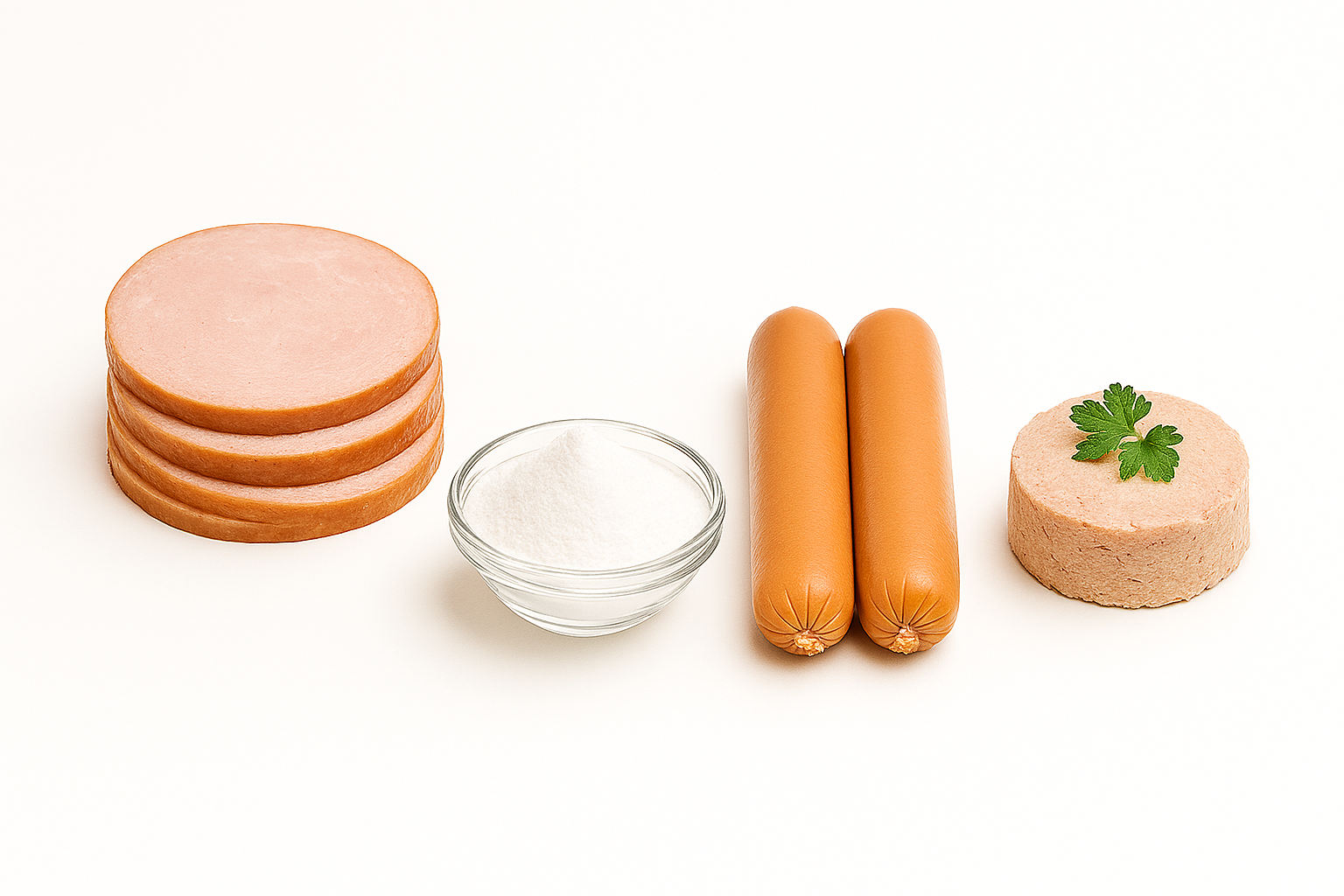
Phosphates are one of the key functional ingredients in the meat industry. A properly selected phosphate blend is often the difference between a stable, juicy product with high yield and a problematic batch with high cooking losses, separated water or fat and non‑uniform texture. However, “phosphate” is not a single substance – there are different types with different degrees of polymerisation, solubility, buffering capacity and ability to affect myofibrillar proteins.
This text focuses on the practical selection of phosphates for three typical product groups: formed ham, frankfurters (emulsified sausages) and pâtés. The aim is to explain the functional differences, what exactly we expect from phosphates in each of these systems and how technologists can better navigate commercial phosphate blends.
Basic functions of phosphates in meat
In meat products, phosphates primarily affect myofibrillar proteins (actin and myosin), ionic strength and pH. By increasing pH away from the isoelectric point of proteins, as well as increasing ionic strength, the protein structure opens up and extraction of soluble proteins during salting and tumbling is improved. These extracted proteins later form a three‑dimensional network that binds water and fat and provides the typical texture of hams and emulsified sausages.
Another important function of phosphates is the complexation of calcium and magnesium ions, which affects the stability of proteins and emulsions. Phosphates also have a buffering role, helping to keep the system pH in the optimal range for protein functionality, thermal stability and product safety. In practice, a single phosphate type is rarely used; most often these are carefully designed blends of pyrophosphates, polyphosphates and orthophosphates with different ratios and solubilities.
For the technologist it is important to understand that two phosphate blends with the same total phosphorus content will not necessarily give the same result in ham, frankfurters or pâté. Differences in composition and component ratios directly affect brine rheology, binding speed, slice appearance and cooking losses.
Differences between phosphate types from a functionality standpoint
From a technological point of view, the most important distinction is between short‑chain (e.g. pyrophosphates) and long‑chain polyphosphates. Short‑chain phosphates are usually more soluble and act faster on the protein system, enabling rapid extraction of myofibrillar proteins and a strong water‑binding effect. Long‑chain polyphosphates have a more pronounced effect on ion complexation and system stability, but act more slowly and are more sensitive to dissolution and processing conditions.
Orthophosphates have a milder effect on myofibrillar proteins and pH, but contribute to buffering capacity and overall ionic strength. In practical commercial blends, manufacturers combine these different types to achieve a balance between rapid and strong effect on proteins, stable pH, good solubility and minimal impact on taste.
Two phosphate blends may therefore be declared similarly but behave quite differently in ham, frankfurters or pâtés. The only reliable approach is to understand the target functionality and test in your own process conditions.
Ham: phosphates for maximum water binding and piece structure
For formed hams (chunk or reformed products), the main task of phosphates is to increase the water‑binding capacity of muscle tissue and ensure good adhesion between meat pieces, without an overly “rubbery” bite. Ham should have a juicy but not excessively elastic texture, a uniform slice and minimal purge in the package.
In these systems, the phosphate blend should provide efficient extraction of myofibrillar proteins during tumbling, with controlled pH increase. Excessive pH lift can lead to an overly rubbery texture and potential problems with colour stability, as well as the perception of “artificial” structure. This is why ham formulations often use blends combining pyrophosphates (for rapid protein activation) with orthophosphates and a moderate share of long‑chain polyphosphates, in order to balance functionality and sensory quality.
Correct dissolution of phosphates in brine is crucial. Poorly dissolved or locally overdosed phosphates can lead to non‑uniform structure, grey spots or “pockets” with different water binding. The technologist should pay attention to brine temperature, order of ingredient addition and mixing intensity to fully exploit the potential of the phosphate blend.
Frankfurters and emulsified sausages: stable emulsion and elastic texture
In frankfurters and other emulsified sausages, the role of phosphates is even more directly linked to myofibrillar protein extraction and meat emulsion stability. The final product is expected to have an elastic, uniform texture, without fat separation, jelly layer around the casing or voids in the slice. Yield after cooking and smoking should be high, with minimal mass loss.
In such systems, phosphate blends with a pronounced effect on pH and ionic strength are desirable, usually with a higher share of pyrophosphates and short‑chain polyphosphates. Their fast and strong interaction with myofibrillar proteins enables the formation of a stable protein‑fat matrix. This matrix later “holds” water and fat during thermal processing.
Unlike ham, frankfurters have a much finer structure, so control of meat particle size, temperature during chopping and the timing of phosphate addition is extremely important. If phosphates are added too early or at too high batter temperatures, their functionality may not be fully utilised or undesired texture changes may occur. The combination of phosphates with other functional ingredients, such as hydrocolloids and emulsifiers, further highlights the importance of selecting a phosphate blend specifically tailored for emulsified products.
Pâtés: fine texture, stable emulsion and spreadability control
Pâtés are specific because they are very fine, often heavily heat‑treated emulsions with a significant share of fat and water. Here, phosphates need to provide sufficient protein extraction to form a stable emulsion structure, but with very different rheological requirements compared to frankfurters. Pâté should be spreadable, smooth, without a separated fat layer on the surface and without syneresis during storage.
Phosphate blends for pâtés often have a more pronounced role in pH control and buffering capacity, with a somewhat milder “gelling” effect compared to those for frankfurters. The reason is the desire to achieve a soft, spreadable texture rather than pronounced elasticity. They are frequently combined with hydrocolloids that provide viscosity and prevent syneresis, while phosphates provide the basic protein network and emulsion stability.
In these products it is important to pay attention to the impact of phosphates on flavour. High doses, especially of certain polyphosphate types, can lead to a “soapy” or metallic aftertaste. Therefore, pâtés usually use blends with well‑balanced composition and strictly controlled dosage, as well as a carefully chosen matrix of other ingredients that can mask or emphasise any off‑notes.
Regulatory framework and dosage limits
Whether we are talking about ham, frankfurters or pâté, phosphates are subject to strictly defined maximum levels in the finished product. These limits are prescribed by national and often European regulations and are usually defined via the maximum total phosphorus from added phosphate salts.
The technologist must always take into account that total phosphate content in the product also comes from other ingredients (e.g. functional blends, brine additives and even some functional proteins or injection blends). Exceeding the permitted level can lead to regulatory issues, batch rejection and damage to the manufacturer’s reputation.
At the same time, consumer perception matters. Phosphates are easily recognisable on labels and part of the broader “clean label” debate. In many cases, the solution is not to remove phosphates entirely but to rationalise their use: optimise formulations, use more efficient blends, improve process control and leverage synergy with other functional ingredients to reduce the overall dose while maintaining functionality.
How to practically select a phosphate blend for a given product
When choosing phosphates for ham, frankfurters and pâtés, the technologist should start from the target product performance: desired yield, texture, sliceability, spreadability, flavour profile and technological process (injection, tumbling, chopping, canning). The next step is to decide whether the priority is fast protein extraction, stronger pH increase, more intensive calcium ion complexation or stronger emulsion support.
For ham, the emphasis is on piece adhesion, moderate elasticity and minimal purge in the package, with a moderate pH increase. For frankfurters, strong water and fat binding, elastic and homogeneous texture and minimal cooking losses are crucial. For pâtés, priority shifts to spreadability, emulsion stability, absence of syneresis and a neutral impact on flavour.
Collaboration with the phosphate supplier and testing under your own production conditions remain essential. Any change in raw material, degree of comminution, equipment or heat‑treatment regime can alter the optimal phosphate choice. Systematic trials and documentation of results allow you to reach, through a few iterations, the blend that best suits your specific product portfolio.
Conclusion
Selecting the right phosphate for ham, frankfurters and pâtés is not an administrative issue but a key technological lever that directly affects texture, juiciness, yield and product stability. Understanding the differences between phosphate types and knowing what is prioritised in each product system helps technologists choose a blend that delivers the optimal balance of functionality, cost and sensory quality.
Phosphates for ham should support formation of a stable piece structure with good juiciness, for frankfurters they should provide a strong, elastic protein network and a stable emulsion, and for pâtés they should enable a fine, spreadable structure and a stable emulsion without fat and water separation. Within regulatory limits and consumer expectations, a well‑chosen and rationally used phosphate blend remains one of the most important tools for achieving reliable quality in the meat industry.