
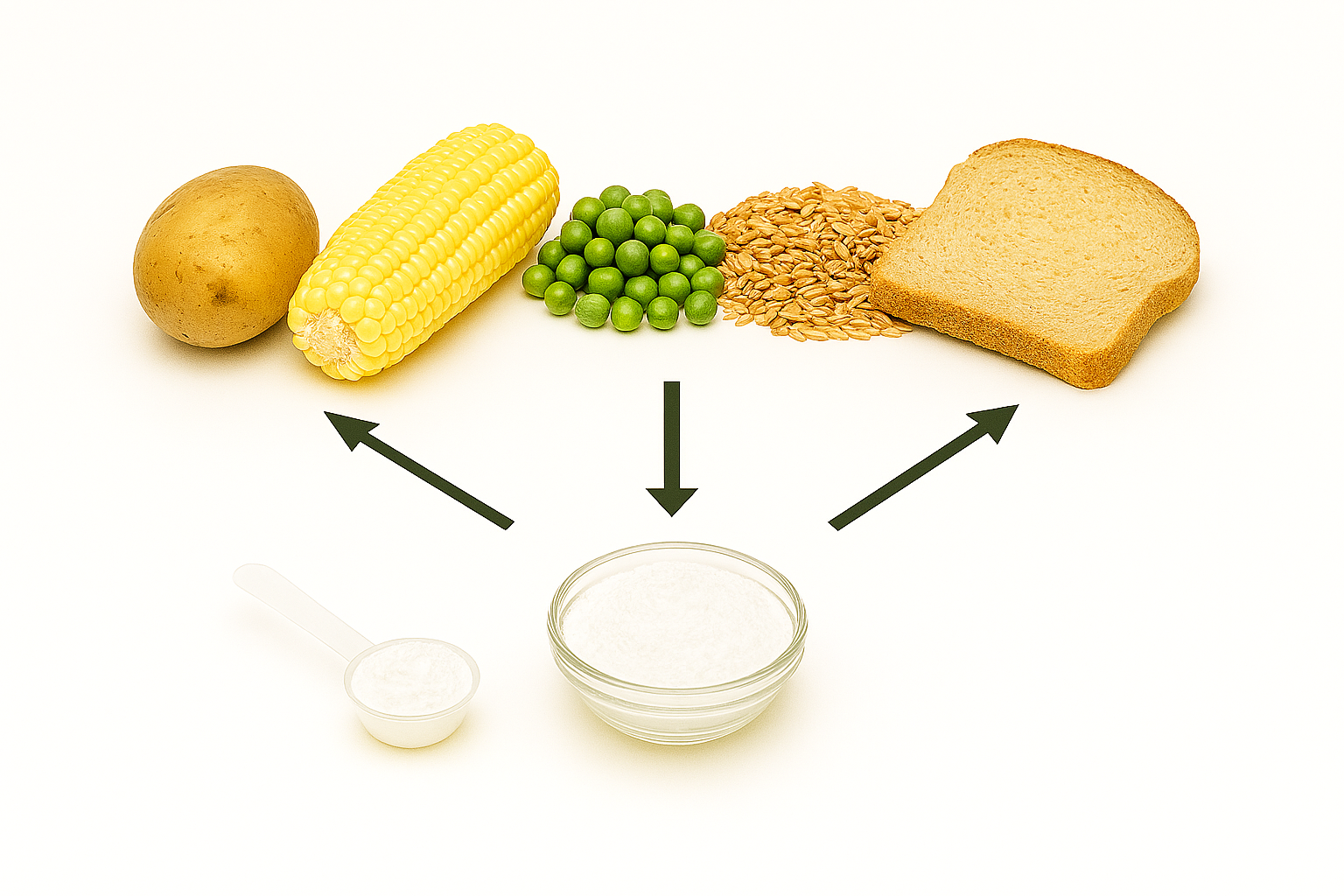
Increasing fiber content has become one of the key market demands, whether we talk about bread, snacks, meat products or dairy desserts. At the same time, consumers do not want changes in what they are used to: volume, softness, crunchiness or creamy texture have to remain recognizable. Resistant starch has proven to be one of the most useful tools for technologists, because it allows a declared increase of fiber content with minimal or no change in texture. In this text the focus is on technological and formulation use of resistant starch in different product categories.
What is resistant starch and why it “acts like fiber”
Resistant starch is the fraction of starch that resists digestion in the small intestine and largely reaches the colon, where it behaves like dietary fiber. Unlike regular starches, which are quickly digested and trigger a glycemic response, resistant starch contributes to lowering the effective glycemic load and improving the nutritional profile of the product. In most regulatory frameworks, certain types of resistant starch can be counted as fiber in the nutrition facts panel.
From a technological perspective, an important advantage of resistant starch is that it, depending on the type, behaves very similarly to regular starch or even flour, but without the typical “thickening” effect that characterizes many other fiber sources. This allows a fraction of flour or regular starch to be replaced with resistant starch and thus increase fiber content, with minimal changes in dough or mass rheology.
Bakery products: more fiber without “heavy” dough
In bakery, classic fibers (psyllium, bran, inulin, various plant fibers) often lead to increased water absorption, more difficult dough handling, a more compact crumb and higher brittleness or chewiness. In products where the consumer expects “standard” bread, sandwich toast or fine bakery goods, this compromise is often not acceptable.
Resistant starch, especially resistant corn starch, can replace part of the flour or native starch without significantly affecting dough viscosity and crumb structure. In standard breads and rolls it is possible to incorporate double‑digit percentages in the formulation, without obtaining a typical “wholegrain” or “fibrous” chewing sensation. It is important to properly adjust water and possibly strengthen the gluten network using wheat vital gluten, in order to maintain good gas retention, porosity and softness.
In cookies and biscuits, resistant starch is often used as a replacement for part of the flour or sugar, because it can help reduce energy density and total available carbohydrates. Since it does not act like typical highly‑thickening fibers, the spread, shape and crunch of the cookie can remain very similar to the original recipe, with an increased fiber content on the nutrition label.
Dairy desserts and drinks: texture under control
In fermented dairy products and dairy desserts, the consumer expects a smooth, creamy structure without grittiness or sandiness. Adding classic fibers may sometimes lead to a sandy mouthfeel or over‑thickening of the system. Resistant starch, if it has suitable particle size and functionality, can contribute to fuller body and mild thickening, but without a pronounced “gel” or lump formation.
In protein drinks and yogurts with increased protein and fiber content, resistant starch is used as part of the system that provides viscosity and mouthfeel, but also as a nutritional tool to achieve claims such as “source of fiber” or “high in fiber”. It is important to carefully harmonize resistant starch with dairy proteins, lactose or other sugars, and possibly stabilizers such as pectin or CMC, to avoid sedimentation and phase separation during shelf life.
In puddings and cream desserts, part of the regular or modified starch can be replaced with resistant starch. With the right balance with dairy proteins and fats, this provides the familiar spoonable or creamy texture, while significantly improving the nutritional profile in terms of fiber and glycemic response.
Meat and savory products: functional fiber without “rubbery” texture
In the meat industry and production of savory ready meals there is often a requirement to reduce energy intake, reduce saturated fat and increase fiber, without compromising typical texture. Classic fibers can disrupt protein–water interactions, change bite and lead to an overly firm or rubbery structure.
Resistant starch can enter the formulation as a functional carbohydrate that partly plays the role of a filler, increases water binding and contributes to stability, but without the typical “rubbery” feel given by highly dosed fibers. In emulsified sausages, pates, burgers and coated products, part of the standard starch or flour can be replaced with resistant starch with relatively small adjustments of water and seasoning mix.
In ready meals and sauces, resistant starch allows the formulator to increase fiber and reduce energy density while keeping the familiar viscosity profile. This is particularly interesting for products targeting retail and HoReCa channels focused on the “health & wellness” segment.
Impact on sensory properties and consumer perception
One of the biggest advantages of resistant starch is its discreet sensory profile. Unlike some fibers that can cause dryness, sandiness or excessive chewiness, a well‑chosen resistant starch generally does not significantly change mouthfeel. This enables manufacturers to develop products with fiber‑related claims, while the consumer practically does not notice a difference compared to the standard version.
Of course, sensory evaluation is mandatory, because the effect varies by category. In bread and rolls, small deviations in crumbliness or elasticity may be acceptable, while in premium cookies or creamy dairy desserts even minimal changes in crunchiness or smoothness may be noticed. For this reason, resistant starch is often introduced gradually, through several formulation iterations, to find an optimum between nutritional requirements and sensory stability.
Formulation and interactions with other ingredients
The technologist has to take into account that resistant starch is not completely inert. In bakery, replacing part of the flour with resistant starch reduces the effective gluten content in the dough, which may affect gas retention and crumb structure. Using wheat vital gluten or optimizing mixing and fermentation processes can compensate for this lost structure.
In other categories, it is important to consider interactions with proteins and fats. In dairy systems, resistant starch together with proteins and fats affects rheology and stability, so fine adjustments of stabilizers are often needed. In meat and savory products, it is necessary to harmonize the amounts of water, salt, phosphates and possible hydrocolloids to prevent purge of water and fat, without obtaining an overly firm structure.
Resistant starch can also affect extrusion, baking or frying. In extruded snacks it may change expansion and crunch, therefore trials under real process conditions are mandatory. In cookies and crackers it influences spread and browning during baking, which has to be taken into account when fine‑tuning the recipe.
Regulatory and marketing aspects
From a regulatory point of view, it is crucial that the resistant starch used is recognized as fiber in the relevant legislation or that it fulfills the dietary fiber criteria. Only then can its contribution be counted toward fiber content in the nutrition facts and be used for nutrition and health claims. From a marketing angle, resistant starch is interesting because it enables claims such as “source of fiber” or “high in fiber” in categories where the consumer does not necessarily expect it, such as standard cookies, snacks, filled products and even some chocolate and cream products.
From the clean label perspective, resistant starch is often perceived more favorably than some more complex fibers or additives. Nevertheless, the labeling approach has to be carefully aligned with regulations and expectations of target consumers. Transparent communication of benefits, without exaggeration and without promising effects that cannot be substantiated, is key to long‑term brand trust.
Where resistant starch brings the most value
Resistant starch brings most value where the goal is that “you don’t see it is there”. This means products in which the primary priority is preserving the familiar texture and sensory profile, while at the same time there is pressure to improve nutritional value through fiber and reduce glycemic response. In bakery, cookies, cereals, dairy desserts, protein drinks and savory ready meals, it can play a key role, especially when cleverly combined with other functional ingredients.
For the technologist, this is a tool that offers flexibility: instead of dramatic changes in recipe and process, it is often possible to introduce resistant starch as a partial replacement for flour, regular starch or part of the sugar, with relatively small adjustments. The result are products that meet regulatory and marketing goals, while staying true to what is most important to the consumer – taste and texture.