
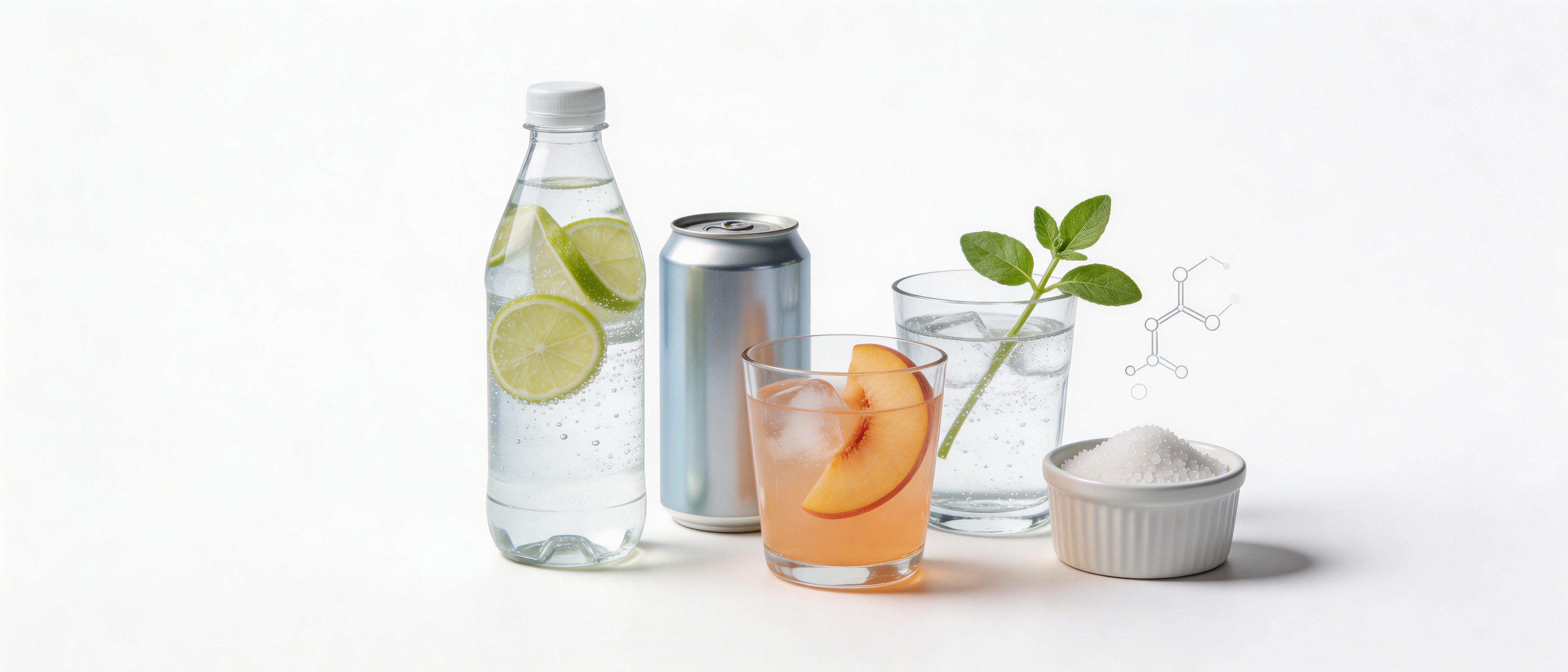
Low‑calorie drinks and products with no added sugar are no longer a niche; they are part of the standard portfolio of almost every brand. Consumers want less sugar and fewer calories, but are not willing to compromise on taste. For technologists, this creates a serious challenge: sugar is not just sweetness, it also impacts volume, texture, mouthfeel, flavour stability and even microbiological stability.
Sweeteners – from high‑intensity, low‑calorie options to nutritive polyols – have become key tools in the formulation of “light”, “zero” and “no added sugar” products. Their correct use requires a good understanding of sweetness intensity, temporal taste profile, synergies between ingredients, potential off‑notes and regulatory limits.
This article focuses on how sweeteners are used in low‑calorie beverages and no added sugar products, with emphasis on technological aspects, impact on taste, labeling and stability.
What “low‑calorie” and “no added sugar” mean in practice
From a regulatory point of view, the terms “low‑calorie”, “sugar‑free” and “no added sugar” are not the same. “Low‑calorie” usually means a significant reduction in energy value compared to a reference product. “Sugar‑free” typically means the sugar content is below a defined threshold (for example less than 0.5 g sugars per 100 ml/g). “No added sugar” means no mono‑ or disaccharides such as sucrose, glucose or fructose, nor honey, syrups or concentrated fruit juices have been added as a source of sugar, while intrinsic sugars from raw materials (fruit, milk) may still be present.
For the food technologist, this means combining different types of sweeteners to achieve the target sweetness and energy value, while respecting acceptable daily intake (ADI) limits for high‑intensity sweeteners and growing consumer expectations for a “cleaner” label. In practice, this often leads to combinations of nutritive sugar replacers (polyols) and high‑intensity sweeteners (for example steviol glycosides, synthetic sweeteners), with adjustments in acidity, flavour and sometimes added fibre to compensate bulk.
Types of sweeteners and key characteristics
High‑intensity sweeteners (steviol glycosides, sucralose, acesulfame K, aspartame and others) deliver multiple times the sweetness of sucrose with negligible caloric contribution. Their main advantage is efficiency – achieving the desired sweetness at very low dosages. The main challenges are different temporal sweetness profiles and potential off‑notes such as bitterness, metallic or licorice‑like taste.
Polyols (erythritol, maltitol, sorbitol and others), which we consider collectively as sugar replacers, have lower energy values than sucrose and different sweetness levels, but behave more similarly to sugar from a technological perspective: they contribute bulk, affect viscosity, mouthfeel and freezing point depression. They are used more cautiously in beverages because of their potential gastrointestinal effects at higher intakes, but play a central role in confectionery “no added sugar” systems.
In low‑calorie beverages, a combination of a bulk component (a small amount of sugar, some polyol or maltodextrin) and one or more high‑intensity sweeteners is therefore often applied, to deliver the most sugar‑like taste and body with restricted calories.
Formulating low‑calorie beverages: balancing sweetness and taste profile
In non‑alcoholic soft drinks, consumers have a very clear benchmark: the classic sugar‑sweetened version. This means low‑calorie and “zero” products must mimic not only the level of sweetness, but also the way sweetness develops and disappears over time, as well as the mouthfeel that sugar provides.
High‑intensity sweeteners often give a different, “sharper” sweetness signal, with a fast onset and a long sweet aftertaste that may feel unnatural. For this reason, they are rarely used alone in commercial formulations. Combinations such as acesulfame K + sucralose or steviol glycosides + erythritol allow formulators to exploit synergistic effects, reduce the dose of each single sweetener and mitigate off‑notes.
The beverage matrix itself strongly affects perception. In drinks with fruit juice or citrus flavours, certain bitter or metallic notes are more easily masked by acidity and intense flavouring, while in lightly flavoured waters any imperfection in the sweetener profile becomes more evident. This is why cola drinks typically use a different sweetener system than flavoured waters or energy drinks.
Body, texture and mouthfeel in sugar‑free beverages
Sugar contributes both sweetness and body. Low‑calorie drinks sweetened only with high‑intensity sweeteners can feel thin and watery, which consumers subconsciously interpret as “diet” and less satisfying.
To compensate, formulators include components that slightly increase solids and provide a sense of fullness: limited amounts of polyols, fibres or low‑DE maltodextrins. Although these cannot fully replace all functional roles of sugar, they can significantly improve the overall sensory experience.
The key is not to overshoot, in order to avoid an overly viscous texture, particularly undesirable in carbonated soft drinks, where too high viscosity compromises refreshment perception. Fine‑tuning between perceived fullness and refreshing character is one of the main tasks for R&D teams.
Sweeteners in “no added sugar” confectionery products
In beverages, the main focus is the sweetness profile and mouthfeel, while in no added sugar confectionery technologists must also replace the bulk that sugar provides. In chocolate, biscuits, bars and cream fillings, sugar is a structural element: it affects firmness, crystallisation, water activity and shelf‑life.
In these systems, polyols and other sugar replacers take over the “bulk” function. They provide mass and influence texture and water activity, while high‑intensity sweeteners are used to fine‑tune sweetness, because most polyols have less than 100% sweetness relative to sucrose. It is also important to consider the cooling effect (endothermic dissolution) of some polyols, as well as potential laxative effects at high intakes, which directly impact mandatory labelling.
In cream fillings and spreads, the sweetener system must be aligned with the fat phase, emulsifiers and stabilisers in order to maintain desired spreadability, emulsion stability and shelf‑life. Poor sweetener choices can lead to unwanted crystallisation, grainy texture or syneresis during storage.
Stability of sweeteners and interactions with other ingredients
Not all sweeteners react the same way to heat, pH changes or extended storage. Some high‑intensity sweeteners are sensitive to high temperatures or acidic conditions, which can result in loss of sweetness and off‑flavours over shelf‑life. For this reason, the development of low‑calorie drinks must include testing both immediately after production and after accelerated and real‑time storage.
Interactions with acids, flavours, colours and preservatives can significantly influence taste perception. Certain flavours pair better with certain sweeteners, so flavour houses often develop specific profiles optimised for “zero sugar” applications. In confectionery, hygroscopicity of some sugar replacers adds another challenge, as it may lead to changes in crispness or sticky surfaces.
Regulation, labeling and consumer perception
The use of sweeteners is strictly regulated: which sweeteners are permitted, in which product categories and at what maximum levels. Additionally, products containing polyols often must carry a warning about possible laxative effects when consumed in excess.
From a marketing perspective, consumer perception is increasingly important. Steviol glycosides and so‑called plant‑based sweeteners often enjoy a more positive image than classical synthetic sweeteners, even though both groups have undergone rigorous safety assessments. At the same time, some consumers are sensitive to long ingredient lists and numerous E‑numbers, which drives a trend towards shorter labels and more carefully selected sweetener combinations.
For technologists, this means formulations must balance three goals: sensory acceptability, technological robustness and regulatory/marketing requirements. Sometimes a slightly less aggressive calorie reduction is deliberately chosen, so that a simpler and more consumer‑friendly ingredient list can be maintained.
A practical approach to developing “light” and “no added sugar” products
Developing a low‑calorie drink or a no added sugar confectionery product is typically an iterative process. Multiple sweetener systems are usually tested, with fine adjustments to acidity, flavour profile, viscosity and, for confectionery, structure and moisture distribution.
One practical strategy is to first define the target sweetness as a sucrose equivalent, then use internal sensory panels to select sweetener combinations that deliver the closest temporal sweetness profile and mouthfeel. Technological parameters, stability and cost are then optimised. For confectionery products, storage, distribution and handling conditions must be simulated to assess resistance to crystallisation, syneresis and changes in crispness or spreadability.
In practice, it often makes sense to develop different variants for different markets, as preferences regarding sweetness intensity and acceptance of certain sweeteners (for example stevia vs synthetic sweeteners) can vary substantially.
Conclusion
Sweeteners in low‑calorie beverages and no added sugar products are far more than simple sucrose replacements. They form part of a complex functional system that must recreate not only sweetness, but also body, texture, stability and expected shelf‑life.
High‑intensity sweeteners provide the necessary sweetness strength with minimal calories, while polyols and other sugar replacers bring bulk and structure, particularly in confectionery systems. A successful formulation requires understanding interactions with acids, flavours, hydrocolloids and starches, as well as close monitoring of changes over product life.
Ultimately, success depends on striking the right balance between taste and nutritional profile, between technological robustness and label simplicity, and between formulation cost and consumer expectations. Manufacturers who master this balance gain a real competitive advantage in the fast‑growing “better‑for‑you” category.