
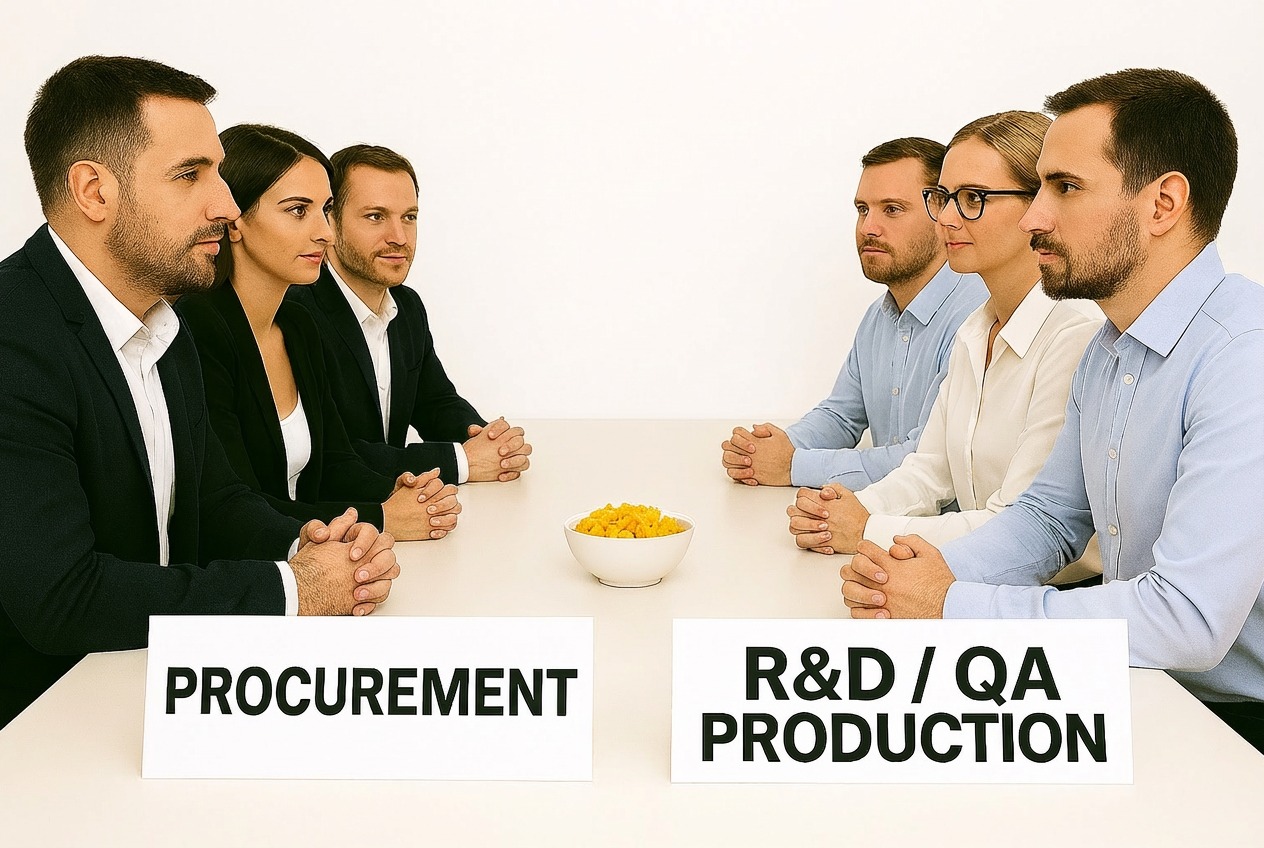
In the food industry, every new raw material affects product quality, safety, shelf life, process performance and cost. If procurement alone selects suppliers, driven almost exclusively by price, you risk process issues, sensory problems, documentation gaps and more complaints.
That’s why selecting a new supplier is a shared responsibility of three functions. Procurement leads the process, gathers offers and negotiates terms. R&D/technologists evaluate functionality and process behavior. QA checks safety, compliance and documentation. Only when all three perspectives are covered is the supplier decision truly controlled.
Jointly defining requirements before sending RFQs
Before procurement sends any RFQs, it must define, together with R&D and QA, what exactly the company is looking for.
R&D formulates technical and technological requirements: type of raw material, key parameters (e.g. dry matter, fat, protein content, viscosity, solubility, particle size), expected behavior in the process (pH and temperature range, stability during heat treatment) and intended use (for example: dairy dessert, bakery filling, processed meat product, spreadable cheese, juice, carbonated drink, cream, topping…).
QA adds requirements related to safety and regulation: necessary microbiological and chemical limits, allergen requirements, GMO status, Halal/Kosher or vegan status, as well as which certificates and statements the supplier must have (BRC/IFS/FSSC, HACCP, declarations of compliance with EU and local regulations).
Procurement defines commercial and logistics frames: target price range, payment terms, minimum and maximum delivery quantities, expected lead times, packaging type, storage conditions and minimum remaining shelf life at delivery.
The result is a unified requirement specification used for all suppliers. If this is not done properly, time will be wasted later on suppliers who may be cheap but unable to meet basic technological or QA requirements.
How to create a supplier shortlist
Once initial offers and basic information arrive, the next step is a joint screening.
Procurement first prepares an overview of offers – prices, payment terms, lead times, basic company information (size, references, country of origin) and brief info on certifications. This is the starting point, but not the final decision criterion.
At this stage QA checks whether the certificates claimed by the supplier are real and valid, whether a HACCP/FSMS system is in place and whether there is any obvious elevated risk (for example for materials known for fraud or contamination in certain regions).
R&D then checks whether the specification offered by the supplier even fits within the defined requirements, i.e. whether such a material can run in the existing process and equipment. Often at this level it is already clear that particle size, emulsifier type, starch type or solubility are simply not suitable.
Based on this joint assessment, a shortlist of suppliers is created – only with them does it make sense to proceed further, request samples and complete documentation.
Samples and documentation: a filter before expensive trials
For shortlisted suppliers, samples and documentation should be treated as the first serious filter.
Procurement coordinates shipment of samples and ensures they are representative of commercial goods, not “special, hand‑picked” material just for testing. At this stage they can already discuss preliminary commercial terms, clearly marked as “subject to successful validation”.
QA requests the full specification, CoA for the specific sample, allergen and GMO statements, and where relevant, information on pesticides and heavy metals, as well as copies of certificates. These documents quickly reveal how serious the supplier’s system is. If documents are late, incomplete or contradictory, this is a warning sign regardless of price.
R&D defines how the sample will be tested: whether it first goes into a lab trial and then, if successful, into pilot or directly into a trial production run, which formulations will be used and which success criteria must be met (texture, taste, aroma, color, stability, yield, line behavior).
If QA concludes that the documentation does not meet basic requirements, further technological testing is essentially pointless. It is important to agree this principle in advance so that resources are not spent on materials that QA would block at a later stage anyway.
Technological testing under real conditions
Once the documents are acceptable, technological testing starts, first in the lab and then, if needed, on the line.
In the lab, the team checks whether the material does what the specification promises. For example: does the thickener reach target viscosity under the specified conditions, does the emulsifier create a stable emulsion, does the protein contribute to the expected texture, is the solubility really good at the intended temperature and pH. In parallel, a sensory evaluation is performed: any off‑flavours or off‑odours, appearance, color and impact on the final product look.
If lab results are satisfactory, pilot or production trials follow. Here the focus is on how the raw material affects the process flow: does it change line speed, cause foaming, sedimentation, sticking to equipment or slower CIP; what is the impact on overall line robustness. Product stability during storage is also observed – at least through a shorter test to see whether syneresis, phase separation, color change or texture change appears.
During this time, QA runs its own analyses on samples and trial batches and compares the results with the supplier’s CoA. Significant discrepancies signal that the supplier’s process is not stable or that the lab is unreliable. QA also checks whether the new raw material introduces new allergens or critical points into HACCP, which might require updating procedures.
Procurement participates in the final debrief so they can directly hear from R&D and QA why a certain supplier is good or problematic. This makes later negotiations easier and prevents rejections from being interpreted simply as “too expensive” or “we don’t like it”.
Joint risk assessment and decision making
Before the final decision, all three functions should jointly assess risks.
R&D assesses how stable the raw material is from batch to batch, how sensitive it is to process variation and whether additional operator training or process tuning is needed. A material that operates “on the edge” of process capability may be cheap per kilogram but expensive due to downtime and waste.
QA evaluates the robustness of the supplier’s system, speed and quality of responses to questions, as well as incident history for this type of material or region. If the supplier passes technically but leaves many open questions, the risk is that issues will appear only once you’ve already introduced larger volumes.
Procurement considers the total economics: not just price per kilo, but also impact on dosage, yield, waste, complaints and potential product returns. They also assess logistics risks – lead time, geopolitical stability of the region, dependency on a single supplier – and decide whether a back‑up source is needed.
It is useful to record this assessment in a simple template where each supplier gets scores on key criteria. Based on this, the team takes a joint decision and documents it clearly. Later, it is transparent why a supplier was selected or rejected, and responsibility is shared.
Supplier onboarding and monitoring of initial deliveries
The decision does not end the process – it starts the onboarding phase, which is equally important.
Procurement negotiates the contract, but the contract should not only list price and lead times; the technical specification must be an integral, binding part, along with mandatory CoA for every delivery, complaint handling terms and communication rules for deviations. This significantly reduces room for “misunderstandings”.
QA implements enhanced incoming inspection for the first several deliveries. Analyses are more frequent or more detailed than in normal routine, and results are systematically compared with CoA and expected values. If the supplier proves to have a stable process and to respect the specification, the control level can be reduced after the agreed monitoring period.
R&D monitors how the material behaves in daily production – whether the same behavior seen in trials repeats under full‑scale conditions, or whether new deviations appear related to larger volumes, other equipment or slightly different conditions. Minor recipe or process adjustments are made if needed.
It is important to define this intensified monitoring period in advance (for example, the first 3–5 deliveries or the first few months), as well as the criteria based on which the supplier is considered fully “approved”.
How to maintain cooperation between procurement, R&D and QA
To keep this way of working alive in practice, it helps to establish a few simple rules.
First, at least quarterly joint meetings should be held to review key suppliers and raw materials: quality issues, price changes, logistics risks, upcoming specification changes announced by suppliers. Second, a list of “critical materials” should be defined (those that strongly impact safety, quality or process performance), for which a stricter procedure for approval and monitoring is mandatory.
Third, standardized templates should be created: a unified specification signed by R&D and QA, a supplier questionnaire that covers technical, QA and commercial aspects, and a validation report for new raw materials or suppliers. The more standardization there is, the less decisions depend on individuals and the more on a clearly defined process.
Conclusion
Selecting a new supplier in the food industry must combine three perspectives: technological, QA and procurement. If procurement acts alone, the risk is high; if R&D and QA insist only on ideal solutions without considering commercial reality, the process becomes too slow and expensive.
The best results come when procurement leads the process but involves R&D and QA at all key milestones: defining requirements, testing samples, making the final decision and monitoring initial deliveries. In that case, the company gains stable quality, fewer complaints and a predictable supply chain – with optimized costs and controlled risks.