
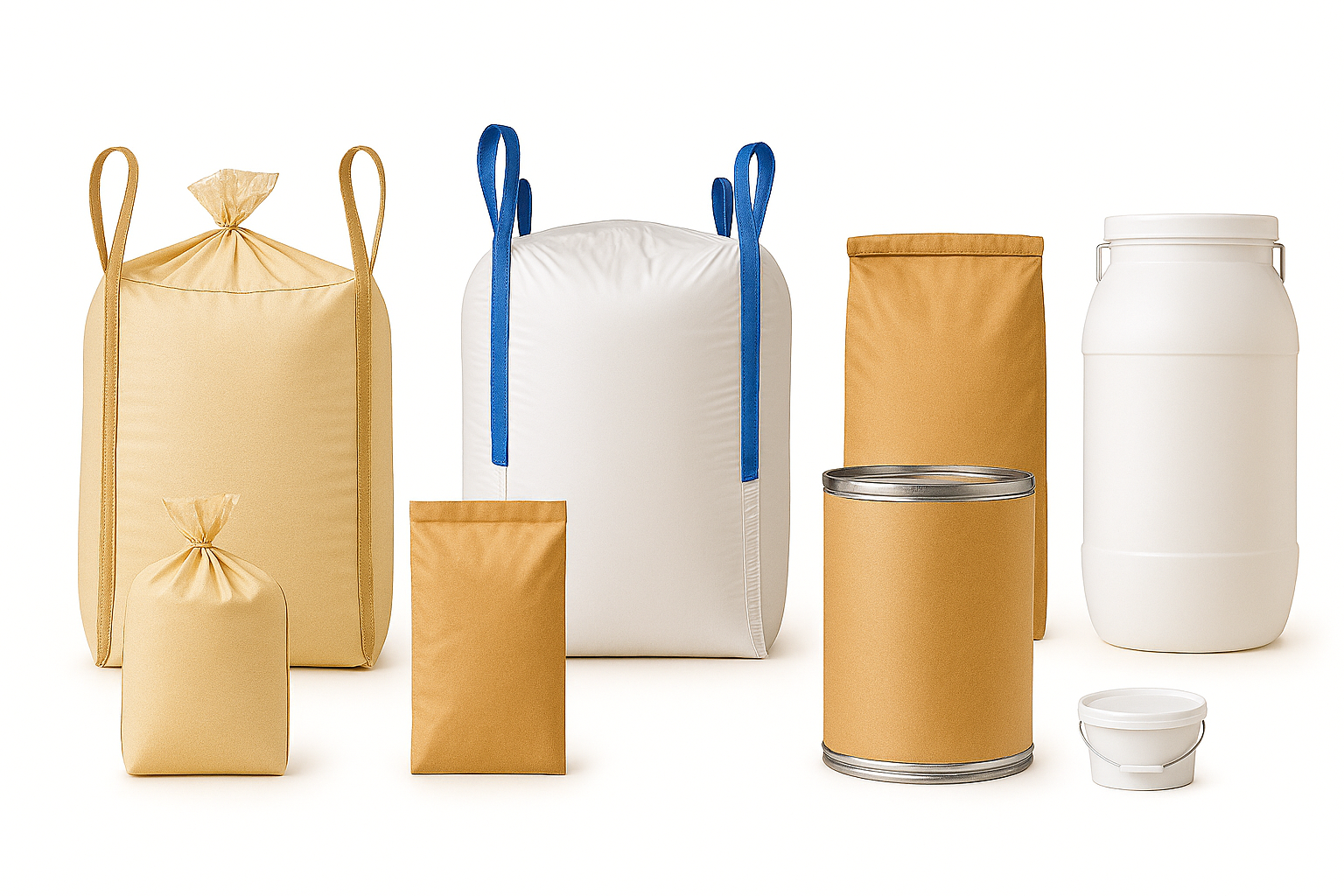
In most food factories, raw materials such as flour, sugar, salt, milk powder, starch, proteins or additives can arrive in three main formats: bulk (loose product in tankers and silos), big bags (FIBCs) or classic 10–25 kg sacks. At first glance, it may seem enough to compare prices per kilo and pick the cheapest option. In reality, the true cost of packaging only emerges once you factor in labor, unloading speed, line stoppages, losses, storage space, occupational safety and food safety risks.
This “hidden” part of the cost often makes the difference between a profitable and an unprofitable decision. That’s why it’s essential to understand what each option gives you and what it takes away – not just in purchasing, but in day‑to‑day operations.
Bulk: maximum automation and the lowest cost per kilo
Bulk means the material is delivered by tankers or silo trucks and unloaded directly into your silos or closed vessels. The supplier has no cost of unit packaging, pallets or manual packing, which almost always results in the lowest price per kilo compared to big bags and sacks. For the plant, bulk also means minimal manual handling: materials are transferred by pumps, screw conveyors or pneumatic systems, with no lifting and opening of packages, no piles of packaging waste and no constant interruption of work to add another sack.
The greatest benefit of bulk is faster and more stable processing. A tanker with, say, 24–26 tons of material can be unloaded in an hour or two, and the material is immediately available in the silo. This is especially important in segments with large, continuous consumers: bakery (flour), confectionery (sugar, cocoa mixes), dairy (sugar, milk powder) or beverage production (sugar, syrups). Lines suffer fewer stoppages, and dosing is easier to automate and control.
However, bulk comes with a different kind of cost. It doesn’t show up in the purchase price, but in the investment the plant has to make. You need silos (steel or concrete), conveying systems, dust filtration, level measurement and monitoring. If the materials are sensitive or prone to caking, you may need additional equipment for aeration, vibration or bridge‑breaking in the silo. For allergens and high‑hygiene materials, cleaning (CIP or other systems) is another layer of complexity.
Flexibility is limited as well. Bulk makes sense when volumes are high and material specifications are relatively stable. If you frequently change flour type, sugar particle size or milk powder grade, you’ll need additional silos or complex cleaning and changeover procedures, which increases cross‑contamination risk, especially with allergens. This is why bulk is best suited for large bakeries, dairies, confectioners and beverage producers that consume tens or hundreds of tons of a given material per month and run stable, repetitive recipes.
Big bags: the middle ground between bulk and small sacks
Big bags (FIBCs) typically contain 500 to 1,000 kg of material and represent a compromise between bulk efficiency and sack flexibility. Compared to small sacks, big bags usually offer a lower price per kilo because packaging is faster and cheaper for the supplier and the amount of packaging per ton is much smaller.
From a production perspective, switching from sacks to big bags often significantly reduces manual labor. Instead of opening and emptying dozens or hundreds of sacks per shift, operators handle a few big bags that are hung on a frame, opened from a controlled position and discharged into receiving hoppers or feeding stations. This cuts down the number of manual operations, reduces spillage and dusting, and lowers the risk of dosing errors caused by “counting sacks” per batch.
Still, big bags come with certain requirements. You need stable frames, proper discharge equipment (with good sealing and dust collection) and enough forklifts, plus operator training for working with suspended loads. For materials that are consumed slowly, a big bag can remain partially or fully open for a long time, raising the risk of moisture pickup, caking or microbiological contamination. So you should consider not only total monthly or yearly consumption, but also the usage pattern per line.
Big bags usually make most sense for mid‑sized users: plants that consume from a few to a few dozen tons of a given material per month, where bulk is not yet justified or not possible (limited space for silos, high CAPEX, too many different material types). In bakery, this can be medium‑sized bakeries with higher flour or sugar usage; in meat and savory industries – larger users of salt, phosphates, starches and proteins; in dairy – sugar and milk powder; and in confectionery – sugar, cocoa or certain starches.
Once the analysis is done properly, the switch from sacks to big bags often brings a significant reduction in labor cost, less packaging waste and better ergonomics for operators, even when the purchase price per kilo is almost the same.
Sacks (10–25 kg): maximum flexibility, but also maximum hidden cost
Classic 10, 20 or 25 kg sacks are still the most widespread format in many plants. Their key advantage is flexibility: it’s easy to change suppliers, test new materials, order smaller quantities or run small and special batches. This is particularly important for more expensive and specialized ingredients – enzymes, additives, functional blends, specialty proteins, starter cultures – where consumption is low and value per kilo is high. For start‑up plants, pilot lines and product development, sacks are practically unavoidable because they don’t require any special infrastructure.
However, with sacks the gap between price on the quote and total cost is often the largest. Manual handling of sacks is labor‑intensive and physically demanding. Every sack must be lifted, carried to the point of use, opened, emptied and the packaging disposed of. When this is repeated hundreds of times during a shift, labor costs become significant, and the strain on workers’ musculoskeletal system serious. This increases the risk of injuries, sick leave and productivity loss.
Manual work also increases the risk of errors: if dosing is based on the number of sacks, one missed sack or one extra sack can easily disrupt the recipe. In bakery this means variations in loaf volume and crumb structure, in dairy unstable texture of yogurts or desserts, in meat processing deviations in water binding or product firmness, and in confectionery differences in texture and hardness. Add to that the dust generated when opening sacks, which is problematic not only for people but also for hygiene and food safety.
Packaging waste is another major issue. A large number of sacks means large amounts of paper or plastic that must be collected, stored, compacted and removed or passed on to recyclers. In the context of limited storage space and rising waste disposal costs, this segment is becoming increasingly important, especially when you look at total costs per ton of finished product.
Where the cost really hides: more than price per kilo
When choosing between bulk, big bags and sacks, the purchase price per kilo is only the starting point. To get a realistic picture, you also need to include:
- the time and number of people needed for unloading, opening, emptying and dosing materials,
- the impact of packaging format on production speed and continuity (stoppages, waiting for material, bottlenecks),
- typical losses (spills, residues in packaging, damaged sacks, spoiled opened units),
- required warehouse space and its cost, especially for conditioned or refrigerated storage,
- the cost of managing packaging waste,
- occupational health and safety risks (lifting loads, dust, working with suspended loads),
- impact on food safety (number of contact points, contamination opportunities, time the material spends open).
Only after these factors are quantified can you realistically compare how much one ton of material in bulk, big bags or sacks really costs – not just at the factory gate, but at the point of entry into the process.
Industry specifics: bakery, dairy, meat, savory and confectionery
In bakery, flour is typically a bulk candidate in large bakeries, while medium‑sized players often move to big bags as a compromise between efficiency and investment. Additives such as improvers, enzymes and emulsifiers, due to low consumption and the need for precise dosing, usually remain in smaller packs and sacks.
In dairy, sugar and milk powder are common bulk or big‑bag materials in larger dairies because they are consumed in large volumes and have standardized quality. Stabilizers, emulsifiers, flavors and cultures remain in small formats, as there are many recipes and SKUs, and consumption per SKU is relatively low.
In the meat and savory industries, salt, phosphates, functional proteins and starches often migrate from sacks to big bags as volumes grow, mainly due to ergonomics and reduced manual labor. Spice blends, functional blends and starter cultures typically stay in smaller packs because of specialized use and high value.
In confectionery, the biggest players source sugar, cocoa and flour in bulk, while mid‑sized manufacturers rely on a mix of big bags and sacks. Fillings, pastes and emulsifiers may come in very different formats (sacks, pails, IBCs), so packaging format decisions have to be made individually for each material.
How to decide: bulk, big bag or sacks for your plant?
Instead of relying on habit or supplier quotes alone, it pays to run a simple but concrete analysis for each key material. Start from annual and monthly consumption: how many tons do you use, and how is that usage distributed across days and lines? Then compare offers for different packaging formats, but add your internal costs of labor, storage, waste, downtime and safety.
In practice, it often turns out that switching from sacks to big bags becomes attractive already at around 10–20 tons of monthly consumption per material, while switching to bulk usually pays off somewhere above 50–100 tons per month, assuming space and investment are feasible. These are not hard limits, of course, but reference ranges to be refined for each plant.
Conclusion: packaging as a lever for savings and more stable production
The choice between bulk, big bags and sacks is not just a logistics question; it is a strategic decision that directly affects total cost, workload for people, process stability and risk in the plant. Bulk is the natural target for large consumers of base materials, offering the lowest cost per kilo and the highest level of automation. Big bags are a powerful compromise for mid‑range consumers, where manual sack handling is already a problem but bulk is not yet possible or justified. Sacks remain indispensable where volumes are low, materials are special or expensive, or where flexibility is the top priority.
The biggest long‑term savings and productivity gains usually don’t come from negotiating the price; they come from optimizing packaging format by material. When you approach that systematically, the chain from truck to process inlet becomes shorter, more stable and cheaper – and that shows up directly on your plant’s bottom line.