
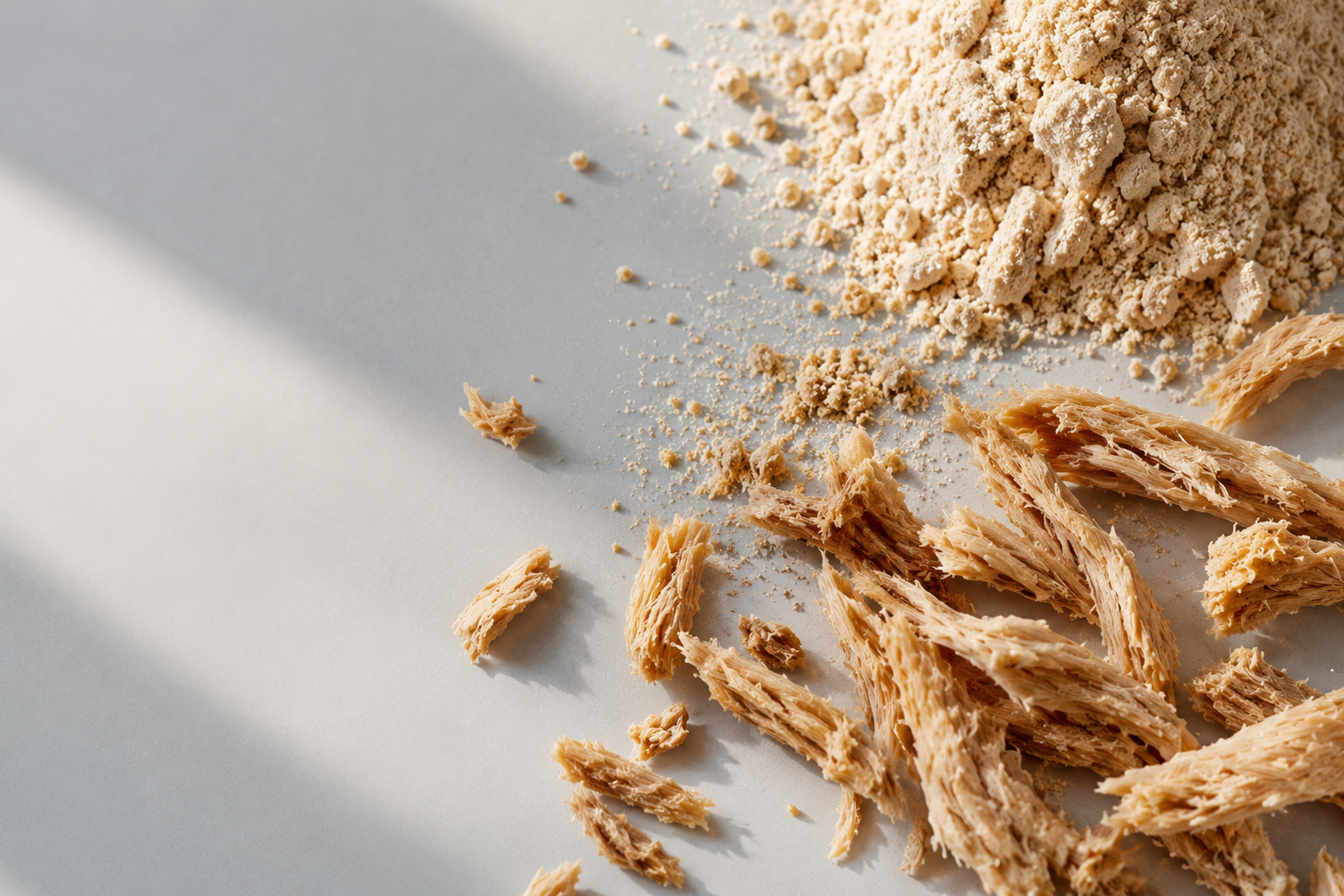
Dietary fibres have long been regarded as ingredients that primarily increase the nutritional value of food products. In the modern food industry, however, their role is much broader. Thanks to their water-binding capacity and their influence on texture, stability and product structure, fibres are increasingly used as functional ingredients in the development and optimisation of various food formulations.
Manufacturers use them in meat products, bakery applications, dairy products, ready meals and products with reduced fat or sugar content. In addition to their nutritional benefits, fibres can contribute to improved raw material utilisation, higher yields and more consistent finished product quality.
Functional Properties That Determine the Application of Fibres
One of the most important characteristics of dietary fibres is their ability to bind and retain water. Depending on their origin, structure and particle size, certain fibres can absorb significant amounts of water and form a structure that influences product consistency.
This property is particularly important in meat processing, where controlling water loss during heat treatment directly affects product yield and quality. Adding suitable fibres can improve water binding, reduce liquid separation and help achieve a more stable product structure.
Another important function is their influence on texture. Fibres can contribute to a firmer or more compact structure, improve mouthfeel and affect the viscosity of various food systems. Their effect depends on the type of fibre, its concentration and its interaction with other ingredients in the formulation.
Certain types of fibres also have fat-binding properties, which is why they are used in reduced-fat formulations. In this way, they can help preserve product fullness and texture when part of the fat is removed from the recipe.
Which Types of Fibres Are Most Commonly Used?
The choice of fibre depends on the technological requirements and characteristics of the final product. Different fibre sources have different functional properties, meaning they cannot be substituted for one another without prior testing in the formulation.
Pea fibre is an important ingredient in the production of meat products, ready meals and products with increased fibre content. Its water-binding capacity and influence on structure make it useful for improving yield and consistency. It is particularly interesting for manufacturers looking to use plant-based ingredients.
Potato fibre is used in various food systems due to its good water-binding capacity and ability to improve texture. It is applied in the meat industry, bakery products and ready meals, where it can help reduce losses during processing and storage.
Wheat fibre has a wide range of applications in the bakery industry, meat products and foods with increased dietary fibre content. Depending on its particle size and characteristics, it can contribute to product structure, texture and moisture retention.
Soy fibre is used as a functional ingredient in meat products and various processed foods. It can contribute to water binding, structural stability and increased fibre content in the finished product.
Sugar beet fibre is another option for manufacturers looking to improve texture and water retention. Due to its functional characteristics, it is used in bakery products, meat preparations and other food formulations.
Applications of Fibres Across Different Segments of the Food Industry
In the meat industry, fibres play a particularly important technological role. They are used in the production of sausages, frankfurters, burgers, pâtés and other processed meat products. Their water-binding capacity can help reduce losses during heat treatment, while their influence on structure contributes to achieving the desired consistency. In certain formulations, they can enable recipe optimisation and reduce production costs.
In the bakery industry, fibres are used to increase dietary fibre content, improve moisture retention and modify dough structure. Their application can be particularly important in the production of bread, rolls, tortillas and other products with enhanced nutritional value. However, the appropriate dosage is essential, as excessive amounts of fibre can affect gluten network development, loaf volume and the texture of the finished product.
In the production of dairy products and desserts, certain fibres are used to adjust viscosity and improve product texture and system stability. They can be incorporated into formulations for yoghurt, beverages, puddings and reduced-fat products. Their function depends on compatibility with proteins, pH levels and processing conditions.
In the ready meal, sauce and dressing industries, fibres can contribute to stability, the desired consistency and reduced water separation during storage. In these products, selecting fibres that retain their functionality after heat treatment is particularly important.
Fibres as a Tool for Optimising Production Costs
In addition to their technological and nutritional benefits, one of the reasons for the growing interest in fibres is their potential to optimise production costs.
In the meat industry, for example, improved water-binding capacity can contribute to higher yields after heat treatment. In reduced-fat products, fibres can help preserve texture and product fullness, while in the bakery industry they can improve moisture retention and influence the characteristics of the finished product during storage.
However, the economic justification for their use does not depend solely on the purchase price per kilogram. It is important to consider dosage, functionality, compatibility with other ingredients and the impact on the overall production process. For this reason, the selection of an appropriate fibre should be evaluated in terms of the total formulation cost rather than simply the price of the raw material.
What Should Be Considered When Selecting Fibres?
Not all fibres have the same functional properties. Their characteristics depend on the plant source, processing method, particle size and other parameters that determine how they behave in a specific formulation.
When selecting fibres, particular attention should be paid to water-binding capacity, moisture retention, particle size, colour, flavour and performance during heat treatment. In certain applications, fat-binding capacity and the influence of fibres on viscosity and the texture of the final product are also important.
Special attention should also be given to product labelling. The origin of the fibres, allergens and labelling requirements must comply with the regulations of the market where the product is placed. Furthermore, replacing one type of fibre with another requires technological testing, as the same quantity of different fibres does not necessarily produce the same result.
Conclusion
Dietary fibres are becoming increasingly important functional ingredients because they allow manufacturers to address several requirements simultaneously: improving texture, controlling moisture, increasing nutritional value and optimising production costs.
Their application is no longer limited to products intended for consumers who pay attention to their dietary fibre intake. Today, they represent an important technological tool in the meat, bakery, dairy and ready meal industries.
Selecting the right type of fibre according to the requirements of a specific formulation can significantly influence the quality, stability and cost-effectiveness of the finished product. Nutra follows the needs of the food industry and offers various plant-based raw materials for technological applications. For information about available fibre types and relevant specifications, please contact our team.