
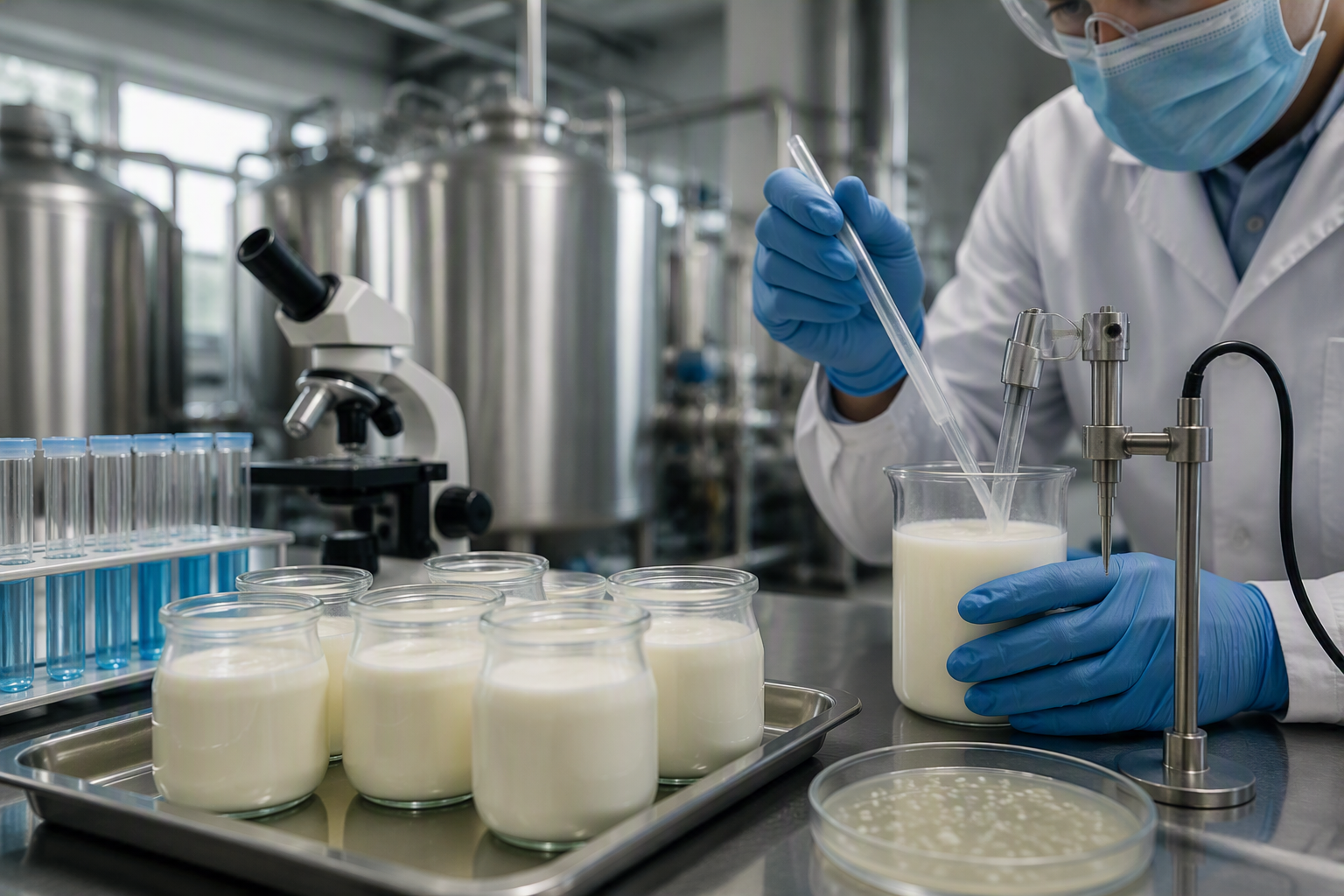
When a new shipment of starter cultures arrives at a dairy, everything seems simple. Bags of freeze-dried powder or frozen pellets come from carefully controlled conditions, ready to use. However, the real story begins only when these cultures enter the milk. Fermentation is not a passive process, but a living activity of billions of bacteria working under precisely defined conditions. That is why monitoring fermentation parameters is a crucial step in the production of every yoghurt, cheese or kefir. Without these measurements, production would be left to chance, and consistent quality would be nearly impossible to achieve.
Why is monitoring fermentation important?
Fermentation is the process in which lactic acid bacteria convert lactose into lactic acid. This acidification changes the structure of milk proteins, creates a gel, develops flavour and shapes the texture of the final product. If fermentation proceeds too quickly, the product can become overly acidic and grainy. If it proceeds too slowly, contamination, off-flavours or insufficient gel firmness can occur.
On an industrial scale, where several thousand litres of milk are fermented simultaneously, even a single degree of deviation can mean huge financial losses. Imagine discovering only after packaging that an entire batch of yoghurt has failed. That is why monitoring fermentation parameters is standard practice in every serious dairy. It is not just a technical procedure, but a way to ensure that every batch is as good as the previous one.
Key parameters monitored during fermentation
When it comes to monitoring fermentation, four parameters are absolutely crucial: pH value, titratable acidity, temperature and time. Their interrelationship defines the success or failure of the entire batch.
pH value as the primary indicator
pH is probably the most important parameter in fermentation. Fresh cow's milk has a pH between 6.5 and 6.7. As bacteria produce lactic acid, the pH decreases. For yoghurt, fermentation usually ends when the pH reaches a value between 4.0 and 4.5, depending on the desired profile. For some cheeses, the final pH can be lower, while for mild cheeses it can be slightly higher.
What makes pH particularly useful is that its change can be monitored in real time. A pH probe immersed in the fermentation tank provides continuous insight into how the culture is progressing. Research shows that the pH drop curve can be divided into three phases. In the first, the lag phase, bacteria adapt to the new environment. Then comes the logarithmic phase, where rapid acidification occurs. Finally, the deceleration phase, when acidity reaches a level that inhibits further bacterial growth. These phases are characteristic of microbial growth and are directly related to the activity of the starter culture.
In industrial conditions, continuous pH measurement is desirable but comes with challenges. Milk proteins can accumulate on the probe surface and affect measurement accuracy, so regular cleaning and calibration are necessary. That is why many plants still use periodic sampling and laboratory pH measurement, although this is more time-consuming and carries a risk of contamination.
Titratable acidity as a complementary measure
While pH measures the concentration of hydrogen ions, titratable acidity measures the total amount of acid in the product. These two values are not always directly proportional, but together they give a more complete picture of what is happening during fermentation.
Titratable acidity is expressed in degrees according to Soxhlet-Henkel or other units specific to individual countries. For yoghurt, final acidity is usually around 7 to 8 °SH. For cheeses, acidity is monitored to determine the right moment for curd cutting.
In practice, titratable acidity is determined by sampling the product and titrating with sodium hydroxide in the laboratory. Although this method is slower than pH measurement, it provides information that pH cannot give, for example about the amount of lactic acid actually produced, not just its activity.
Temperature and its influence on fermentation rate
Temperature is the parameter that directly controls the rate at which starter cultures work. Mesophilic cultures, used for most cheeses, work optimally at temperatures between 25 and 32°C. Thermophilic cultures, used for yoghurt and some hard cheeses, prefer temperatures from 37 to 45°C.
Deviation from the optimal temperature by just a few degrees can significantly change the fermentation rate. At lower temperatures, fermentation proceeds more slowly, which can lead to longer processing times and an increased risk of contamination. At higher temperatures, fermentation accelerates, but excessive acidification and unwanted texture changes can occur.
That is why modern dairies use precise temperature control systems. Fermentation tanks are equipped with jackets through which water or steam flows, and temperature sensors continuously monitor and adjust conditions. In some plants, especially for yoghurt, programmed temperature profiles are also used, which change the temperature during fermentation to achieve the desired sensory profile.
Fermentation time as an indirect indicator
Time itself is not a parameter that is monitored, but rather the result of the interaction of all other factors. Under standard conditions, such as temperature, inoculation and milk composition, yoghurt fermentation usually takes 4 to 6 hours, depending on the desired acidity. For cheeses, the time can be longer or shorter depending on the type of product and the desired final pH.
What is important is that fermentation time is not used as the sole criterion for process completion. Many producers have learned the hard way that the same fermentation time can give different results if any of the other parameters change. That is why time is always used in combination with pH and temperature.
How to know if a starter culture is working properly?
The question every technologist asks is: how can you be sure that the culture is alive, active and doing what it is supposed to do? The answer lies in a combination of several indicators.
The first and most important indicator is the expected pH drop curve. Each starter culture has its own characteristic acidification profile. A quality DVS culture, for example, should show a consistent pH drop during fermentation. If the pH drops more slowly than usual for that culture, it may indicate reduced culture activity, poor milk quality, inadequate temperature or the presence of inhibitors such as antibiotics.
In industrial conditions, the most common sign that something is wrong is slowed acidification. When this happens, the temperature is checked, a sample is taken for laboratory analysis, and in some cases additional starter culture is added or the fermentation time is extended.
The second indicator is gel consistency. During fermentation, milk gradually changes from liquid to a gelatinous state. For yoghurt, for example, gel formation occurs when the pH drops below 5.2, and final firmness is achieved at a pH of around 4.5. If the gel does not form at the expected rate or is weaker than usual, this may indicate a problem with the culture.
The third indicator is smell and taste. Experienced technologists can often recognise good fermentation just by the smell wafting from the tank. A characteristic, slightly sour smell indicates that the culture is working properly. Unpleasant, rancid or foreign smells are a sign that something is wrong, whether it is contamination, an inappropriate culture or poor fermentation conditions.
Challenges in monitoring fermentation in industrial conditions
Although monitoring fermentation parameters seems straightforward, in practice there are numerous challenges. pH probes can become fouled with proteins, requiring regular cleaning and calibration. Sampling for laboratory analysis carries a risk of contamination. Temperature sensors can give inaccurate readings if not properly positioned.
That is why advanced monitoring techniques are increasingly being used. Multiple light scattering allows monitoring of changes in gel structure during fermentation without the need for sampling. Near-infrared spectroscopy can predict pH and titratable acidity based on the spectral characteristics of the product. Machine learning is used to predict microbial growth and acidification based on historical data.
These techniques are particularly useful in large plants where multiple tanks are fermented simultaneously. They allow rapid detection of deviations and timely intervention, reducing the risk of losing an entire batch.
What to do when fermentation does not go as expected?
When it is noticed that fermentation is deviating from the expected course, the first step is to check all parameters. Is the temperature correct? Is the pH probe calibrated? Was the milk of adequate quality? Was the starter culture properly stored and dosed?
If all parameters are in order and fermentation is still not proceeding as it should, it is possible that the culture has lost its activity. This can happen if it was improperly stored, if its expiry date has passed, or if contamination with bacteriophages has occurred. Bacteriophages are viruses that infect starter bacteria.
In such cases, the only solution is to add fresh culture or, in extreme cases, discard the batch. That is why prevention is key. It involves regular checking of culture activity before use, proper storage and rotation of cultures to reduce the risk of bacteriophage resistance developing.
Conclusion
Monitoring fermentation in the dairy industry is not just a technical procedure, but a fundamental condition for producing a consistent and safe product. pH, titratable acidity, temperature and time are the four pillars on which every successful fermentation rests. When these parameters are under control, the starter culture does what it is supposed to do, it transforms milk into yoghurt, cheese or kefir with precisely defined characteristics.
But monitoring parameters is not just a matter of numbers. It is also the skill of recognising the signs that fermentation leaves behind, the smell, texture and appearance of the gel. Experienced technologists can sense when fermentation is proceeding correctly, even before they look at the screen.