
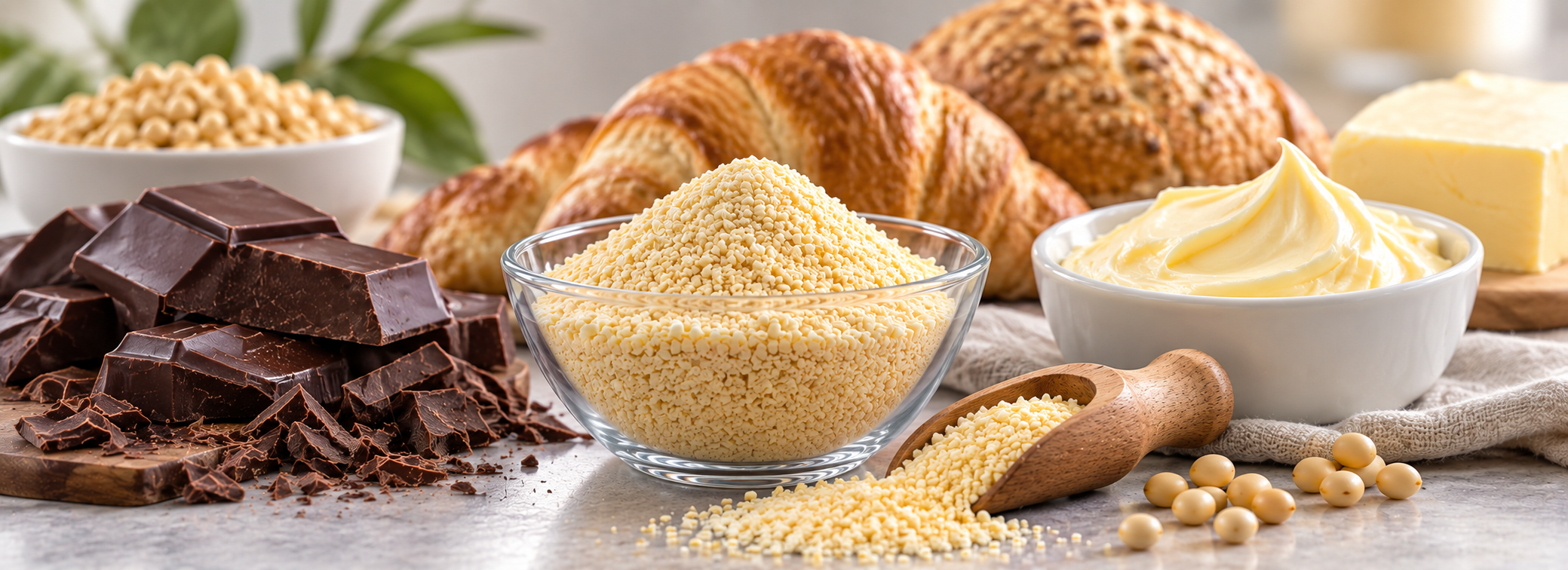
If lecithin were just another emulsifier, we would not have entire laboratories measuring its impact on viscosity for days, nor would manufacturers switch suppliers because their chocolate turns into paste. The truth is that this phospholipid compound, present in soy, sunflower or rapeseed, does much more than simply bringing water and fat together. It dictates crystal behaviour, dough rheology and margarine stability on the shelf. What bothers me is how often I see it treated as a standard raw material, without understanding the nuances that decide whether your product will be premium or just average. In this text, we will go through three key applications and uncover the parameters that most specifications conveniently omit.
Soy versus sunflower lecithin under real mixing conditions
Replacing soy lecithin with sunflower lecithin, driven by consumer pressure, often turns into a disaster on the production floor. Chocolate manufacturers reported a viscosity jump of twenty percent at the same dosage of 0.3 percent. The reason lies in the different phospholipid profile. Sunflower lecithin contains more phosphatidylcholine, which gives it a higher HLB value, making it more effective in water based systems but not in hydrophobic chocolate. To achieve the same plastic viscosity, they had to increase the dosage to 0.45 percent, which raised the cost and introduced a slight bitterness. If you are planning a replacement, do your own rheological measurements with your specific base, because generic tables do not apply.
Dosing temperature and its hidden role in dispersion
Adding lecithin at room temperature into bakery dough is a mistake repeated daily. Powdered lecithin has a softening point at fifty degrees Celsius. In cold dough, it forms aggregates that do not disappear even after fifteen minutes of intensive mixing. Those aggregates tear the gluten network and create uneven porosity. The solution is pre dissolving it in a small amount of warm water at sixty degrees. This step reduces the required quantity by fifteen percent because the active surface area of lecithin increases manifold. Bakeries that introduced this practice reported less waste and more uniform loaf volume.
Lysolecithin as the silent saboteur of margarines
Margarine producers often overlook the lysolecithin content in their delivery, and that is fatal. Lysolecithin, formed by the action of phospholipase, has stronger hydrophilic properties. When its share exceeds five percent of the total lecithin fraction, it accelerates the crystallisation of the beta prime form. The margarine becomes hard and less spreadable, contrary to the expected softness. The optimal content for table margarines is below three percent. For bakery versions, where higher firmness is needed, you can go up to four and a half percent, but there you are already entering the danger zone that requires daily rheological monitoring.
Synergy between lecithin and PGPR in chocolate
Lecithin in chocolate never works alone. Its combination with polyglycerol polyricinoleate, abbreviated as PGPR, gives optimal flow without excessive addition of cocoa butter. The ratio is not linear. With 0.2 percent lecithin and 0.1 percent PGPR, the effect on reducing the yield value is greater than with double the amounts of each individually. The problem arises when lecithin dominates. Too much lecithin relative to PGPR increases sensitivity to moisture, so chocolate develops that unwanted white bloom during storage. Premium manufacturers have therefore reduced lecithin to just 0.15 percent and compensate for the rheology by longer conching, which is expensive but yields a more stable product.
Dough acidity and lecithin degradation
In sourdough breads with acidic fermentation, the pH drops below five. Under these conditions, lecithin hydrolyses and releases linoleic acid, which makes gluten more extensible but also less stable. The result is sticky dough that deforms during baking. A practical solution is acetylated lecithin. Acetylation protects the ester bonds, so at pH 4.2 the lecithin remains intact. The price is about thirty percent higher, but it eliminates line stoppages and reduces waste by ten percent. For rye breads, this has become the standard. For wheat breads with short fermentation, regular liquid lecithin still works.
Packaging and oxidation as silent loss makers
Liquid lecithin in plastic pails without a nitrogen atmosphere loses up to forty percent of its emulsifying power within three months. The peroxide value exceeds ten milliequivalents, which is the limit for food use. Powdered lecithin is more stable, but manufacturers avoid it because of dust during dosing. The most reliable option is aluminium pouches under vacuum, which guarantee twelve months of stability. Larger systems have started using them, even though they are more expensive, because they pay off through fewer rejected batches.
Freezing as a stress test
In frozen doughs, lecithin maintains the emulsion during thawing and slows down the growth of ice crystals. A dosage of 0.25 percent reduces crystal size by about thirty percent, which causes less damage to gluten. But this effect only lasts if the dough freezes quickly, at least one degree per minute. In slow freezers, water separates before crystals form. That is why the key factor is a rapid freezer, not the choice of lecithin. Those who installed spiral freezers at minus forty degrees reduced losses by fifteen percent, with the same type and quantity of lecithin.
Acid value as the first quality filter
Forget about phosphatidylcholine content, check the acid value first. A value above ten milligrams of potassium hydroxide per gram indicates the onset of hydrolysis. In margarine, lecithin with an acid value of twelve breaks down after only two thermal shock cycles, while the one with a value of six withstands five cycles. That is why you should demand this data in every specification. If your supplier cannot provide it, change them.
Conclusion
Lecithin is not just an additive; it is a strategic parameter that connects chemistry, technology and production economics. What we have seen through these examples shows that every change in source, dosage, temperature or packaging has a measurable and often costly impact on the final product. Simple substitutions without prior testing are gambling, and gambling with emulsions always loses in the long run. So before you order lecithin next time, ask yourself whether you know its acid value, lysolecithin content and exact temperature dispersion curve. If you do not, it is time to start asking. In this industry, small details make big differences, and lecithin is one of those details that separates top producers from the average ones.