
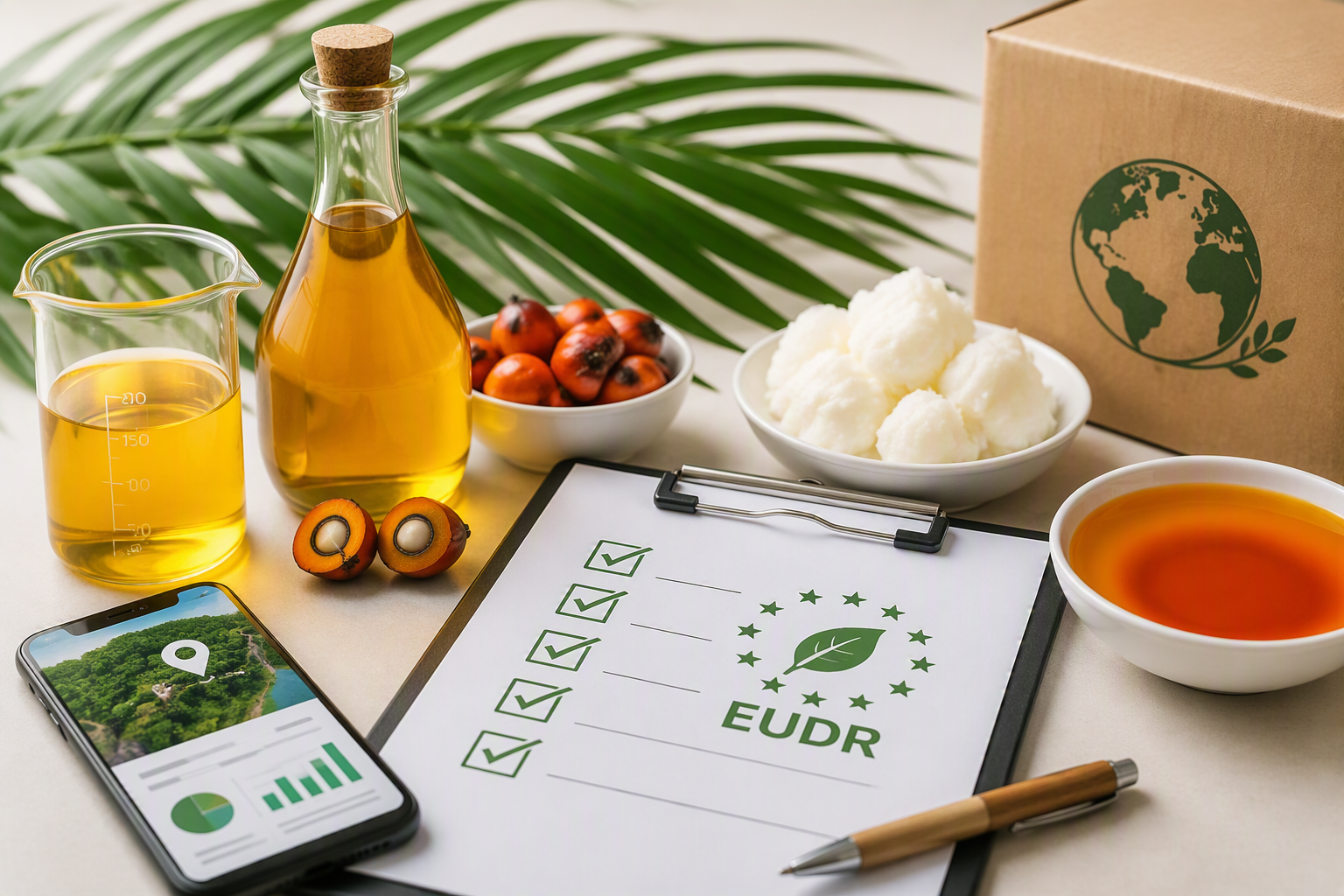
The EU Deforestation Regulation (EUDR) is no longer just a topic of discussion, it becomes a binding requirement from 30 December 2026 for large and medium‑sized operators, with small and micro operators given until 30 June 2027. Although companies outside the EU are formally exempt from direct liability as long as they do not place goods on the EU market themselves, European buyers will require them to provide full documentation on origin, geolocation, and traceability. For companies exporting to the EU or supplying European manufacturers, this is the time to prepare seriously.
Which raw materials fall under EUDR?
The regulation covers seven key commodities: cattle, cocoa, coffee, palm oil, rubber, soya, and wood, along with a wide range of derived products. For palm oil, this means that not only crude oil but also numerous derivatives, from fractions and esterified products to food ingredients, cosmetics, and biodiesel, are subject to the same requirements.
What changed on 13 July 2026?
On 13 July 2026, the European Commission adopted two important acts. A Delegated Act updates Annex I, i.e., the list of products covered by the regulation. Certain categories such as leather, rubber, and reproduction material have been removed from the list, but at the same time soluble coffee, certain palm oil derivatives, and frozen bovine tongues have been added. These changes enter into force on 30 December 2027, giving additional time for preparation.
On the same day, an Implementing Act was adopted defining the technical rules for the Information System for submitting due diligence statements. The system was reopened at the end of June 2026, and the Commission will further improve it during the summer.
Who is an operator and who is a data supplier?
EUDR makes a clear distinction between operators (those who place a product on the EU market for the first time) and traders (who further commercialise it). The obligation to submit a due diligence statement falls on operators. However, this does not mean that suppliers outside the EU are relieved, European buyers will demand all necessary data from them to prepare the statement. In practice, the supplier becomes the key source of information without which the operator cannot fulfil its obligation.
What data must procurement include in the supplier inquiry?
From 30 December 2026, every inquiry for palm oil or its derivatives must contain the following requirements:
- Geolocation of plots - accurate coordinates of every plot where the oil was produced. Without this data, the due diligence statement cannot be submitted.
- Proof of legality of production - confirmation that production complies with the laws of the country of origin.
- Evidence of no deforestation - proof that the land was not deforested after 31 December 2020.
- Supply chain - a complete list of all actors in the chain, from plantation to export.
- Due diligence statement reference number - for goods that have already gone through the procedure.
Geolocation and legality
Geolocation is perhaps the most demanding part of preparation. The data must be precise enough to verify whether the plot was deforested after 2020. For large plantations this is feasible, but for smallholders it represents a serious challenge. Additionally, the product must be legally produced according to the laws of the country of origin, which means compliance with all relevant regulations, from land rights to labour and environmental rules.
How EUDR could split the market into two zones
EUDR is already creating a division between two types of goods: those with documentation and those without. EUDR‑compliant products are expected to command a premium, while undocumented goods will either stay outside the European market or be sold at a significant discount in non‑EU markets. For buyers who want to ensure supply continuity, it is essential to identify suppliers capable of providing the required data as early as possible.
Position of Malaysian smallholders
Malaysia is in a relatively good position. Over 90 percent of palm plantations are covered by the national MSPO certification, and among independent smallholders the certification rate has reached 85 percent. However, it is important to stress that the MSPO certificate itself is not an automatic substitute for a full EUDR due diligence analysis. Although MSPO provides a solid foundation - especially in traceability and legality - European buyers will still require geolocation of plots and individual due diligence statements. The certificate facilitates the process but does not replace it.
What companies should do before the end of 2026
For manufacturers and importers who use palm oil or derivatives in their products and then export to the EU, the following recommendations apply:
- Check whether your products fall under EUDR - consult Annex I of the regulation and verify the CN tariff codes.
- Map your supply chain - who supplies your palm oil? Can your supplier provide geolocation and proof of legality?
- Include EUDR requirements in RFQs - every new inquiry for palm oil or derivatives must include requests for documentation.
- Consider alternative sources - suppliers from Malaysia with MSPO certification are at an advantage, but also explore other options.
- Prepare for the Information System - due diligence statements are submitted through the EUDR Information System. Familiarise yourself with its operation.
- Monitor deadlines - for large and medium operators, compliance starts on 30 December 2026. For small and micro operators, the deadline is 30 June 2027.
Conclusion
EUDR is no longer an abstract regulation, it is becoming an operational task for everyone who procures palm oil or its derivatives. The 13 July 2026 update to Annex I brought additional derivatives under the regulation, but also clarifications that facilitate preparation. The key challenge remains data collection, geolocation, proof of legality, and supply chain mapping. Those who establish cooperation with suppliers in time and prepare internal processes will have an advantage. Those who delay risk being left without goods or paying significantly higher prices.