
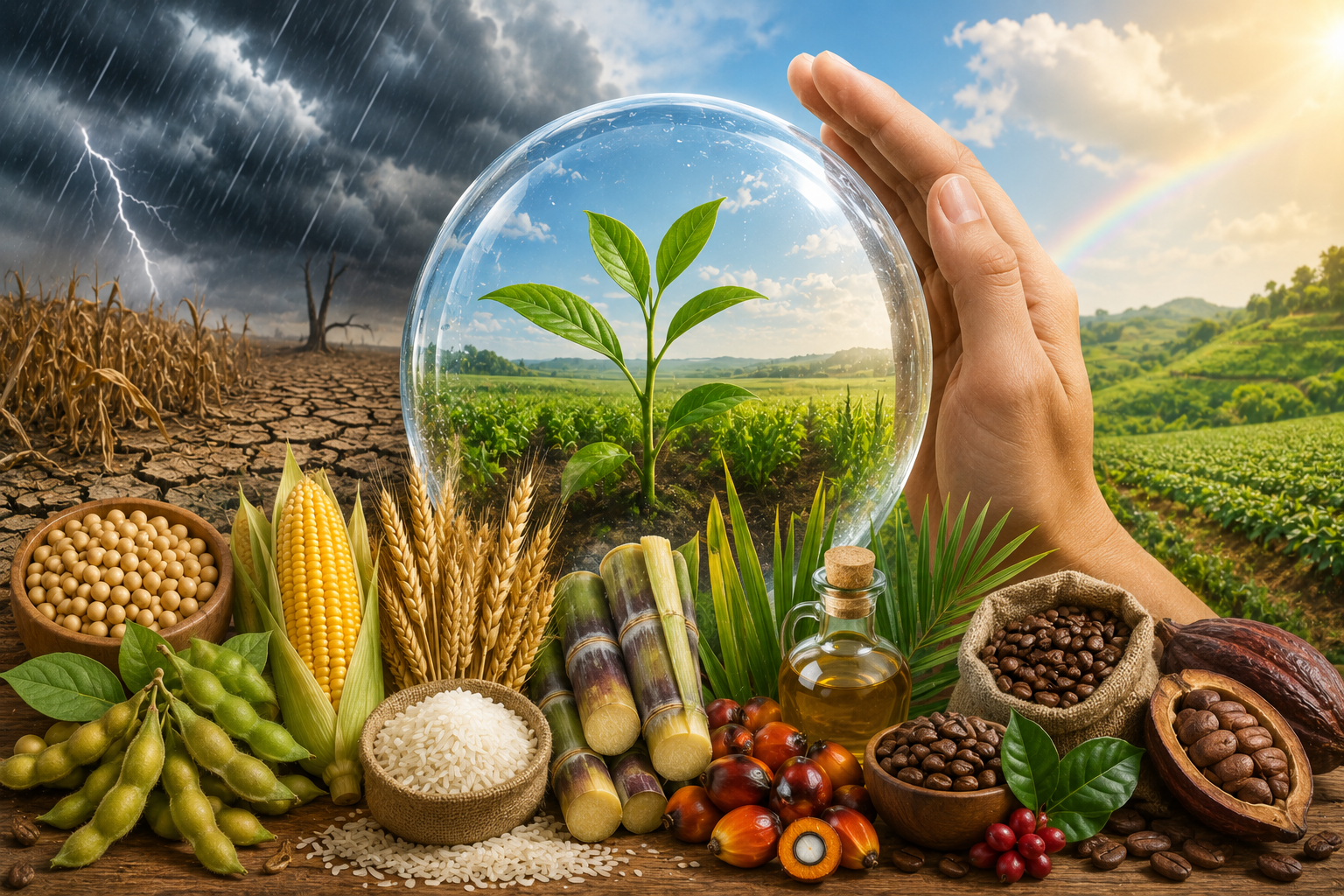
Climate does not ask, does not warn, and does not discriminate – it affects everything, but not to the same extent. While some crops are collapsing under the pressure of drought and heat, others are still holding on, although the cracks are becoming increasingly visible. For the food industry, it is no longer enough to understand what happened last season; it must anticipate what lies ahead and prepare in advance. In this review, we analyze how resilient key agricultural commodities are to weather extremes and what practical measures can be taken to minimize risk.
Agricultural Commodities Under Climate Pressure
Soybean
Soybean belongs to the group of moderately sensitive crops. However, when drought and heat occur during flowering and pod formation, losses can be substantial. Irregular rainfall further complicates planting and harvesting, while the crop's response to elevated carbon dioxide levels remains inconsistent – sometimes beneficial, sometimes detrimental.
The industry's response is built on flexibility: sowing dates are adjusted, sourcing is diversified across multiple regions, and precision technologies enable real-time monitoring of soil moisture and nutrient levels. Soil health and organic matter content are increasingly recognized as critical factors—every additional percentage point of humus represents a valuable water reservoir during prolonged dry summers.
Wheat
Wheat suffers both from cold and excessive heat. Late spring frosts can damage stems, while early heat waves during grain filling reduce both yield and quality. Droughts are becoming more frequent across major production regions—from the Black Sea area to North America and Australia—making production increasingly unstable from year to year.
Adaptation strategies follow two main directions: the development of varieties more tolerant to drought and high temperatures, and the adoption of precision agriculture technologies that allow each part of a field to be managed according to its specific needs. Where feasible, irrigation systems are being introduced, while improving soil moisture management has become a major priority.
Corn
Corn has little room for error—its fate is largely determined within just a few weeks during flowering and pollination. If temperatures exceed 35°C during this period and moisture is lacking, the number of kernels per ear can decline dramatically.
As a result, adaptation efforts focus on shorter-season and drought-tolerant hybrids, as well as agronomic practices that conserve soil moisture, ranging from mulching to more efficient irrigation systems. Planting schedules are increasingly adjusted according to long-term weather forecasts in order to avoid exposing critical growth stages to extreme heat.
Rice
Rice presents a paradox: it requires water, yet it also suffers from it. Its fields are flooded, making drought a threat due to water shortages, while excessive rainfall and flooding can destroy crops. Heat stress during grain filling further aggravates the situation, and extreme monsoon seasons such as that of 2026 demonstrate how fragile the entire production system can be.
To reduce risks, breeders are developing varieties that better tolerate temporary water shortages and high temperatures. More water-efficient irrigation systems are being introduced to maintain yields with reduced water use. Protecting the crop during critical developmental stages has become just as important as it is in corn production.
Sugarcane
Sugarcane requires large amounts of water during the maturation stage in order to accumulate sugar within its stalks. Drought not only reduces total biomass but also decreases sugar content. Brazil and India, the world's two largest producers, have alternated between droughts and floods in recent years, significantly disrupting global supply.
Adaptation relies on several pillars: ensuring stable irrigation, implementing drip irrigation systems, improving soil health, and optimizing both logistics and harvest timing. The objective is clear—to maximize yields before weather conditions become too severe.
Palm Oil
Plantations in Indonesia and Malaysia depend heavily on regular rainfall. When El Niño disrupts monsoon patterns, rainfall can fall by half for several months, fruit development weakens, and inventories decline. In 2026, this directly contributed to rising global prices.
The response includes the development of more drought-tolerant varieties, improved drainage and water retention practices, and stricter control over deforestation, which plays a crucial role in maintaining regional microclimates. Only through such measures can stable yields be maintained in increasingly warmer years.
Coffee
Arabica coffee, which accounts for approximately 60% of global production, thrives only within a narrow temperature range of 18–22°C. Any increase beyond this threshold reduces bean quality and increases the risk of pests and diseases. In Brazil, which supplies roughly one-third of the world's Arabica coffee, droughts and frosts have affected plantations for the third consecutive year.
In 2026, Brazil's harvest was approximately 12% below the five-year average, while drought conditions in Vietnam reduced Robusta production by around 8%. Arabica prices on international markets increased by 27% between January and June. Serbia, which imports more than 30,000 tons of coffee annually, is already experiencing pressure on wholesale prices, with importers announcing additional price increases from September onward.
As a response, producers are returning to shade-grown cultivation systems, which can reduce plantation temperatures by 2–4°C. Meanwhile, Brazilian researchers are developing Arabica hybrids capable of maintaining satisfactory yields at temperatures of 24–25°C. Satellite monitoring of water stress and index-based insurance programs are increasingly helping small farmers protect themselves against climate-related shocks.
Cocoa
Cocoa is extremely demanding, growing successfully only within a narrow temperature range and under high humidity conditions. West Africa, which supplies around 60% of the world's cocoa beans, has experienced prolonged droughts, occasional flooding, and the spread of diseases in recent years.
Global cocoa prices reached historic highs and, although they have since declined somewhat, they remain significantly above long-term averages, signaling persistent uncertainty.
The first line of defense is agroforestry—growing cocoa beneath taller shade trees that reduce temperature extremes and preserve moisture. In addition, new varieties capable of tolerating higher temperatures and longer drought periods are being developed. Index-based insurance programs triggered by satellite drought data are also becoming increasingly common, helping smallholders receive compensation more quickly.
There Is No Longer Time to Wait
Climate change spares no crop, but it does not affect all crops equally. What ultimately determines which commodities remain resilient and which suffer growing losses is not only their inherent vulnerability—it is the willingness to adapt.
More resilient varieties, smart irrigation systems, soil conservation practices, digital technologies, and diversified sourcing strategies are already making the difference between stable supply chains and chaotic market disruptions.
The industries that understand this reality will not wait for the next climate shock—they will be prepared for it.