
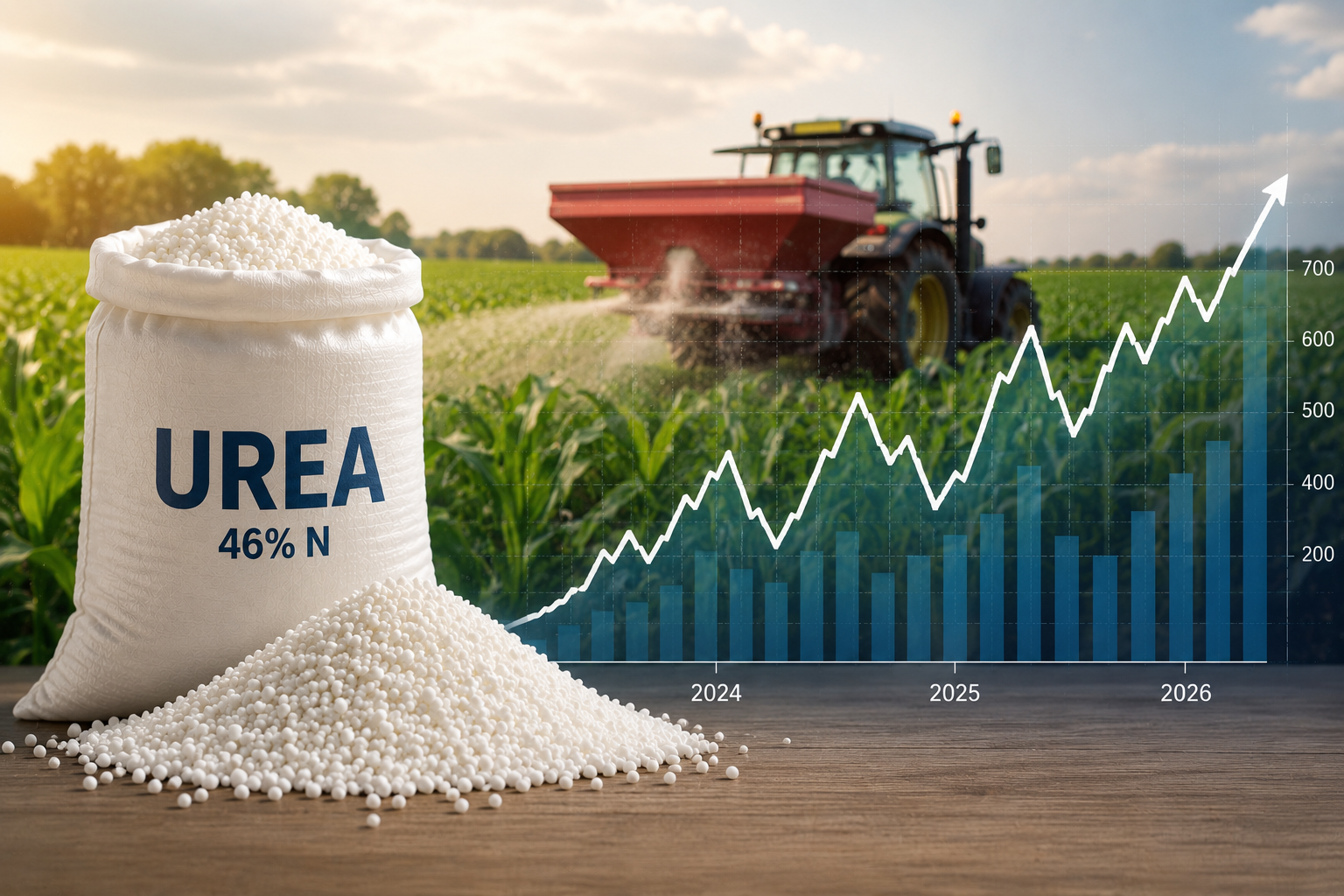
As the world is still recovering from the wave of inflation and geopolitical upheavals, the spring of 2026 has delivered a new blow to the global artificial fertilizer industry. This time, the epicentre was neither the war in Ukraine nor Chinese tariffs – it was the Strait of Hormuz. Below we bring you an in-depth analysis of events, the latest reports, and concrete figures that have shaped the market for phosphate, sulphur, potash, urea, and ammonium nitrate in the period from March to June 2026.
Hormuz – What Happened and Why It Matters for Fertilizers
The Strait of Hormuz is the sea passage between Iran and Oman, barely 33 kilometres wide, through which nearly a fifth of the world's oil and liquefied natural gas trade passes. For the fertilizer industry, it is the artery through which the following are transported:
- Sulphur from Saudi Arabia and the UAE (crucial for phosphate fertilizer production)
- Urea and ammonia from Iran, Qatar, and Saudi Arabia
- Phosphate rock from Egypt and Jordan
- A significant portion of LNG used as feedstock for nitrogen fertilizers in Europe and Asia.
At the end of March 2026, a series of attacks on tankers – for which Western intelligence services blamed pro-Iranian forces – led to a ten-day blockade of the southern shipping corridor. Insurance houses raised war risk premiums by 700 percent, and freight rates for Handymax class vessels from the region skyrocketed from 18,000 to 65,000 dollars per day. Qatar declared force majeure on LNG deliveries, and Saudi Arabia and the UAE temporarily suspended sulphur exports until alternative routes via the Red Sea could be secured – which itself was already under pressure from Yemen's Houthis.
What This Caused:
- A supply-side shock in sulphur – spot prices for granular sulphur FOB Arabian Gulf jumped from 80–90 dollars per tonne to 160 dollars per tonne in the first week of April, according to Argus Media data.
- An explosion in urea prices – Iranian urea (around 4 million tonnes of exports annually) remained trapped, and prompt cargoes FOB Gulf reached 405–420 dollars per tonne, up from 285 dollars per tonne in mid-March.
- Disruptions in phosphate fertilizer logistics – Indian and Brazilian producers of DAP and MAP faced shortages of sulphuric acid and sulphur, leading to a reduction in operating rates of 15–20 percent.
According to the World Bank's May Commodity Markets Outlook, the fertilizer price index jumped by 22 percent month-on-month in April – the highest since the second quarter of 2022.
Price Trends for Key Components (March–June 2026)
Phosphate (DAP/MAP)
After the initial surge, DAP prices FOB Morocco rose from 570 dollars per tonne to 640 dollars per tonne at the end of April. Indian importers rejected this difference, citing government subsidies. A correction then followed: with the signing of a new navigation security agreement under the auspices of China and the Gulf states, by mid-June prices had subsided to 595–610 dollars per tonne. Brazil CFR for MAP fell from 660 to 615 dollars per tonne.
Sulphur
The most volatile component. Chinese CFR sulphur prices touched 158 dollars per tonne at the April peak, after Saudi and Emirati tenders were postponed. As early as May, when the first vessels appeared that were rounding the Cape of Good Hope, prices weakened to 112 dollars per tonne. Today they are forming at a level of 100–110 dollars per tonne, still above the March level of 85 dollars per tonne.
Potash (MOP)
The potash market remained relatively immune to the Hormuz crisis because the bulk of Belarusian and Russian product is transported via the Baltic and by rail to China. The price of MOP CFR Brazil is stable at 305–320 dollars per tonne. However, the Indian contract for the second half of the year, usually signed in June, has been postponed as buyers hope for a discount of 20–30 dollars per tonne due to the global slowdown in demand.
Urea
After the April peak of 410 dollars per tonne FOB Arabian Gulf, prices fell sharply when Iran, under pressure for foreign currency, resumed exports from Bandar-e Homeini. By mid-June, granular urea FOB Egypt (a benchmark for the Mediterranean basin) had returned to 325–335 dollars per tonne. Still, this remains 12 percent above the March low. Urea futures in Shanghai suggest stabilization at 310–340 dollars per tonne over the summer.
Ammonium Nitrate (AN)
The FOB Baltic price (Russian AN) jumped from 260 to 325 dollars per tonne when Russia introduced a temporary export ban on 1 April (see below). After the ban was lifted on 1 June, a correction to 290–300 dollars per tonne followed. European producers (Yara, Borealis) raised wholesale prices by 15–20 euros per tonne, citing more expensive gas during the crisis.
Major Tenders – Who Pulled the Strings
Indian Urea Tender
State trader RCF issued the largest tender of 2026 on 15 May, seeking 1.5 million tonnes of urea. Just as prices began to slide, 22 offers were received. The lowest price CFR West Coast was 358 dollars per tonne (goods from Egypt and Nigeria), and East Coast 368 dollars per tonne (Chinese urea despite restrictions). India accepted 1.2 million tonnes. This pulled the market down, but at the same time set a price above the expected 340 dollars per tonne – a sign that nervousness remains present.
Ethiopian NPS Tender (Phosphate + Sulphur)
Ethiopia sought 800,000 tonnes of NPS fertilizer in April. Morocco's OCP and Saudi Arabia's Ma'aden competed for the contract. Due to sulphur difficulties, Ma'aden offered a double-digit premium, which ultimately led to a price of 520 dollars per tonne CFR Djibouti – 14 percent higher compared to the previous tender in February.
Brazilian Spot Deals
Brazilian buyers became active in May, ahead of potential EU sanctions on Russian fertilizers. Several prompt shipments of Russian MAP were concluded at 600–610 dollars per tonne CFR, with a delivery clause before 1 July.
Export Bans and Restrictions – Who Pulled the Handbrake
Russia – Temporary Ammonium Nitrate Ban
From 1 April to 1 June 2026, Russia banned ammonium nitrate exports to secure its domestic spring sowing campaign. The decree also included quotas for NPK fertilizer exports. According to Russian Ministry of Agriculture data, producers accumulated 300,000 tonnes of AN for internal use. After the ban was lifted, export licences were reissued, but with monthly limits.
China – Extended Restrictions on Urea and Phosphates
The National Development and Reform Commission (NDRC) of China extended the "export permit" (CIQ) regime for urea, DAP, and MAP in March 2026 until further notice. Only quantities approved by provincial governments are allowed, which in the first three months of 2026 reduced urea exports to a mere 0.8 million tonnes (according to General Customs data). CRU Group analysts estimate that China will export a maximum of 3 million tonnes of urea in 2026, which is 40 percent less than in 2023.
Belarus and Potash – Sanctions Remain
The EU and the US have maintained sanctions on Belarusian potash. Nevertheless, thanks to alternative routes via Russian ports and the Chinese market, Belarusian exports in the first quarter of 2026 amounted to 2.5 million tonnes. The EU is considering imposing tariffs of 30–50 euros per tonne on Russian MOP, but a decision is expected only in the autumn.
EU Tariffs on Russian Fertilizers?
The European Commission opened an anti-subsidy investigation in June into imports of Russian AN and UAN. This triggered precautionary buying in Brazil and Turkey, but there are still no active sanctions.
Minor Export Restrictions
- Vietnam lowered import tariffs on urea from 6% to 2% in May to reduce domestic prices.
- Pakistan abolished the state import monopoly on urea, allowing the private sector to buy directly, which boosted demand on the spot market.
What Next?
The fertilizer market today is balancing between lower energy prices (TTF gas has fallen to 30 euros per megawatt-hour, from 43 euros in April) and continuous geopolitical risk. The Strait of Hormuz remains a pressure point – any new tension could instantly send sulphur and urea sky-high. On the other hand, record crops in Brazil and India signal solid demand for the autumn.
The key question for the second half of the year is to what extent China and Russia will permanently restrict exports, and whether the EU will actually impose sanctions on Russian fertilizers. If this happens, the global nitrogen and potash market will face the biggest realignment of trade flows since 2022.
The industry has received yet another confirmation of the old truth – the security of the Hormuz passage is not only an oil issue, but also a food issue.