
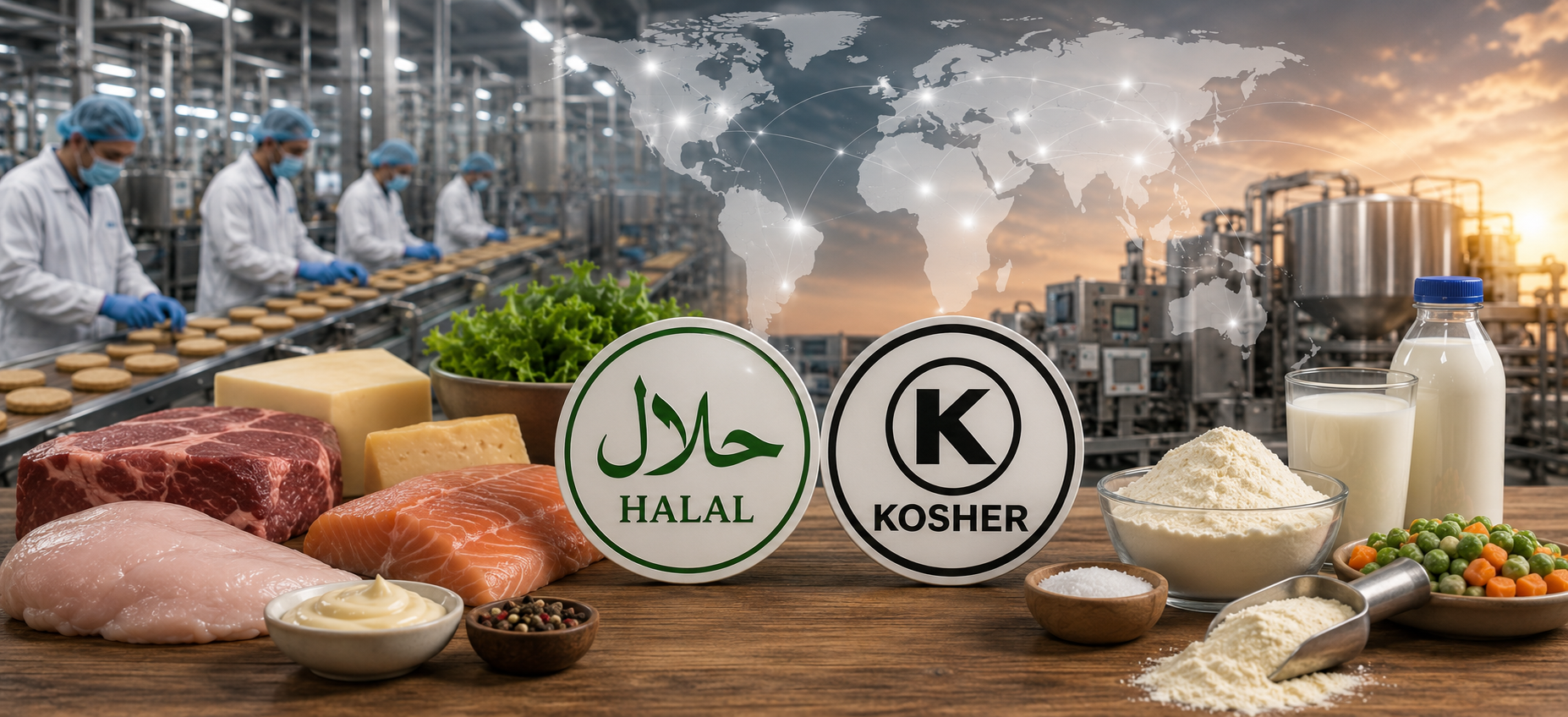
Halal and Kosher certifications are often perceived in public discourse exclusively as religious matters. In the daily practice of the food industry, however, they are much more than that: they represent a regulatory ticket to certain markets, proof of a high level of control over raw materials and processes, and a strong trust signal for consumers, including those who are not religiously motivated.
For manufacturers of foods, beverages and ingredients, the decision to implement Halal or Kosher standards often marks the transition from a local to a regional or global level of business.
What Halal and Kosher mean in technological practice
On an operational level, both systems combine requirements for raw materials, processing and organisation. Halal refers to what is permitted under Islamic law, while Kosher encompasses the rules of Jewish dietary law. In practice this means that clearly prohibited categories of ingredients must be removed from formulations, that processes must be organised so as to prevent contamination with prohibited substances, and that every stage of production must be traceable and documented.
For Halal products, the key points are elimination of pork raw materials and fats, control of alcohol presence in raw materials and flavours, and a specific regime for meat and meat products, including slaughter, processing and storage. Kosher introduces additional complexity, as it strictly separates dairy and meat products, not only at the level of recipes, but also on the level of equipment, storage, production utensils and logistics. For many confectionery, dairy, meat and snack products this means a review of existing formulations and, in some cases, a switch to alternative emulsifiers, gelatins, enzymes or flavours.
For a manufacturer that already has HACCP, ISO 22000, BRC or IFS implemented, introducing Halal or Kosher requires upgrading existing procedures. The essence is not to turn the plant into a “religious institution”, but to systematise the rules on which raw materials are allowed to enter, how equipment is segregated and how to prove that every batch complies with the requirements of the certification body.
Opening new markets through certification
For many export destinations, Halal certification is literally a prerequisite for market entry. In countries in the Middle East, North Africa and Southeast Asia, products based on meat, dairy and animal-derived ingredients, without recognised Halal certification, can hardly get into retail chains or the HoReCa channel. Regulations and practice in Saudi Arabia, the UAE, Malaysia or Indonesia are moving towards increasingly explicit requirements that products be certified by bodies officially recognised by local authorities.
For producers from our region, a Halal certificate often makes the difference between occasional export of individual batches and stable presence on shelves as a regular brand. When tender specifications or supply contracts state that Halal products are mandatory, companies without such certificates are simply excluded from the game. This applies both to finished products and to industrial ingredients such as proteins, dairy derivatives, emulsifiers or flavours.
On developed markets of the European Union, the USA and Canada, the situation is more nuanced but no less interesting. Market segments are growing that target food for Muslim and Jewish communities, as well as consumers who perceive Halal and Kosher as an additional guarantee of control and quality. Supermarkets are opening dedicated shelves for these products, and retail chains increasingly include in their private label supplier requirements the condition that certain categories be Halal or Kosher certified.
The B2B segment is particularly important. Large international food and beverage brands, as well as manufacturers of nutritional and pharmaceutical products, prefer ingredient suppliers that already have Halal and/or Kosher certifications. In the development phase of a new product for multiple markets, R&D teams do not want the constraint that a particular ingredient prevents launch on Halal or Kosher markets. A supplier with certified proteins, stabilisers, emulsifiers or sugars has a clear advantage, because it enters the shortlist of suppliers for global projects.
Impact on brand image and perception of quality
From a branding perspective, Halal and Kosher certifications work as an additional layer of trust. The average consumer may not know the details of the rules behind these marks, but understands that the product has gone through an extra check by an independent body. This fits into the broader trend of growing importance of labels related to quality, safety and transparency in the food sector.
The Halal or Kosher logo on pack sends several key messages. First, that the manufacturer has clearly defined criteria regarding ingredients and processes. Second, that there is a documented system of traceability by batch and supplier. Third, that the company is willing to undergo external inspection and to repeat it through surveillance audits. All of this supports the perception of the brand as serious, controlled and reliable, which benefits consumers who are not searching for these labels for religious reasons.
In saturated categories, where consumers see a number of products as similar or almost identical, Halal and Kosher can be a clear differentiator. On shelves with processed meats, processed cheeses, snacks, confectionery or ready meals, the certification mark can help the brand stand out both visually and in terms of content. With carefully designed communication, the brand can combine a message of respect for diverse consumer needs with a message of additional quality and control.
Halal and Kosher standards are naturally aligned with trends such as clean label, fewer E‑numbers, avoidance of certain additives or animal derivatives and greater transparency of raw material origin. Although they do not in themselves guarantee nutritional superiority, in the eyes of many consumers they carry connotations of more structured processes and more careful ingredient selection.
Technological and organisational challenges
Introducing Halal or Kosher standards into an existing plant is not an administrative formality, but a project requiring coordination between technology, QA, procurement, production, logistics and marketing. The first step is a detailed portfolio and raw material analysis to identify ingredients that do not meet the requirements. This often includes animal-derived gelatin, certain emulsifiers, enzymes, alcohol-based flavours, rennets and components that the manufacturer may not even see as problematic until their technological lists and origin are examined.
The next step is mapping equipment and lines. For Kosher, this means strict segregation of dairy and meat processes, including storage, production and cleaning. For Halal, the focus is on preventing any contamination with pork raw materials, alcohol or other prohibited ingredients. In practice, this may require dedicated lines, adapted cleaning procedures, separate storages or clearly defined production schedules with validated cleaning between runs.
Certification costs include the initial audit, annual surveillance visits and, in some Kosher systems, permanent or periodic supervision in the form of an authorised supervisor’s presence. To achieve a sound return on investment, it is necessary to strategically select which products and lines to certify. It is often more rational to create a clearly defined Halal or Kosher product line with realistic export and domestic potential than to try to adapt the entire portfolio without a clear market strategy.
On the other hand, the project of implementing these standards can significantly improve the existing quality system. Additional structuring of traceability, stricter cleaning procedures, clearer segregation of raw materials and improved supplier documentation make other certifications and audits easier, both by customers and independent bodies. In many plants, experience with Halal or Kosher standards has later accelerated alignment with requirements from major retail chains and global brands.
Halal and Kosher in new product development
For R&D teams, the presence of Halal or Kosher requirements changes how they think about formulations from the very beginning. Rather than “fixing” a finished recipe later to comply with certification requirements, it is more efficient to include Halal/Kosher criteria in the initial product development brief. This means choosing raw materials and additives that are already certified, working with suppliers who have clear documentation and thinking about how the product will be positioned in different markets.
For industrial ingredients such as dairy proteins, plant proteins, emulsifiers, stabilisers or sugars, Halal/Kosher status often directly affects competitiveness. A producer of WPC 80 or sodium caseinate with Halal and Kosher certification has a greater chance of entering global supply chains in the confectionery, dairy or beverage industries. A similar logic applies to manufacturers of stabilisers, emulsifiers or cocoa products used in a wide range of applications.
Market communication strategy
Once certification is in place, the way it is communicated is as important as the mark on the packaging itself. Towards the B2B segment, the emphasis should be on technical benefits: compliance with target market requirements, supply chain stability, the ability to adapt labels, reliability of documentation and support in customer audits. In this segment Halal and Kosher are above all a ticket to doing business with customers operating in multiple markets.
Towards end consumers, communication must be clear but not aggressive. The certification body’s mark in a visible place, together with a short explanation on the website and, where appropriate, in promotional materials, is usually sufficient. It is important to avoid over-promising; Halal or Kosher in themselves do not mean that the product is “healthier”, but that it meets a particular set of rules regarding ingredients and processes. Transparency and willingness to answer consumer questions are key to building long‑term trust.
How to smartly position Halal and Kosher in the growth strategy
In today’s food industry, Halal and Kosher certifications go far beyond their original, narrowly religious dimension and become important strategic tools. They open doors to markets where they are a regulatory condition for placement, facilitate cooperation with global brands and strengthen perceptions of control and quality among end consumers. At the same time, they require serious technological and organisational work, a review of formulations and processes and clear internal accountability.
For companies seeking growth through exports, B2B partnerships and a stronger brand, the question is no longer whether to consider Halal and Kosher certification, but how to position them smartly in the portfolio, which products and lines to include, and in which markets these standards will bring the highest return on investment. In this sense, Halal and Kosher are not just symbols on the pack, but an integral part of broader business strategy and a clear statement of how the company understands quality, traceability and respect for diverse consumer needs.