
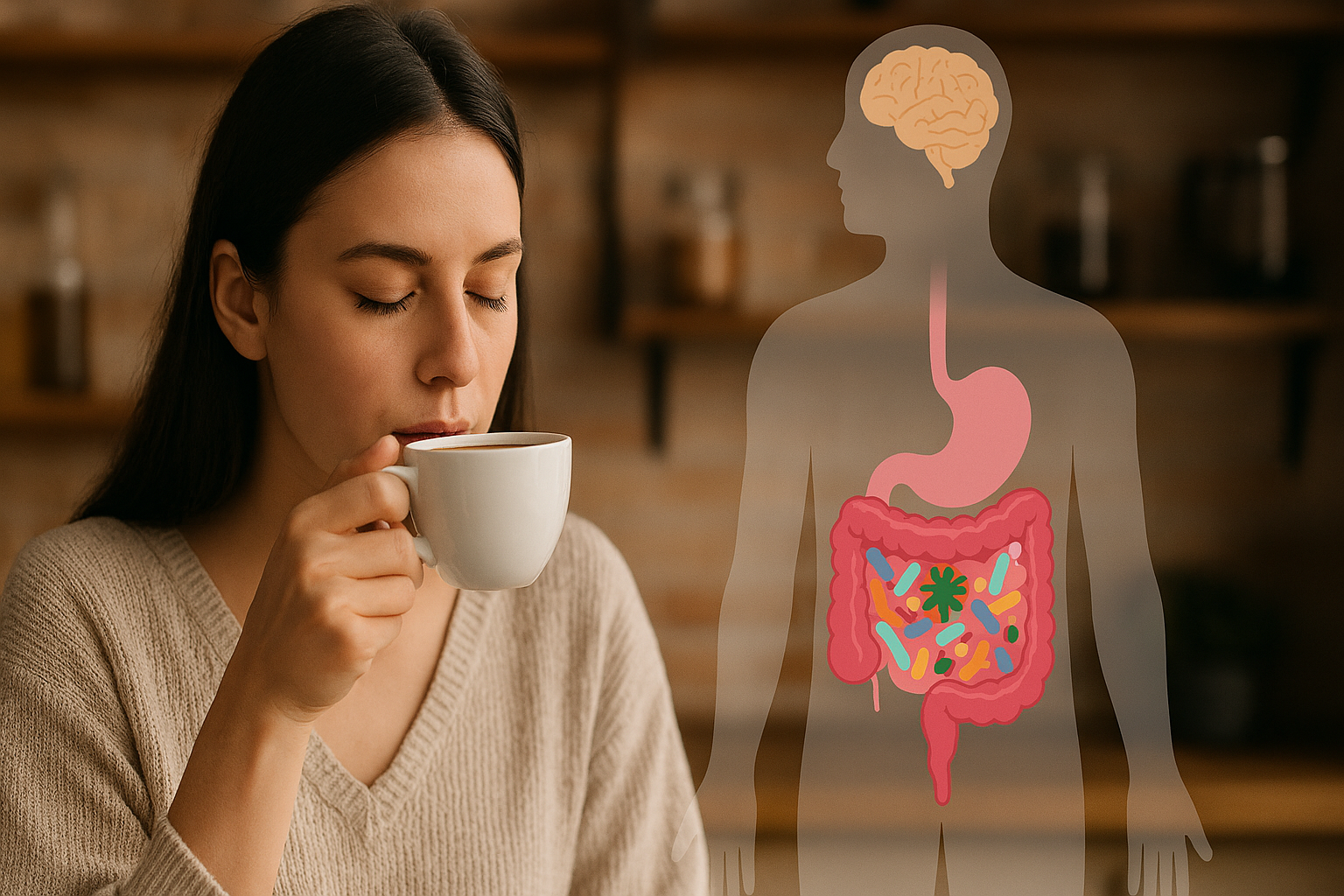
Coffee is one of the most widely consumed beverages in the world, yet discussions about its impact are most often reduced to caffeine alone. The recent paper by Boscaini et al., “Habitual coffee intake shapes the gut microbiome and modifies host physiology and cognition”, published in Nature Communications, shows that the picture is much more complex. The habit of drinking coffee leaves a clear imprint on the gut microbiome, on metabolites in stool and urine, and on behaviour, stress, sleep and cognition – and this is not solely due to caffeine.
How the study was designed
The study included 62 healthy middle‑aged adults. Half of them were habitual coffee drinkers, consuming three to five cups per day, while the other half did not consume coffee at all. In habitual coffee drinkers, a three‑phase protocol was applied. First, baseline status was recorded while they were drinking coffee, then they completely stopped consuming coffee and other major sources of caffeine for two weeks, and after that they drank either caffeinated or decaffeinated coffee for three months, in a double‑blind design.
During all phases, stool samples were collected for gut microbiome and fecal metabolome analysis, and urine samples were collected for the analysis of caffeine and (poly)phenol metabolites. At the same time, psychological profiles (stress, anxiety, depression, impulsivity, emotional reactivity), sleep quality, physical activity level, a range of cognitive functions (attention, working and episodic memory, learning) and markers of stress and immunity, including cortisol and inflammatory cytokines, were assessed.
Impact of coffee on the gut microbiome
The study did not show dramatic changes in overall gut microbiome diversity, but changes at the level of individual species were clearly evident. Habitual coffee drinkers had a higher relative abundance of bacteria such as Cryptobacterium curtum and certain strains of Eggerthella and Firmicutes, whereas non‑coffee drinkers had more Veillonella parvula, other Veillonella strains and Haemophilus parainfluenzae.
When habitual drinkers stopped consuming coffee, the abundance of “coffee‑associated” species decreased and moved closer to the profile of non‑coffee drinkers. Reintroduction of coffee, whether caffeinated or decaffeinated, restored the previous pattern: species characteristic of coffee drinkers increased again. This clearly shows that coffee is a stable and repeatable nutritional signal that tunes the microbiota, more at the level of specific strains than at the level of global diversity.
Metabolites in stool and urine: more than caffeine
At the level of the fecal metabolome, differences were even more pronounced. Stool from coffee drinkers contained higher levels of caffeine and its derivatives, such as theophylline and 1,7‑dimethylxanthine, as well as hippuric acid. At the same time, levels of indole‑3‑propionic acid, indole‑3‑carboxaldehyde and GABA were lower compared to non‑coffee drinkers. These are compounds associated with neuroprotection, regulation of gut barrier function and modulation of anxiety.
After two weeks without coffee, concentrations of caffeine and its derivatives in stool dropped sharply, while certain indole metabolites increased. When coffee was reintroduced, the profile shifted back towards the initial state, but not completely, suggesting that both the microbiome and the host retain a certain “memory” of the previous coffee intake pattern.
In the urine of habitual drinkers, a clear metabolic fingerprint of coffee was observed. A wide spectrum of caffeine metabolites (methylxanthines and methyluric acids) was present, as well as a rich palette of (poly)phenol metabolites arising from the breakdown of chlorogenic and other phenolic acids. During the coffee‑free phase, the urinary profile of habitual drinkers shifted closer to that of non‑coffee drinkers, and after just a few weeks of renewed consumption, differences reappeared. Importantly, phenolic metabolites changed with both caffeinated and decaffeinated coffee, while alkaloid metabolites were present only with caffeinated coffee.
These differences show that coffee, via caffeine and (poly)phenols, profoundly reshapes the chemical milieu in the gut and systemic metabolism, and that the microbiome significantly influences how these compounds will be transformed and excreted.
Behaviour, emotions and cognitive functions
At baseline, habitual coffee drinkers differed from non‑drinkers across several psychological parameters. They had higher impulsivity scores, particularly in the sensation‑seeking dimension, as well as higher emotional reactivity. Non‑drinkers, on the other hand, performed better in some cognitive tasks related to memory.
When habitual drinkers stopped consuming coffee for two weeks, impulsivity and emotional reactivity decreased. Classic withdrawal symptoms (headache, sleepiness) were most pronounced in the first days but subsided sharply by the end of the second week. At the same time, the subjective feeling of fatigue gradually decreased and energy increased, which runs counter to the expectation that there is “no energy” without caffeine. Some improvement in attention test performance was also observed, although the authors note that part of this effect may be due to task familiarisation.
After three months of coffee reintroduction, the differences became even more interesting. In both groups, those drinking caffeinated and those drinking decaffeinated coffee, perceived stress, depressive symptoms, impulsivity and emotional reactivity decreased. This effect was more pronounced with decaffeinated coffee when it came to emotional reactivity.
Caffeinated coffee was additionally associated with further improvements in attention and reductions in anxiety and psychological distress. Decaffeinated coffee, on the other hand, was associated with better sleep quality, higher physical activity and better results in episodic memory tests and paired‑word learning. This suggests that caffeine and non‑caffeine components of coffee have different primary domains of action: caffeine strongly affects wakefulness, attention and anxiety, while phenols and other components of decaffeinated coffee have a greater impact on sleep and cognition.
Stress hormones and immune response
Despite the expectation that clear changes in cortisol, the stress hormone, would be observed, results were fairly stable. Cortisol after awakening and its daily profile did not differ significantly between coffee drinkers and non‑drinkers, nor did they change dramatically during the coffee‑free phase or after reintroduction. Even in the experimental stress protocol, where cortisol is measured before and after a stressor, differences between groups and phases were minimal. This means that subjective experience of stress and anxiety, which did change, was not accompanied by large shifts in HPA axis activity under these conditions.
At the level of the immune system, the picture was more nuanced. Compared to non‑drinkers, habitual coffee drinkers had lower levels of C‑reactive protein, a marker of low‑grade systemic inflammation, and higher levels of the anti‑inflammatory cytokine IL‑10. During the coffee‑free period, an increase in CRP and TNF‑α was observed, suggesting that continuous coffee consumption may exert a mild anti‑inflammatory effect. After coffee reintroduction, immune markers changed differently in the caffeinated and decaffeinated groups, but the overall pattern aligns with previous work showing that phenolic compounds in coffee can modulate inflammatory responses.
Links between microbiome, metabolites and behaviour
One of the most important contributions of this work is the integration of three levels of data: microbiome composition, metabolite profiles and psychological‑cognitive measures. Statistical network analyses were used to show how specific bacterial species correlate with specific metabolites, which in turn correlate with behaviour and cognition.
Veillonella species, for instance, were strongly associated with theophylline, a caffeine metabolite, which in turn was associated with stress, sleep quality and memory. Caffeine was a central node in the network, linked both to the majority of analysed bacterial species and to almost all psychological measures. Metabolites such as theophylline, indole‑3‑carboxaldehyde, fumaric acid, caffeine and 1,7‑dimethylxanthine had the highest number of simultaneous connections with microbiota and behaviour.
These associations do not prove causality, but they strongly support the concept of the microbiome–gut–brain axis. The habit of drinking coffee changes the composition and function of the microbiome, the microbiome changes the metabolite profile, and these metabolites are linked with impulsivity, stress, sleep, attention and memory.
What this means in practice
Based on the study by Boscaini et al., several important take‑home messages emerge. First, coffee is not just a source of caffeine but a powerful nutritional modulator that alters the microbiome and metabolomes. Second, the effects of coffee are not limited to subjective alertness: they are linked to subtle changes in impulsivity, stress, sleep and memory. Third, caffeinated and decaffeinated coffee do not share the same effect profile: caffeinated coffee more strongly influences attention and anxiety, whereas decaffeinated coffee has a greater impact on sleep and specific cognitive domains. Fourth, people who do not drink coffee are not in a worse position; they simply have a different, but stable, psychological and microbiome profile.
For the food and beverage industry, these findings raise new questions around the formulation of coffee‑based drinks, the balance between caffeine and non‑caffeine components, and the potential for targeted products focused on stress, sleep or cognitive performance. It is also clear that individual differences in the microbiome influence how someone responds to coffee, which in the future may lead to more personalised recommendations.
Rethinking coffee: context, composition and consumer
The habit of drinking coffee reshapes the gut microbiome, the metabolite profile in the gut and urine, and is associated with changes in impulsivity, stress, sleep and memory. The work of Boscaini and colleagues shows that the effects of coffee cannot be reduced to a simple caffeine story; instead, they encompass complex communication between the microbiome, gut and brain. Rather than asking whether coffee is “good” or “bad”, a more accurate question is: what kind of coffee, in which context and for which consumer?
References:
Boscaini, S., Bastiaanssen, T. F. S., Moloney, G. M. et al. Habitual coffee intake shapes the gut microbiome and modifies host physiology and cognition. Nature Communications 17, 3439 (2026). doi:10.1038/s41467-026-71264-8.