
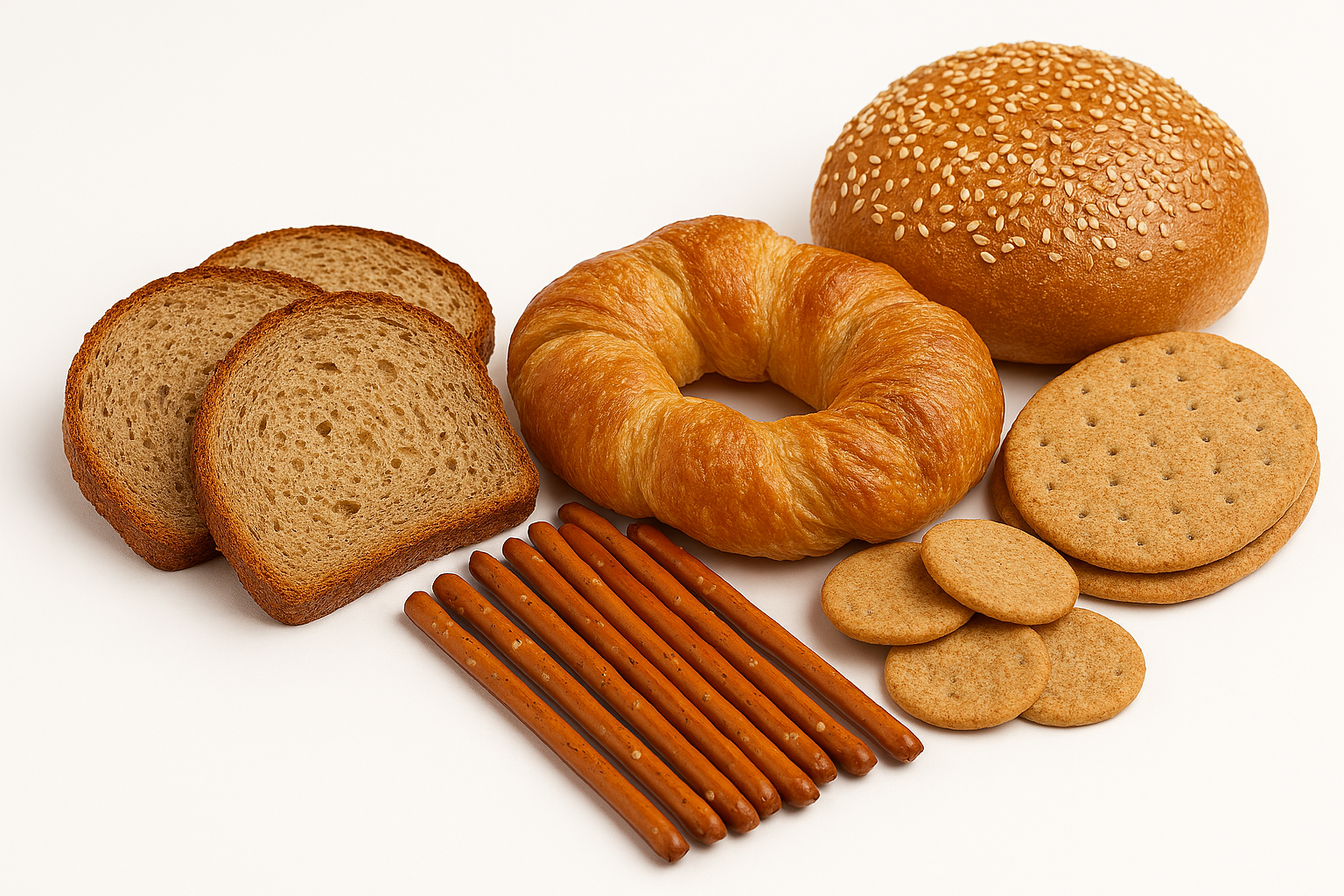
Consumers are increasingly looking for products that are “high in fibre”, “source of fibre” or with reduced refined carbohydrates. Bakery and snack segments face a dual challenge: increasing fibre content without losing volume, softness, crispiness and pleasant taste. Changing fibre content directly affects dough rheology, gluten network formation, gas retention and mouthfeel, which is why a thoughtful formulation is needed rather than merely “adding fibre”.
This article focuses on how technologists and R&D teams can increase fibre levels in bread, bakery goods, tortillas, crackers and extruded snacks while controlling texture, volume and sensory acceptability.
Why adding fibre is technologically demanding
Dietary fibres, whether soluble or insoluble, have a strong impact on water balance in dough and on crumb or crispy phase structure. Insoluble fibres increase water absorption, “dilute” the gluten network and act as particles that interrupt dough continuity. The result can be lower volume, denser structure, crumbliness and shorter freshness.
Soluble fibres form viscous solutions or gels, thus influencing dough viscosity and plasticity, gas cell development and perceived moistness. Excessive viscosity makes handling on industrial lines, sheeting and moulding more difficult, while insufficient water binding leads to faster drying of the product.
At the same time, fibres change the ratio of starch, proteins and fats, influence Maillard reactions and crust colour, as well as the speed of starch retrogradation. For this reason, increasing fibre requires adjusting both the recipe and process parameters, not just swapping “flour – fibre”.
Fibre types relevant for bakery and snacks
In practice, bakery and snack industries use different fibre groups: wheat fibres, fibres from other cereals, psyllium, citrus fibres, and specific functional fibres derived from starch or pulp. Each group has its own impact on texture.
Wheat fibres show good compatibility with wheat flour and are often used in bread, wholegrain bakery goods and crackers. They increase water absorption and affect crumb firmness but do not contribute to gluten formation, so the balance with gluten is critical.
Citrus fibres and other highly functional fibres have the ability to form viscous systems and may partially replace fat or improve moisture retention, which is useful in soft bakery goods and tortillas. At the same time, thanks to their gel‑forming ability, they can contribute to structure and reduce brittleness in snacks.
Psyllium‑derived fibres form a gel that significantly increases viscosity and water‑binding capacity. They are often used in high‑fibre and gluten‑free bakery, as they help compensate for the absence or lower quality of gluten network.
Balancing gluten and fibre in bread and bakery goods
In standard wheat bread and bakery products, the key challenge is to maintain volume and softness while increasing fibre. Adding higher levels of fibre without other corrections leads to “dilution” of the gluten network, which is first seen through poorer dough development, lower gas holding capacity and uneven cell structure.
One practical solution is the use of additional vital wheat gluten. By increasing the level of gluten proteins, the effective gluten concentration in flour after adding fibres is compensated. This enables the dough to retain sufficient elasticity and extensibility to form appropriate crumb structure and sufficient volume.
In addition to adding gluten, water levels often need adjustment due to increased water binding to fibres. The goal is to achieve dough with a rheological profile similar to the control product without fibres. In practice this is done via trial absorption tests and by adjusting mixing and fermentation times.
Managing water and dough viscosity
Water is the central parameter in high‑fibre formulations. Fibres have different water‑binding capacities, and poor estimation leads either to overly firm dough or to sticky systems that are difficult to process. Besides total water quantity, the timing and method of addition matter as well.
In some technologies it is beneficial to pre‑hydrate fibres so that a part of the water is bound before mixing and to reduce unpredictable viscosity changes during processing. In other formulations, fibres are blended directly with dry ingredients and water is added gradually, while dough consistency is monitored.
For dough that goes through sheeting, lamination or high‑speed moulding, viscosity must be precisely controlled. Excessive fibre hydration can lead to extensible but “weak” dough that tears or sticks to tools. Conversely, insufficient water produces firm dough that does not develop well and does not allow proper gas cell formation.
Role of hydrocolloids and starches in structure stabilisation
In products where higher fibre levels significantly compromise texture, a combination of fibres with hydrocolloids and starches can be used. Hydrocolloids such as xanthan gum, guar gum, locust bean gum or carboxymethyl cellulose (CMC) help stabilise gas bubbles, improve viscosity during fermentation and baking and reduce crumbling.
Modified starches and, to a lesser extent, native corn starch influence crumb structure and resistance to retrogradation. When part of the structure “relies” on a network of starch and hydrocolloids, higher fibre levels can be incorporated without completely losing volume and softness. At the same time, declaration aspects must be taken into account, as adding starches and hydrocolloids changes composition and possible consumer communication.
In snacks, especially extruded ones, the combination of fibres and starch influences expansion and porosity. Excessive fibre levels without starch and moisture correction lead to poor expansion, hard texture and darker colour. A properly balanced starch–fibre system provides satisfactory expansion at higher fibre contents.
Fibres in snacks: crunchiness, expansion and mouthfeel
In the snack segment, the goal is usually to achieve a “light” crunch and attractive bite, even in products with elevated fibre content. Adding fibre affects extrusion, frying or baking processes and changes the way water is released from the structure.
In extruded snacks, fibres affect mass viscosity in the extruder, the development of steam bubbles and cell structure in the final product. Higher fibre levels, especially insoluble ones, may reduce expansion, give denser, harder snacks and rougher surfaces. The solution often lies in combining different fibre types with controlled particle size, as well as optimising moisture before extrusion and temperature of the barrel and die.
In baked cracker‑type snacks, fibres affect lamination, layer formation and breaking strength. Using fine fibres and well‑adjusted water content allows retention of characteristic crispiness with a controlled increase in hardness. Citrus fibres or combinations with hydrocolloids can contribute to a more pleasant mouthfeel and reduce perceived “dryness”.
Effect of fibres on freshness and shelf life
One of the beneficial aspects of fibres is their effect on moisture retention and product staling. Fibres that bind water can help bread and bakery goods remain soft for longer and slow down starch retrogradation and stale texture development. Similarly, in snacks a well‑balanced fibre presence and water activity control can contribute to more stable crispiness throughout shelf life.
However, an inadequately adjusted system may produce the opposite effect: accelerated dryness or uneven moisture distribution within the product. Therefore, in the development of fibre‑enriched products it is advisable to test textural changes over storage, not only initial sensory evaluation right after production.
Declaration, nutrition requirements and consumer perception
From a regulatory standpoint, thresholds for claims such as “source of fibre” or “high in fibre” are defined, which impacts target fibre levels in formulations. At the same time, fibre type and source can be relevant for product positioning: whole grains, “natural” fibres, fibres from fruits or vegetables, or specific functional fibres.
Consumers are increasingly sensitive to “clean labels”, so fibre choice should align with expectations of the target group. Industry can combine different fibre types to achieve both technological functionality and acceptable declaration while clearly communicating digestive health benefits.
Practical guidelines for R&D and technologists
When developing bakery and snack products with increased fibre content, it is important to start from the targeted nutrition profile and labelling constraints, and then test several variants of flour, fibre, gluten, starch and hydrocolloid combinations. Special attention should be paid to water absorption, mixing time, fermentation and baking or extrusion conditions.
In bread and bakery, it is often effective to use additional vital wheat gluten and rely part of the structure on the gluten network, while fibres contribute to volume and nutrition profile. In snacks, the focus is on expansion and crunchiness, so the balance between fibres and starch, as well as particle size selection, plays a key role.
Pilot‑scale trials, monitoring texture during storage and sensory evaluations on the target consumer group make it possible to select a formulation that offers an optimal compromise between higher fibre and unchanged eating quality.
Conclusion
Increasing fibre content in bakery and snacks is not only a nutritional decision but also a complex technological task. Fibres affect dough rheology, volume, texture, freshness and sensory acceptability. Through careful selection of fibre type and level, combined with gluten, starches and hydrocolloids, it is possible to develop products that meet “source of fibre” or “high in fibre” claims while maintaining desired volume, softness or crunchiness. An integrated approach by R&D, technology and marketing teams enables fibres to become a product differentiator rather than a reason to compromise on quality.