
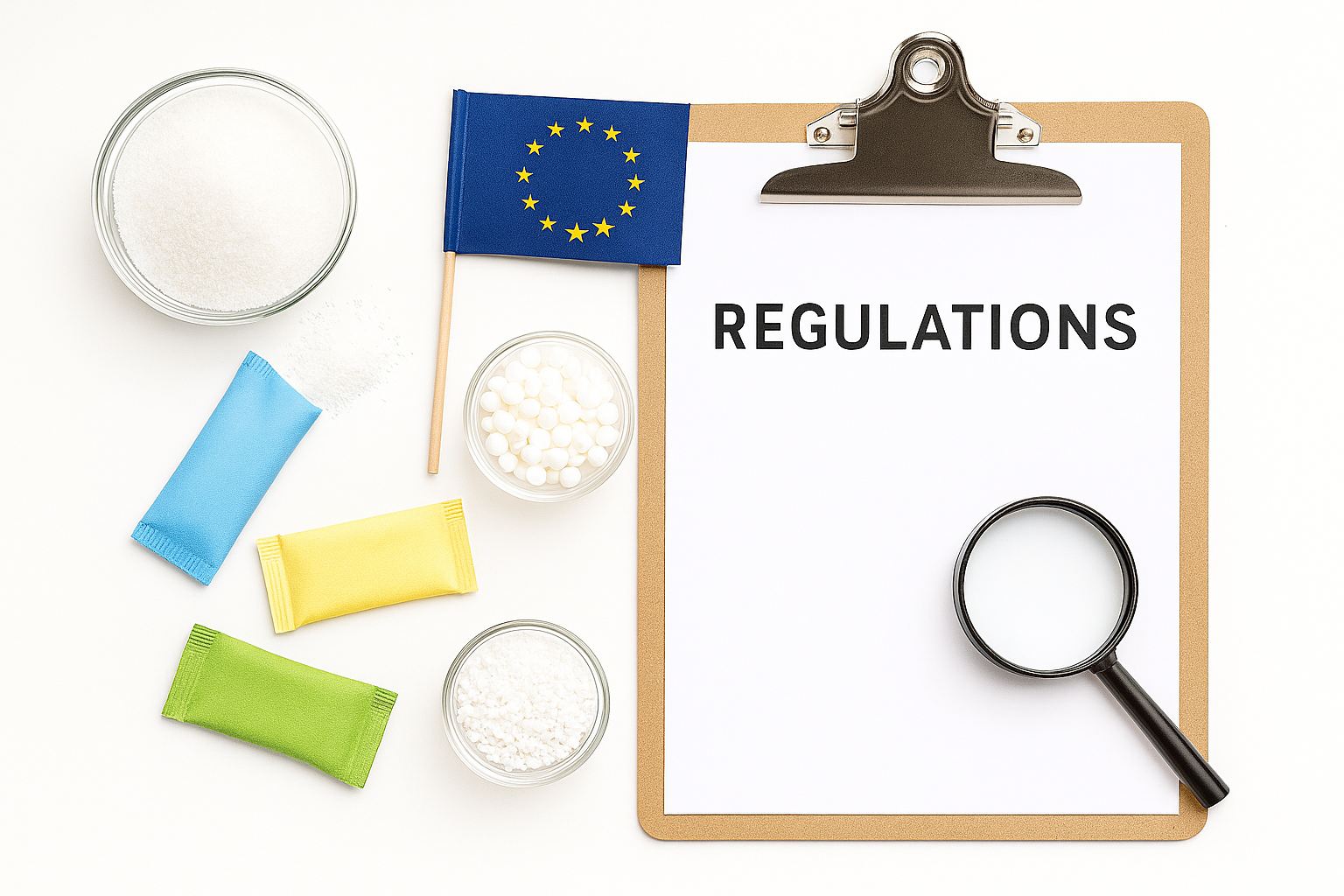
Sweeteners are now key ingredients in a wide range of products: from reduced‑sugar soft drinks, through dairy desserts, gums and confectionery, to functional foods. At the same time, sweeteners are among the most strictly and dynamically regulated ingredient groups in the European Union. Technologists and R&D teams must understand both the technological role and formulation limits, while procurement is responsible for sourcing compliant raw materials from reliable suppliers, with full regulatory documentation. Non‑compliance with EU rules can result in product withdrawals, fines and serious reputational damage.
This article focuses on nutritive and non‑nutritive sweeteners in the context of EU regulation, with practical implications for procurement and product development.
Core regulatory framework for sweeteners in the EU
The regulation of sweeteners in the EU is based on the general framework for food additives. Sweeteners are defined as additives which impart sweetness to foods or are used in table‑top sweetening products. A central concept is the “positive list” principle: only those additives explicitly listed as approved in the relevant legislation may be used, and only in the specified food categories and up to the specified maximum permitted levels.
For product development this means that the choice of sweetener does not start from a purely technological or sensory need, but from checking whether the desired sweetener is legally permitted in the specific food category, under which conditions and with what labelling restrictions.
Types of sweeteners: nutritive and non‑nutritive
In practice it is useful to distinguish between nutritive sweeteners (sugars and polyols) and intensive, non‑nutritive sweeteners. Nutritive sweeteners such as sucrose, fructose, glucose syrup powder and dextrose, and polyols, provide energy and often additional technological functions such as bulk, texture and contribution to Maillard reactions. Intensive sweeteners (for example steviol glycosides, aspartame, acesulfame K) deliver sweetness at very low dosages, with virtually no energy contribution at typical serving sizes.
For R&D teams, this means that any change in sugar content is multi‑layered: not only sweetness changes, but also total solids, water activity, texture and stability. From a regulatory perspective, nutritive sweeteners such as sucrose and fructose are usually not treated as additives but as standard food ingredients, whereas polyols and intensive sweeteners are mostly classified as additives with their own E numbers and specific conditions of use.
Approval and re‑evaluation of sweeteners
Every sweetener used as an additive in the EU must undergo a safety assessment by EFSA. Based on these opinions, the European Commission decides whether the sweetener is approved, in which food categories and at which maximum levels. In many cases an Acceptable Daily Intake (ADI), expressed in mg per kg body weight, is defined, which has a particular impact on products with high consumption frequency such as soft drinks.
For procurement and product development it is important to understand that approval is not static. Sweeteners are subject to periodic re‑evaluation in light of new scientific data. This may lead to modified permitted levels, additional labelling restrictions or, in extreme cases, withdrawal of authorisation. Maintaining a practice of monitoring regulatory changes and updating ingredient specifications is therefore a mandatory, not optional, activity.
Permitted uses and maximum levels
For each individual sweetener it is defined in which food categories it may be used and up to which level. Some categories operate under the “quantum satis” principle, while for most intensive sweeteners explicit maximum levels are set. These limits do not only reflect the technological minimum, but also take into account total consumer exposure from all potential dietary sources.
In practice this means that an R&D team cannot freely increase the dosage of a sweetener to reach a desired sweetness profile, but must balance between sensory targets, technological constraints and maximum permitted levels. Even when a dose is technologically justified, under EU law it must also be safe in terms of potential total exposure.
Labelling of sweeteners on pack
Sweetener labelling comes with several layers of obligations. First, sweeteners used as additives must be listed in the ingredients with their functional class and specific name or E number, for example “sweetener: steviol glycosides (E960)”. Second, for products containing certain types of sweeteners additional statements are mandatory, such as warnings on potential laxative effects for polyols, or the mandatory notice for phenylketonurics when aspartame is present.
For product development and marketing teams it is crucial that claims on the front of pack (for example “sugar‑free”, “reduced sugar”, “sweetened with stevia”) are fully aligned with the back‑of‑pack declaration and with the rules on nutrition and health claims. Inconsistent or ambiguous claims are a frequent focus of regulatory inspections.
Nutrition claims: “sugar‑free”, “reduced sugar” and “no added sugar”
The use of sweeteners is closely linked to nutrition claims. In order to use claims such as “sugar‑free”, “reduced sugar” or “no added sugar”, the product must meet strictly defined quantitative criteria. This means that it is not enough simply to replace part of the sugar with polyols or intensive sweeteners; the entire nutritional profile must be checked, including sugars coming from other ingredients such as fruit preparations, dairy components or cereals.
For R&D teams this is effectively an optimisation task: choosing a combination of nutritive and intensive sweeteners that delivers the target sweetness and texture while meeting the criteria for the desired nutrition claim. Procurement, on the other hand, must secure reliable specifications on sugar and polyol contents so that the calculated nutritional profile actually matches reality.
Interaction with other regulations: additives, flavours, colours, ESG
The use of sweeteners cannot be viewed in isolation. It is often part of a broader reformulation strategy in which other additives, flavours, colours or starch types are also changed. Each of these changes carries its own regulatory consequences. For example, moving from conventional sugar to a combination of intensive sweeteners and resistant starches may alter not only the energy value, but also justify new nutrition and health claims, which in turn must comply with the specific rules for health claims.
Additionally, companies increasingly assess sweeteners through the lens of ESG criteria. Raw material origin, traceability, sustainable supply chains and environmental impact are gaining importance. While these aspects are not part of classical “hard” additive regulation, they shape supplier selection and the types of sweeteners that will be preferred in new product development.
What procurement specifically needs to control
For procurement, a regulatory‑compliant sweetener means much more than an acceptable price. The supplier must provide complete documentation: specification, safety data sheet, statement of conformity with EU legislation, origin information, any GMO statements, allergen status and Halal/Kosher certificates where relevant. It is crucial that specifications clearly state E numbers, purity and any carriers or processing aids.
Procurement must ensure that declared characteristics are aligned with the actual composition, because any discrepancy directly affects the accuracy of the product’s nutritional declaration and compliance with maximum permitted levels. Regular supplier audits and internal verification of incoming materials, including analytical checks, are an essential part of the quality system.
What R&D teams must consider in formulation
For product development, regulation is as important as sensory and process parameters. Every product concept involving sweeteners has to be checked through a regulatory lens: is the sweetener permitted in this food category, up to what level, which additional label statements are required, which nutrition claims are realistic and lawful, and can total consumer exposure remain within the ADI.
When changing supplier or type of sweetener (for example switching from sucrose to a blend of fructose and polyols, or introducing steviol glycosides) it is necessary to recalculate nutritional values, verify labelling and, where needed, conduct additional stability and sensory tests. A regulatory‑compliant formulation must not be undermined by subsequent, seemingly minor changes in raw materials.
Conclusion
Regulatory requirements for sweeteners in the EU demand close cooperation between product development, procurement, quality and legal teams. Sweeteners are not just the “sweet” part of a recipe, but a highly regulated ingredient group whose use affects safety, labelling, nutrition claims and consumer perception. Establishing systems for continuous monitoring of regulatory changes, careful supplier selection and a disciplined approach to formulation are key prerequisites for successful product launches and long‑term market presence. When technological, sensory and regulatory aspects are aligned, sweeteners become a powerful tool for innovation rather than a source of regulatory risk.