
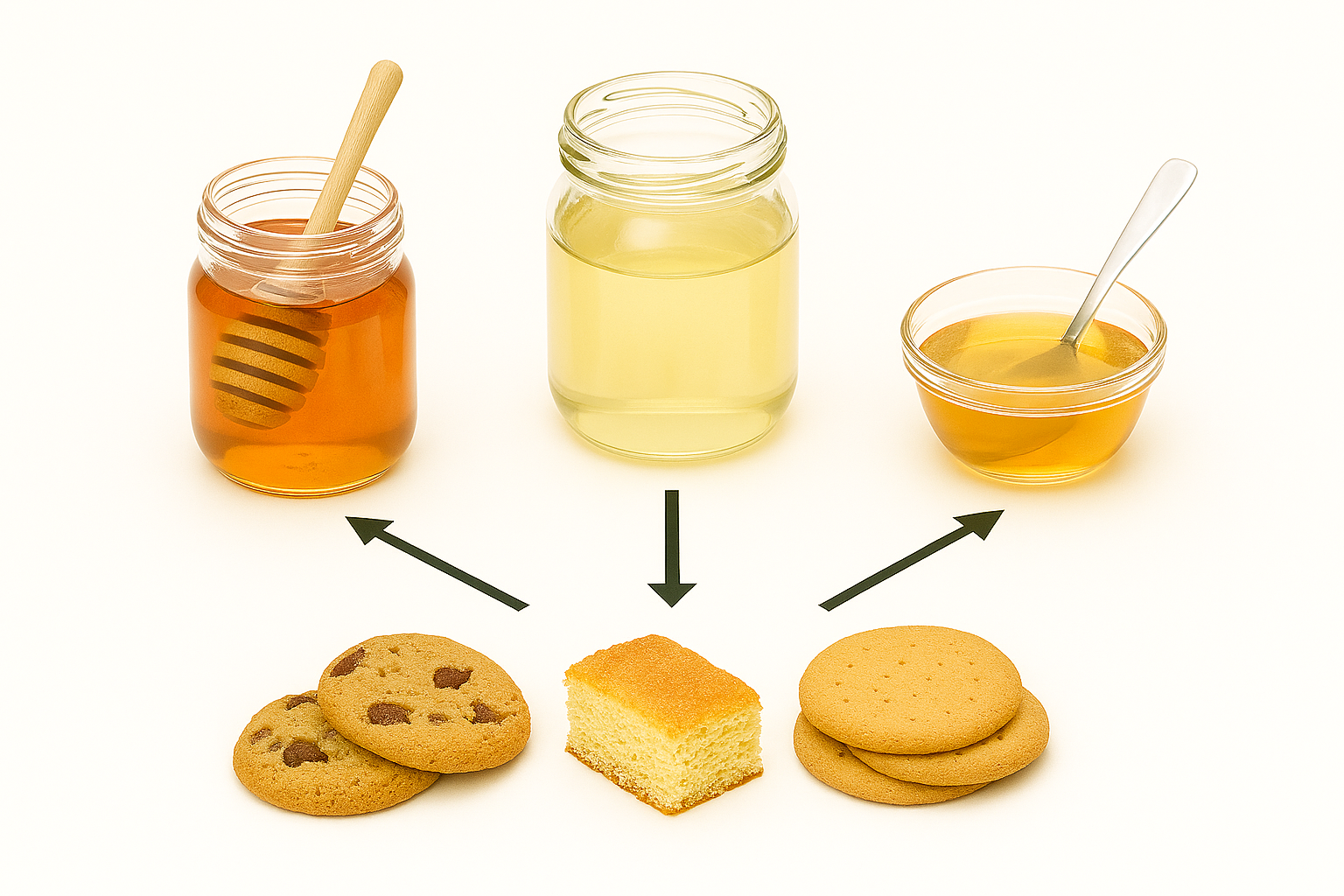
Invert sugar, honey and various sugar syrups are increasingly used in cakes, sponge cakes and biscuits to extend freshness, improve texture and achieve a richer flavour profile. However, their pronounced hygroscopicity is both an advantage and a challenge. When properly controlled, products remain soft and moist for longer. When neglected, the result is sticky surfaces, deformed packaging and a rapid loss of crispness. This article focuses on what actually happens with water in the system and how technologists can manage the hygroscopicity of invert sugar, honey and syrups in cakes and biscuits.
What does hygroscopicity mean in cakes and biscuits
Hygroscopicity is the ability of a substance to bind and retain moisture from its surroundings. Sugars such as fructose and glucose, which dominate in invert syrups and honey, have a strong ability to bind water. In a product, this means that water is not free but bound to dissolved sugars, which affects water activity and, consequently, microbiological stability, texture and product staling.
In soft cakes and sponge-type products, the goal is to prevent rapid drying and starch retrogradation, so a certain level of hygroscopic sugars is desirable. In biscuits and crisp cookies the situation is reversed: too much hygroscopic sugar can lead to softening and loss of crispness during storage. Understanding this balance is the starting point for any serious formulation.
Invert sugar: between extended freshness and stickiness
Invert sugar is a mixture of glucose and fructose obtained by hydrolysis of sucrose. Due to the high fructose content it has a higher sweetness than crystalline sugar and is significantly more hygroscopic. In cakes and sponge products, invert sugar is often used to extend softness and reduce sugar crystallisation during shelf life.
From a technological standpoint, invert sugar lowers the freezing point and affects water activity, but also the rheology of the dough. Doughs become softer and more plastic, with a tendency to spread more during baking. This can be desirable for certain biscuit types, but problematic when a defined, stable shape is required. Excessive dosage of invert syrups leads to a sticky surface, especially at higher relative humidity, complicating packaging and dosing.
Therefore, in practice, invert sugar is typically introduced as a partial replacement for sucrose, with careful correction of total solids and water. It is necessary to adjust the ratio of flour and starch in the formulation, because a change in free water content directly affects the desired crumb structure.
Honey: natural sweetener with complex hygroscopicity
Honey is a natural mixture of fructose, glucose, enzymes, organic acids and minor components. Due to its high fructose content and specific composition, it is highly hygroscopic. In soft cakes honey contributes to moistness, a prolonged perception of freshness and a characteristic aroma profile, but at the same time complicates moisture control and texture stability.
In cakes and sponge products with longer shelf life, honey can prevent rapid drying, but it simultaneously increases the risk of stickiness and pieces sticking together in the package. Due to its acidity, honey also affects system pH, which can alter protein and starch behaviour and the browning dynamics during baking. In formulation, it is important to consider the variability of honey by botanical origin and season, because the fructose-to-glucose ratio can differ, and with it the intensity of hygroscopicity.
In industrial practice, a smaller proportion of honey is often combined with other sugar syrups and crystalline sucrose, to leverage honey’s aromatic benefits while maintaining better control over rheology and hygroscopicity. Control of water activity and the choice of suitable packaging become key factors in stability.
Glucose and other syrups: controlling crystallisation and moisture
Glucose syrup in powder form or as a liquid is used as an important tool for controlling sugar crystallisation and the water phase. Unlike pure invert sugar, glucose syrups contain a mixture of glucose, maltose and higher oligosaccharides, which have a different hygroscopic profile and viscosity.
A higher content of oligosaccharides means less pronounced hygroscopicity compared to fructose-dominant systems, but a greater contribution to “body” and viscosity. In cream fillings and toppings for sponge cakes and biscuits, glucose syrups help achieve the desired spreadability and prevent rapid sucrose crystallisation, while at the same time controlling surface stickiness.
In dry mixes and powders, glucose syrup powder enables precise control of solubility and water binding during baking. Depending on DE value, a technologist can choose a syrup with more or less pronounced sweetness and hygroscopicity, which directly affects the texture of the finished cake.
How to balance different sugars in formulation
The key to managing hygroscopicity is intelligently balancing different sugar types: sucrose, glucose, fructose and oligosaccharides. Sucrose provides structure and a crystalline framework but is less hygroscopic. Fructose is highly hygroscopic and contributes to softness and a fuller flavour. Glucose syrups act as a “buffer” between these extremes, controlling crystallisation and adding functional benefits in terms of texture.
In soft cakes and sponge products where extended moistness is the goal, part of the sucrose is replaced with invert sugar, honey or syrups, while the total water level is carefully adjusted. In crisp biscuits and cookies, the proportion of strongly hygroscopic sugars must be limited, and some of their functional role can be transferred to other ingredients such as fats or appropriate starches, which contribute to texture without excessive moisture uptake from the environment.
In practice, formulation is developed through a series of pilot batches, monitoring not only the fresh product but also its behaviour during storage under different relative humidity conditions. This is particularly important for products distributed across regions with varying climates.
The role of starches and solids in moisture control
Starches, especially native and modified corn starch, are often the silent “regulators” of texture in sugar-rich systems. In the presence of invert sugars and syrups, starch gelatinisation and subsequent retrogradation take place under altered conditions, because the presence of dissolved solids affects water availability and gelatinisation temperature.
By increasing the proportion of solids from syrups and sugars, the amount of free water available to starch decreases, which influences crumb structure and how the product stales. In practice, the proportion of flour and starch can be adjusted to compensate for high levels of invert sugar and honey. In some cases, a combination of native and modified starch offers better control over moisture retention and prevents excessive softening during storage.
Process parameters: baking, cooling and packaging
Even the best formulation can fail if process conditions are not optimised. For products containing invert sugar, honey and syrups, baking time and temperature influence the final moisture content and water activity. Insufficient baking can leave too much free water, which in combination with hygroscopic sugars leads to stickiness and an increased risk of microbiological issues. Excessive baking accelerates surface drying, which can cause cracking and unwanted colour changes.
The cooling phase is critical for moisture redistribution between the core and the surface of the product. Poorly controlled cooling in a high-humidity environment can cause condensation and subsequent moisture uptake on the surface, especially in products rich in fructose. Immediately afterwards, suitable barrier packaging helps maintain the achieved moisture and texture throughout shelf life.
Conclusion
Invert sugar, honey and various sugar syrups are powerful tools for managing texture, freshness and flavour in cakes, sponge products and biscuits. Their high hygroscopicity is at the same time an advantage, slowing staling and maintaining softness, and a challenge, as it can cause stickiness and loss of crispness, especially under unfavourable storage conditions. Success lies in a balanced combination of different sugars, careful adjustment of the starchy and flour phase, and well-defined process parameters for baking, cooling and packaging. When these elements are aligned, it is possible to develop products that maintain the desired texture throughout shelf life, with stable sensory quality and a reliable declaration.