
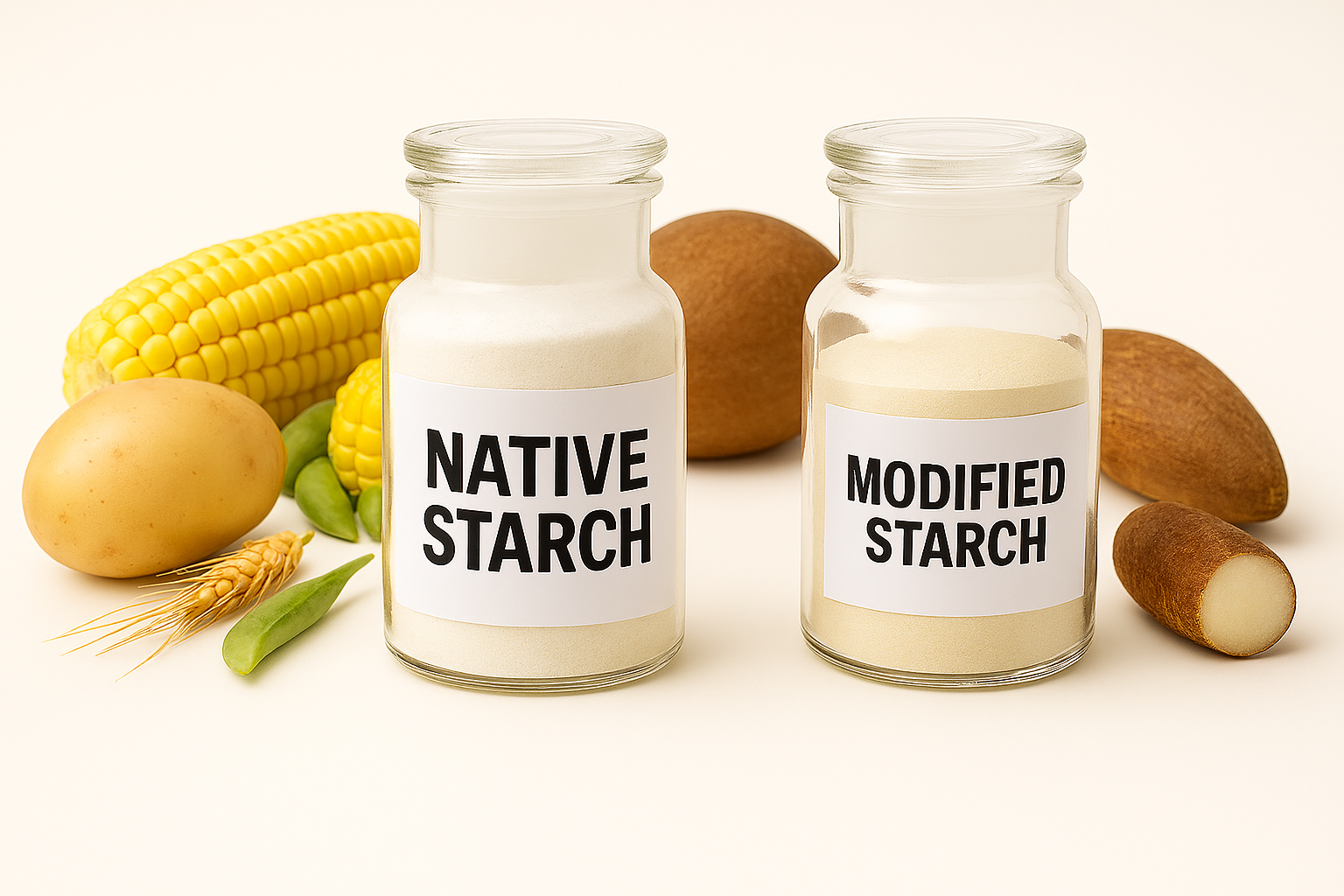
Starch is one of the core functional ingredients in the food industry. It thickens, forms gels, binds water and shapes texture in a wide range of products – from sauces and puddings to fillings, baked goods and confectionery.
In product development, the same question comes up very quickly: should you use native or modified starch? And what really changes in the final product, the process and the label when you choose one or the other?
Native vs. modified starch – basic differences
Native starch is “natural” starch isolated from raw materials such as corn, wheat, potato, tapioca or rice, without chemical modification. Its functionality depends on botanical origin and process conditions: temperature, pH and shear intensity. It usually thickens only after gelatinization at a certain temperature, is more sensitive to high heat, mechanical shear and freeze–thaw cycles, and is prone to retrogradation – subsequent firming and water separation during storage. On the other hand, it is easy to communicate on the label (“corn starch”, “wheat starch”, “potato starch”) and fits well into clean label concepts.
Modified starch is produced by targeted chemical, physical or enzymatic treatment of native starch. On the label it appears as “modified starch” (sometimes with the botanical source), and may be associated with E‑numbers in technical documentation, depending on the market. Such modification changes the behaviour of starch: it becomes more resistant to heat and shear, more stable under freeze–thaw conditions, less prone to retrogradation and syneresis, and, if required, more transparent, shinier or creamier in texture. In short – you get more controlled, robust performance under industrial conditions.
What changes in functionality?
In thermally demanding processes, the differences are particularly visible. Native starch may thicken well at the beginning of cooking, but during prolonged heating or intensive homogenisation its viscosity can start to break down, so the sauce or dessert ends up thinner than intended. Modified starches are designed to maintain viscosity and structure under UHT, sterilisation or long cooking, with less batch‑to‑batch variation.
During storage, native starch tends to retrograde: gels become firmer, syneresis (water separation) appears, and texture can become rubbery or grainy. This is especially critical in desserts, fillings and sauces with longer shelf life. Modified starches slow down or significantly reduce these effects, so products remain more uniform from the first to the last day of shelf life.
The practical difference is also large in frozen products. With native starch it is common to see a “broken” structure and a layer of free water after thawing. Special freeze–thaw‑stable modified starches withstand such cycles and keep texture almost unchanged.
Finally, there are visual and sensory aspects. Depending on the source, native starch can give a floury, dull or less glossy structure. Modified starches have been developed to provide clearer gels, higher gloss and a precisely tuned “short” or “long” texture – from short, pudding‑like to more elastic and stretchy, which is important in confectionery jellies, for example.
Where does native starch make sense?
Native starch is a good choice when stability requirements are not extreme and a simpler label is an advantage. These are situations where the product is consumed relatively quickly, does not undergo aggressive processing and is not frozen.
In bakery applications, native starch works well in doughs as a structure‑former, in creams and fillings for fresh products, and in desserts that are kept in the cold chain with shorter shelf life. In dairy desserts with moderate shelf life, where proteins provide part of the structure, native starch acts as an auxiliary thickener and is often sufficient.
In savoury and foodservice applications, native starch performs well in sauces, stews and marinades that are prepared and consumed within the same or next day. In confectionery creams for fresh cakes and fillings for immediate consumption, it can also deliver satisfactory texture with an attractive declaration.
When is modified starch practically indispensable?
As soon as the product has to withstand “tough” processing and demanding logistics, modified starch becomes almost indispensable. In the beverage industry this includes fruit nectars and drinks with pulp that undergo UHT, as well as dairy beverages with slightly increased viscosity. Stable texture over the entire shelf life, without phase separation or sedimentation, is critical.
In dairy, desserts with long ambient shelf life, sterilised puddings and fillings that must survive baking and sometimes subsequent freezing are very hard to manage with native starch alone. Modified types ensure consistency, prevent syneresis and help maintain texture during storage and transport.
Fruit toppings, fillings and cream masses in bakery that are baked together with the dough and then frozen and shipped through distribution are a classic example where modified starch makes the difference between a product that holds its shape and one that “leaks”. In savoury products – ketchups, dressings, mayonnaise‑type and sauce systems with long shelf life and variable storage conditions – robustness and high tolerance to shear are key, which is exactly the domain of modified starch.
In confectionery, modified starch is crucial in jelly candies and fruit gel products where you target a precise bite, stable structure and good resistance to temperature fluctuations, as well as in chocolate fillings that must remain stable on shelves across different climate zones.
Labelling, clean label and consumer perception
One of the main arguments for native starch is the label. Formulations that want to emphasise “naturalness” and “no E‑numbers” prefer to list “corn starch”, “potato starch” or “tapioca starch” instead of “modified starch”. Consumers often generalise – anything “modified” or associated with E‑numbers is viewed with some suspicion, even though these ingredients are well regulated from a technological and safety perspective.
Because of this, many brands choose compromise strategies. Some completely avoid modified starches and accept shorter shelf life and a narrower process window. Others combine native starch with modified starch, fibres or other hydrocolloids to reduce the total dose of modified starch, achieve the required functionality and at the same time soften the “burden” on the label.
It is important to keep in mind that switching from modified to native starch without adjusting the process and the rest of the recipe almost certainly leads to lower stability: viscosity fluctuations, increased syneresis, texture changes after freezing, and higher technological risk. This often turns into hidden costs through complaints, product returns or reduced shelf life.
Economics: ingredient price vs. risk cost
Native starch often looks cheaper per kilogram, but the ingredient price alone is not decisive. If you need to dose more starch to reach the same viscosity, the total cost per kilogram of finished product can equal or even exceed that of a solution with modified starch. On top of that, the risk of quality deviations is higher, which comes back as complaints and losses along the supply chain.
Modified starch is more expensive per kilogram, but is usually dosed at lower levels and provides a more stable process with fewer production issues. When you factor in the reduced technological risk, better batch‑to‑batch consistency and less waste, overall economics often favour modified starch, especially in demanding, long‑shelf‑life products.
How to decide in practice?
The most sensible approach is to first clearly define product requirements: shelf life, storage conditions, whether freezing/thawing is involved, and what the process looks like (UHT, sterilisation, baking, regeneration). In parallel, define marketing priorities – is a cleaner label more important, or is absolute technological security the main objective?
Based on this, it is worth preparing several lab prototypes: with native starch, with a suitable modified starch and possibly with a combination. Then test rheology under different temperatures and shear, sensory properties and stability during storage (including freezing, if relevant). Only such a practical comparison will show where the optimal balance lies between texture, shelf life, labelling and total economics.
In many cases the final solution is not strictly “native” or “modified” starch, but a smart combination supported by fibres or other hydrocolloids. This way you can satisfy the requirements of technology, marketing and consumers at the same time, while keeping production risk under control.