
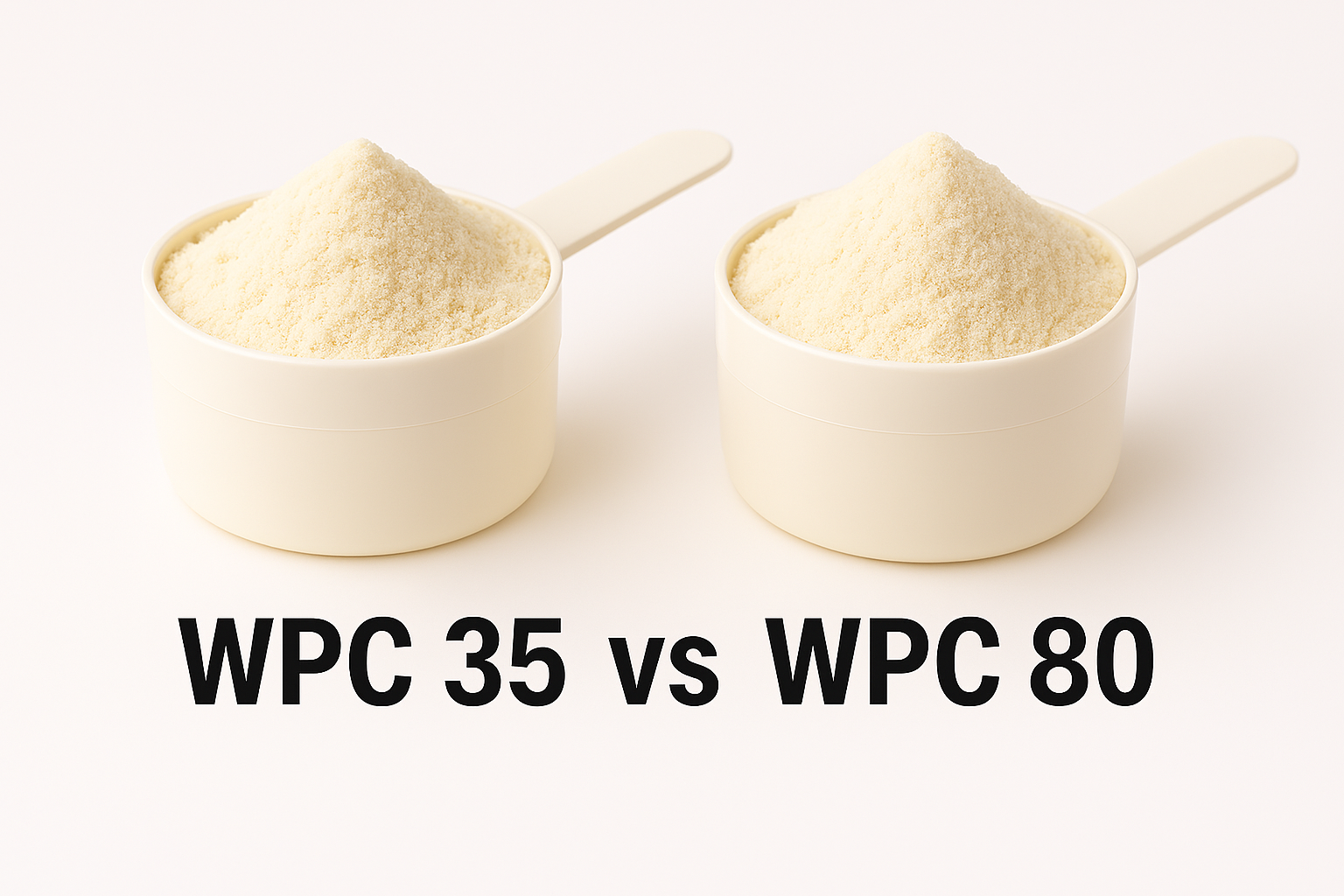
On paper, “whey protein concentrate” looks like a simple line in a specification. In reality, the choice between WPC 35 and WPC 80 shapes your formulation, your label, and your cost per kilo of finished product far more than one row in an RFQ suggests.
In most factories, the difference first shows up in the tank or mixer, and only later in Excel. Technologists notice changes in viscosity, foaming, flow, or texture. Procurement and commercial teams look at the cost breakdown and ask a different question: is the more expensive protein per kilo actually cheaper when we look at the finished product?
That’s why it makes sense to stop thinking of WPC 35 and WPC 80 as “weaker” and “stronger” versions of the same thing, and start treating them as two different tools for two different jobs.
How WPC 35 behaves in real products
WPC 35 usually finds its place in classic dairy drinks, yogurts and fermented products where the goal is not to “sell” the product on high protein content, but to strengthen the recipe and improve stability.
Many manufacturers also use it in instant cocoa drinks and other powdered mixes, where it brings a more milky character and lifts nutritional value without pushing the cost out of what the market will tolerate.
In bakery products, WPC 35 is a quiet but useful helper – it can support structure, influence crust colour and help keep products fresher for slightly longer. In ice cream, it contributes to a more stable texture and a better “dairy” mouthfeel, especially in lower and mid‑priced ranges where there is pressure on recipe costs.
The common theme in all these uses is simple: the product is not built around protein as a marketing claim; protein is there in a supporting role. In those situations, WPC 35 often turns out to be the rational choice – good enough to improve the product without overloading the cost.
Where WPC 80 really earns its place
With WPC 80, the story is different. You won’t usually find it in standard, mainstream dairy drinks. Its natural territory is products where every gram of protein is tracked more closely than the retail price per unit: sports nutrition beverages, protein powders, “high protein” yogurts and puddings, protein bars and functional snacks.
When you work on these concepts, space is limited – one cup, one bar, one scoop. Within 150–250 ml or 50–60 grams of bar mass, you need to fit as much protein as you reasonably can, while keeping taste, texture and nutrition claims within acceptable limits. Here, WPC 80 behaves like a concentrated tool: it gives you more protein in less powder and frees up space in the formula for other ingredients.
Lactose is another key factor. WPC 80 typically contains noticeably less lactose than WPC 35. That makes it easier to keep overall lactose intake per serving in check, even if you are not aiming for a strict “lactose free” claim. Many brands simply want to avoid products that feel heavy or uncomfortable to more sensitive consumers. Lower lactose content in the protein source gives you more headroom to manage that.
So while WPC 80 looks more expensive per kilogram in a price list, in the context of high‑protein concepts it often behaves like the only realistic option that keeps the product technically feasible and commercially attractive.
Why “price per kilogram” is the wrong starting point
One of the most common sources of confusion between WPC 35 and WPC 80 is the way prices are compared. If you only look at a supplier’s price list, WPC 35 almost always looks cheaper and therefore more “efficient”.
But factories don’t live from tonnes of purchased WPC; they live from tonnes of finished product sold.
The real difference appears as soon as you move from catalogue numbers into a real formulation. How many grams of each protein do you need to reach your target protein per serving? How many units of finished product do you get from one batch? What does that mean in terms of protein cost per kilogram of finished yogurt, drink or bar?
In standard products without a strong protein claim, WPC 35 often stays on top in that calculation – targets are moderate, there is no strict pressure around lactose, and the end consumer is very price‑sensitive.
For high‑protein products, the picture shifts. Once you factor in doses required to hit, for example, 20 grams of protein per serving, WPC 80 can turn out to be the more economical choice per portion, despite its higher price per kilo. You simply use less of it, and you have more flexibility with the rest of the recipe.
Switching between WPC 35 and WPC 80 is not just changing a code
The more sensitive the product, the more dangerous it becomes to treat WPC as a generic commodity. Moving from WPC 35 to WPC 80 or the other way around is not just an administrative change in your ERP system. It is a change in formulation.
Technologists will feel the difference first. Density, foaming, solubility, behaviour during homogenisation or drying – all of these can shift. Lactose content influences sweetness and potential browning, total solids affect body and texture. On top of that, different WPC manufacturers have their own process specifics and raw material streams, so two WPC 80 products with very similar specs on paper don’t always perform identically in your process.
This is why serious producers rarely make such decisions solely from the office. They link them to trials, sensory checks, specification reviews and cost comparison on the formulation level. They are especially cautious when changing suppliers, not only when changing protein concentration.
How to make a sensible choice for your product
If you’re currently thinking about introducing whey protein into a new product, or re‑working an existing one, the first question is not “what is your best price for WPC 80?”, but “what role should protein play in this concept?”.
Is whey there to quietly support texture and nutrition, or is it the centre of your marketing story? If you are working on a mainstream dairy drink for a price‑sensitive market, WPC 35 will often cover your needs without putting pressure on your cost of goods.
If you are building a product that will be chosen because it offers 15–25 grams of protein per serving, it is hard to deliver that with WPC 35 and still keep taste, lactose and cost under control. In those high‑protein cases, WPC 80 usually becomes the more realistic starting point.
The second step is to translate that into numbers on the recipe level. It doesn’t have to be a complex scientific exercise. Build two simple versions: one based on WPC 35, one on WPC 80, both designed to hit the same target protein per serving. Compare:
- dosage needed per batch
- protein and lactose per serving
- cost of the protein component per kilo of finished product
Once you see that side‑by‑side, the “cheaper” option per kilo of raw material often stops looking so attractive – or you might confirm that in your specific case there is no real value in going to WPC 80.
The third step is to test in production. This is where the real picture appears: process behaviour, stability over shelf life, sensory profile after a few days, and how consistent the product is over multiple batches. Only when you combine technical feel, cost calculation and market positioning do you really get a solid answer to the WPC 35 vs WPC 80 question.
In the end, WPC 35 and WPC 80 are not rivals. They are two different tools designed for different commercial and technical goals. Once you start treating them that way, your RFQs stop being just lists of product codes and become a way to define what performance, stability and positioning you actually expect from your next product line.