
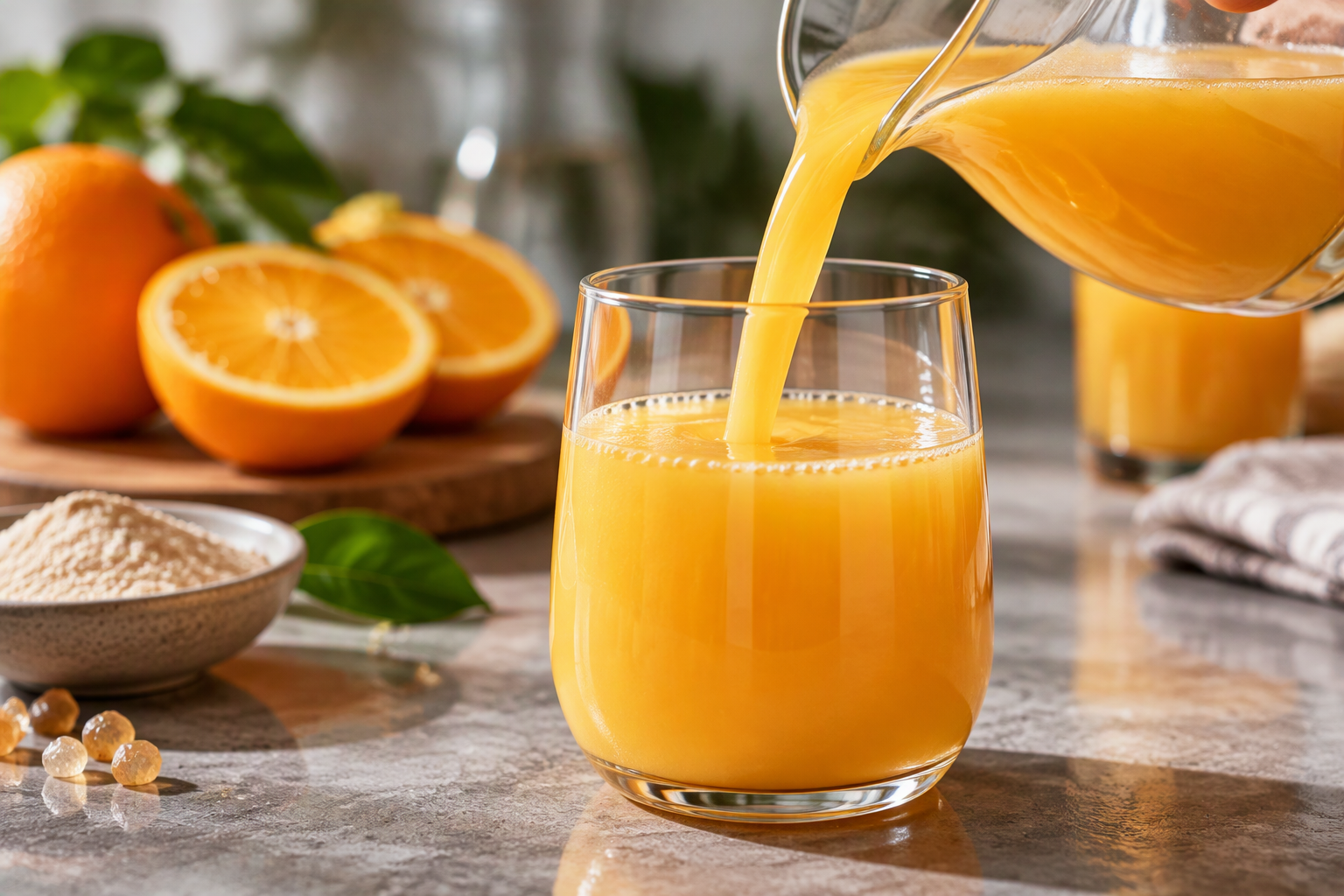
In beverage production, a stable emulsion is not a matter of chance, but of precise process control. Gum Arabic (E414) has held the status of the gold standard for decades, but for technologists, it is crucial to understand the essence of its action, far beyond simply adding powder to water.
The Molecular Secret of Stability
The secret to gum Arabic's efficiency lies in its heterogeneous structure. Its emulsifying potential depends entirely on a specific fraction known as arabinogalactan-protein (AGP), which makes up only about ten percent of the total mass. The hydrophobic protein part of this complex acts as an anchor that firmly binds to the oil droplet surface. On the other hand, the hydrophilic polysaccharide chains extend deep into the aqueous phase, creating a steric shield between five and ten nanometers thick.
Why the Steric Shield Is Essential
It is precisely this steric mechanism that sets gum Arabic apart from proteins or modified starches. While other emulsifiers often rely on electrostatic repulsion that weakens at low pH, gum Arabic provides a physical barrier. This makes the emulsion highly stable in acidic environments, in the presence of electrolytes, and during pasteurization, with no risk of curdling.
What to Look for in the Specification
When selecting a raw material for production, the focus must not be on price alone. A nitrogen content between 0.24 and 0.41 percent is a direct indicator of protein presence and emulsification potential. Solution viscosity should range from 60 to 100 mPa·s, while moisture must be as low as possible, ideally below 10 percent, for microbiological stability. Total ash must not exceed 4 percent, guaranteeing a low level of mineral impurities.
The Role of High-Pressure Homogenization
Attention must also be paid to the production process itself. The efficiency of gum Arabic directly depends on molecular weight, and high-pressure homogenization plays a key role. During homogenization, the AGP complex unfolds and occupies a larger volume around the oil droplet, forming a thicker and much more resistant protective layer. This allows for a stable emulsion even at lower gum concentrations, directly optimizing recipe costs without compromising the quality of the final beverage.