
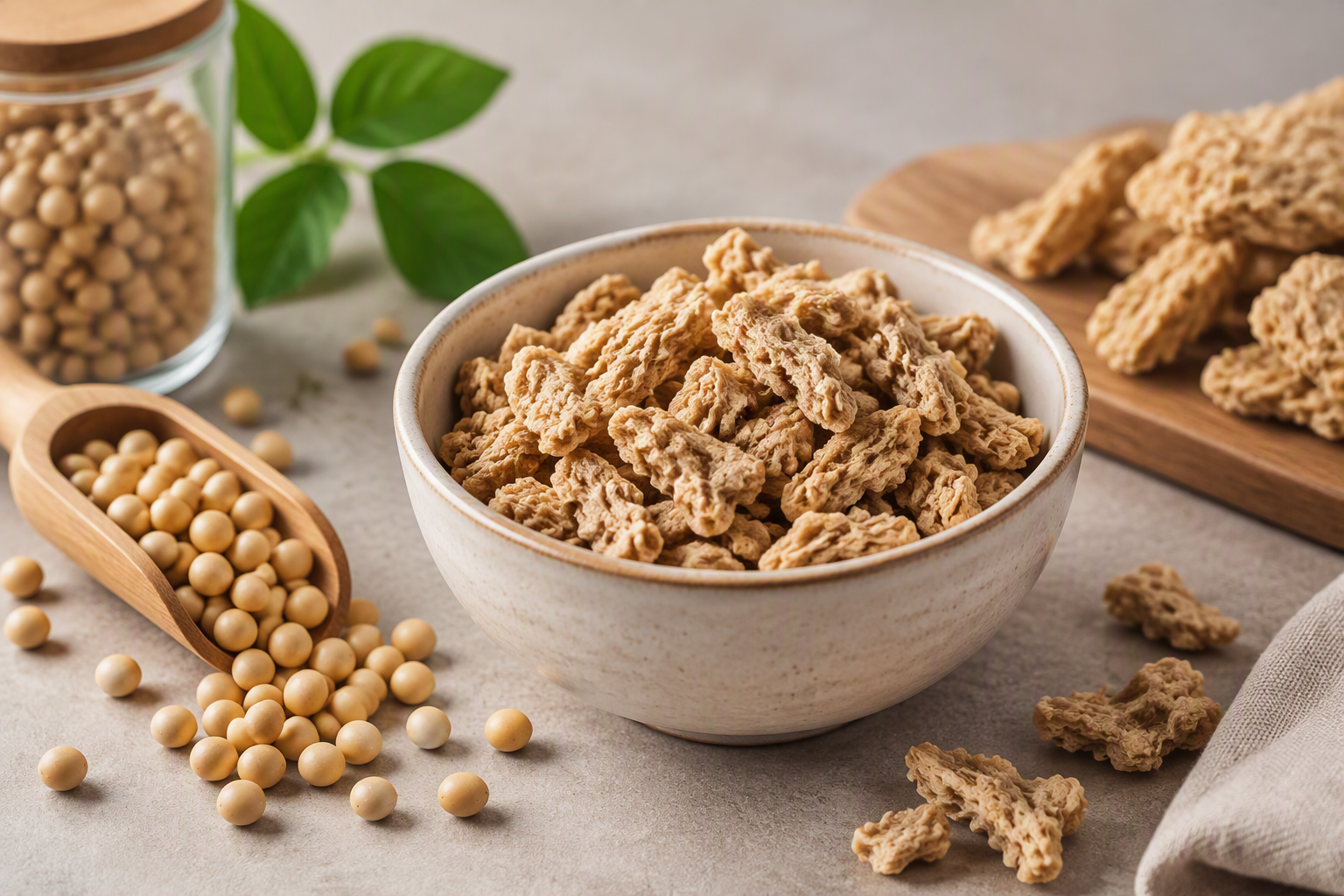
Textured soy protein (also known as TSP or TVP) is one of those ingredients that has been present in the food industry for decades, but its role has changed significantly in recent years. Once viewed primarily as a low-cost meat substitute for industrial-scale production, it is now increasingly recognised as a functional ingredient that can address specific technological challenges in food formulations.
What distinguishes it from ordinary soy flour or soy protein isolate is its physical structure. Through the extrusion process, the protein mass is shaped under high pressure and temperature into a fibrous or spongy structure that resembles minced meat after rehydration. This texture is precisely what makes it indispensable in numerous applications.
How the Fibrous Structure Is Formed
The production of textured soy protein is based on thermoplastic extrusion. Defatted soy flour or soy protein concentrate is mixed with water and fed into an extruder. Under the influence of high temperatures and mechanical shear, the protein chains unfold and reorganise. As the mixture passes through the die at the extruder outlet, the pressure drops rapidly and water evaporates, resulting in the formation of a porous, expanded structure.
There are two main approaches to production. Low-moisture extrusion produces a dry, spongy product that requires rehydration before use. This is the most common and cost-effective form. High-moisture extrusion, on the other hand, produces a fibrous structure that more closely resembles real muscle tissue, with more pronounced anisotropy. This second type requires more complex equipment and is more expensive, but delivers excellent results in plant-based meat alternatives.
Key Functional Properties
When selecting textured soy protein, food technologists need to pay particular attention to its water absorption capacity and fat absorption capacity. These parameters directly affect the texture of the final product and the cost-effectiveness of the formulation.
Water absorption capacity typically ranges from 2 to 3 parts of water per part of protein. When properly rehydrated, the protein swells and increases in weight. If this step is skipped or performed incorrectly, the final product may be dry or lack sufficient cohesion. Fat absorption capacity, on the other hand, enables the protein to bind free fats in the product, which is particularly important in products such as sausages, pâtés and plant-based burgers.
Particle size also plays an important role. Larger pieces provide a more pronounced texture and are used in products where visible meat-like pieces are expected. Finer, minced forms are used to achieve a more homogeneous structure, such as that required in smooth pâtés or plant-based fillings.
Main Applications
The use of textured soy protein extends far beyond plant-based meat alternatives. In the meat industry, it is used as a cost-effective ingredient to increase yield and improve water binding. In the production of sausages and frankfurters, it is added alongside meat emulsions to reduce costs without significantly compromising flavour.
In the bakery industry, textured protein is used as a protein source in enriched breads and rolls, while in snack production it serves as a base for extruded products. It is also increasingly used in ready meals, such as Bolognese sauce, chilli con carne and various meat-based mixtures, where it replaces part of the animal protein.
What to Consider During Formulation
Although highly useful, textured soy protein also presents certain challenges. The first and most common is the development of undesirable flavours, known as “beany” notes, which originate from soy. These notes can be masked by using spices, yeast extracts or other flavour enhancers, but the dosage must be carefully adjusted to avoid bitterness.
The second challenge is allergenicity. Soy is one of the most common food allergens, requiring clear labelling on packaging and strict control of cross-contamination in production facilities. For manufacturers developing products for markets with strict clean-label requirements, this can be a limiting factor.
The third challenge is controlling texture after rehydration. If the protein is soaked for too long, it may become too soft and lose its fibrous structure. If it is soaked for too short a time, it may remain hard and unpleasant to eat. Precise control of rehydration time and temperature is therefore essential for maintaining consistency in the final product.
Market Outlook and Sourcing
As the plant protein market grows, demand for textured soy protein continues to increase. It remains one of the most affordable protein sources on the market, making it attractive to manufacturers looking to increase protein content while controlling costs. However, soybean prices are influenced by global market developments, including weather conditions in South America and trade tensions.
For manufacturers in the region, finding a supplier that offers consistent quality and clear documentation on origin and specifications is essential. Nutra monitors the plant protein market and can help you select the right type of textured soy protein for your application, whether you need larger pieces for plant-based burgers or finely textured protein for meat emulsions. Contact us for advice on sourcing under current market conditions.