
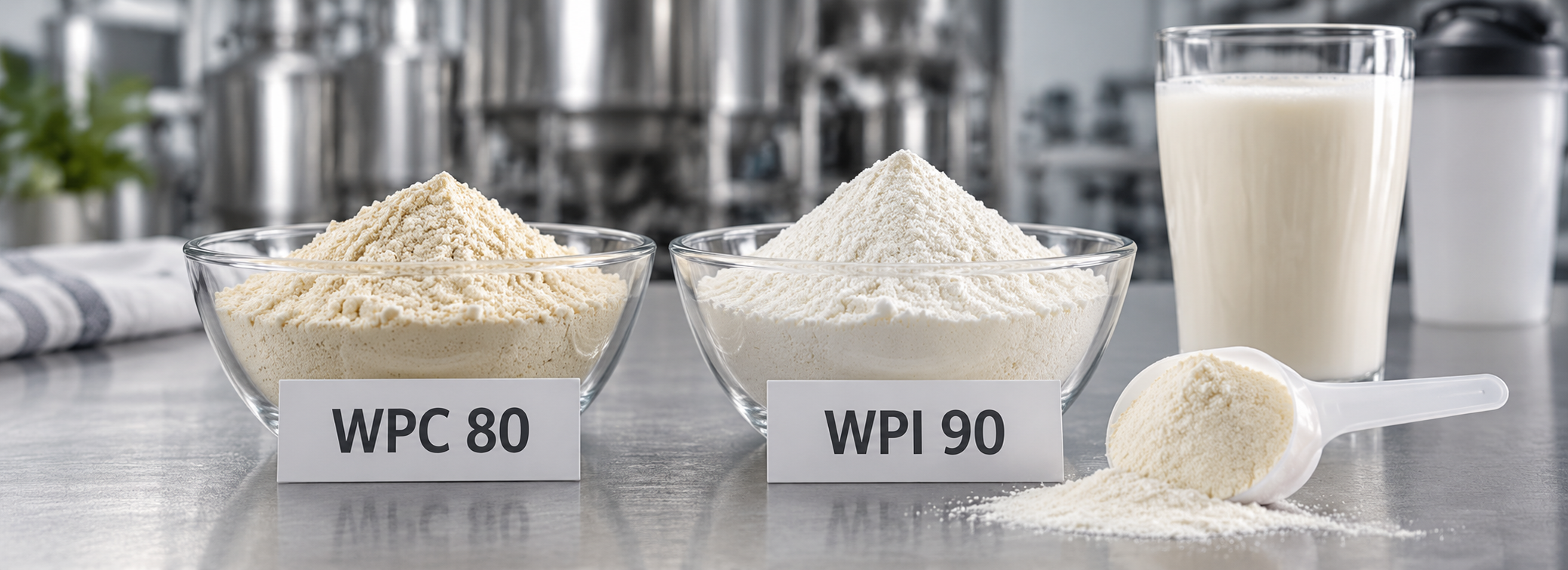
The difference between WPC 80 and WPI 90 is often reduced to protein percentage, yet procurement decisions should not rely on the label alone. In finished product formulation, the real cost is shaped by protein contribution per kilogram, lactose and fat content, processing performance, flavour, solubility and the needs of the intended consumer. An isolate with a higher protein percentage can be a rational choice, but only when it addresses a specific nutritional or technological requirement.
WPC 80 is a whey protein concentrate containing approximately 80 percent protein on a dry matter basis, with the remaining share consisting of lactose, fat and minerals. WPI 90, or whey protein isolate, generally contains around 90 percent or more protein, with significantly lower lactose and fat levels. A difference of roughly ten percentage points on the specification sheet is not, by itself, a reason to use WPI 90 in every formulation.
For standard protein powders, bars, bakery products and functional beverages, WPC 80 often provides a sufficiently high protein contribution with a more favourable balance between cost and functionality. Its lactose and milk fat content can support a fuller flavour, creamier texture and a more rounded sensory profile. In products where protein is combined with cocoa, flavours, fibres, cereals, nuts or other ingredients, the difference between concentrate and isolate may not be decisive for the final consumer experience.
Cost Should Be Calculated per Kilogram of Pure Protein
Comparing purchase prices per kilogram of raw material can be misleading. If WPI 90 costs more but provides more protein per kilogram, part of the price difference is offset by the lower quantity needed to achieve a target protein claim. However, the complete calculation must also include the cost of other ingredients, processing losses, available space in the formulation and the effect on sensory properties.
Consider a product targeting 20 grams of protein per serving. Approximately 25 grams of WPC 80 would be required to achieve that target, assuming all protein comes from the concentrate, while around 22 grams of WPI 90 would be needed. There is a difference in ingredient dosage, but that alone does not guarantee a lower formulation cost. If the isolate carries a substantial premium, WPC 80 may remain the more economical source of protein, particularly when its lactose and fat content do not create a formulation issue.
WPI 90 is justified when the formulation requires very low lactose, lower fat content or a high protein percentage in a small serving. This is often relevant for products aimed at consumers with lactose sensitivity, beverages that require a lighter texture, and products with tightly controlled macronutrient profiles. In these categories, isolate is not simply a more expensive ingredient. It can enable a product specification that concentrate cannot achieve without compromise.
For products with a clear premium positioning, WPI 90 can also have communication value. Consumers who read labels carefully often recognise the term whey protein isolate and associate it with higher protein content and lower sugar and fat levels. However, that communication must be aligned with the actual formulation, applicable labelling rules and the product’s overall quality. The presence of isolate alone does not justify a higher price if the product offers no clear nutritional, technological or sensory advantage.
When WPC 80 Is the More Rational Choice
WPC 80 is generally the more rational option when the product does not require exceptionally low lactose, when the target serving leaves sufficient room for the necessary ingredient dosage, and when a fuller texture is desirable. It is particularly relevant for manufacturers seeking a competitive finished product price without compromising a strong protein content.
The decision should not be based solely on the ingredient name. Batch specifications, protein, moisture, lactose and fat content, microbiological parameters, solubility, processing stability and supplier reliability all directly influence the final result. Two ingredients labelled WPC 80 may differ in flavour, colour, dispersibility and performance in the finished matrix, just as the quality of WPI 90 varies between manufacturers.
The higher price of WPI 90 makes sense when it enables a nutritional claim, technological property or market position that WPC 80 cannot reliably support. Where such a requirement does not exist, whey protein concentrate with approximately 80 percent protein often remains a functionally sound and economically justified option. The best decision is not the one with the highest protein percentage on the specification, but the one that delivers the desired finished product quality at a sustainable formulation cost.